


The Merit Radge Program—Star, Life, And Eagle Ranks. Continued
Description
This section is from the book "Handbook For Scoutmasters. Volume 1 & 2", by Boy Scouts of America. Also available from Amazon: Handbook For Scoutmasters.
The Merit Radge Program—Star, Life, And Eagle Ranks. Continued
Preparation
Whenever a Scout shows his first interest in Merit Badges the Scoutmaster will do well to confer with him and guide him in his selections. Your more mature judgment and your knowledge of the boy's abilities and natural interests will help the boy to benefit more substantially from the Merit Badge Program than if he were permitted to set out alone on the uncharted sea.
When the boy's mind has been made up, you may help him to secure source material on his subject. The Merit Badge pamphlets published by the Boy Scouts of America will furnish the basis for his study, will be a guide for him toward personal exploration and performance, but he should be encouraged to consult his local library for other books and seek publications of both State and Federal sources. Also other

The Merit Badge Pamphlets published by the Boy Scouts of America form a basis for study of the Requirements.
Scouts who have already mastered the subject in question should be asked to guide the boy in his effort. Then, when he has a good start, he should be put in contact with the Merit Badge Counselor in the particular subject.
Merit Badge Counselors
Merit Badge Counselors are chosen by the Local Council from among the finest men and outstanding leaders in their respective vocations or interests. They are men who believe wholeheartedly in Scouting to the extent of making their valuable time available to Scouts eager for advancement. They are registered Scouters, technical experts, men of outstanding character, tact and judgment.
Their job is not just to test a boy's technical knowledge of a Merit Badge subject, but to give the boy a vision of what is behind it, to uncover for the boy's use his qualities of initiative, to assist him in evaluating his Merit Badge work in terms of his Scout life and his general activities, and put merit into the Merit Badge, through a tie-up with the Scout Oath and Law.
The Merit Badge Interview
From the list of Merit Badge Counselors, submitted to you—as Scoutmaster—by the Local Council, you will give the boy the address of the Counselor to see, whereupon he makes his own appointment. (In some Councils the appointment is made by the Scoutmaster through the Council or the District. In still others the Counselors have definite hours at which boys may see them).
At this Merit Badge interview the Counselor explains to the boy what will be required of him, gives him suggestions in regard to his training and answers any questions the boy may put to him in regard to the business or profession represented by the Merit Badge. It is hoped that Scouts and their Counselors may become friends and that a Scout may make return visits to his Merit Badge Counselors.
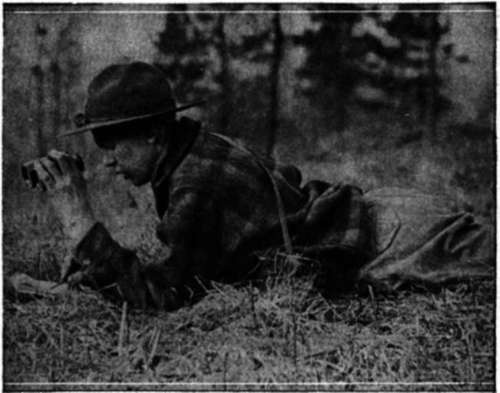
This young artist sketching a bird through his binoculars may turn out to be an Audubon, or an authority on nature or its related subjects.
Period Of Preparation
You should insist that the boy use sufficient time for his preparation. There are very few Merit Badges that do not require considerable time for the boy to become familiar with the subject and adequately prepared.
Encourage the Scout to make a thorough preparation, and make him realize that what really counts, is, as B-P expresses it, "the amount of effort he puts into his work."
Examination
When the Scout is confident that he is ready for the final examination, he makes out a Merit Badge application, secures his Scoutmaster's approval, and gets in touch again with the Merit Badge Counselor. This time he brings with him all materials, statements, articles, etc., as required for the examination and the application form for Merit Badges, properly filled out. Also another Scout to be the "victim" if demonstrations are called for.
If he meets the requirements satisfactorily the Counselor will certify that he has taken the examination and is entitled to the award, after proper review.
Review*
For review the boy appears before the District or Council Board of Review at one of its regular sessions. Here he is asked questions by various members, as to what he has done, and how the examination was given, the purpose of the review being to probe the Scout's practical knowledge as well as his Scout Spirit.
Award
Finally, the Scout is presented with his award at a ceremonious session of the District or Local Council Court of Honor, at which he meets other Scouts from other Troops and other outstanding men of his community. "In no case shall a Merit Badge be awarded unless a Scout has personally appeared before at least
* In certain Local Councils, permission has been Riven to conduct an authorized experiment in review of Merit Badge examinations in the Troop Board of Review. In all other Councils, the review is held by District or Council Boards.
On Your Marks—Get Set—Go! three members of the Court of Honor . . ." (From By-Laws, Art. XV, Sect. 4).
And, then, at the next Troop meeting the wise Scoutmaster will see to it that his achievement is recognized by his fellows, that the Troop shows its pride in his accomplishment and expresses its wishes for his continued success.
Star, Life, and Eagle Scout Ranks Eagle Seout Palm Awards
One of the incentives for a boy's progress in Merit Badge Advancement, is the fact that the mastery of certain numbers of them makes him eligible for advancement in rank to Star Scout and Life Scout and eventually to the rank a Scout covets the most, that of Eagle Scout. In the Eagle Scout Rank is expressed the ideal toward which every Scout should aim— trained to a full degree in woodcraft and campcraft, habituated to service to his community, and thoroughly prepared to meet the emergencies of his every day life.
Who May Qualify?
A First Class Scout may receive the award of Star, Life or Eagle Scout Rank, or the award of Eagle Palms by meeting the specific requirements for each rank as described below, "only when the local Court of Honor or Examining Committee [Board of Review] secures, in such manner as it may determine wise, from those who may be in a position to know from personal knowledge, not the Scout himself, but the parents, school teacher, employer, pastor, Sunday School teacher, Scoutmaster, member of his Troop Committee or others, definite, concrete, satisfactory evidence that the Scout has:
"First, actually put into practice in his daily life the ideals and principles of the Scout Oath and Law, the Motto 'Be Prepared,' and the Daily Good Turn;
"Second, maintained an active service relationship to Scouting;
"Third, Made an effort to develop and demonstrate leadership ability." (By-Laws, Art. VI, Sect. 7, CI. 1).
This provision, generally known as the "Scout Service Requirement," is the most important feature of a Scout's advancement to the higher ranks in Scouting. It is only as he lives the life of a Scout that he may be considered one.
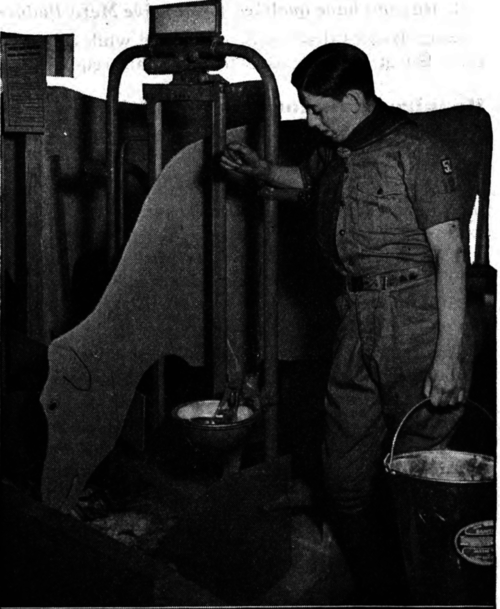
A Rural Scout demonstrating the requirements of the Dairying Merit Badge at a Merit Badge Exposition.
Requirements For The Star Scout Award
A First Class Scout may become a Star Scout upon meeting the following requirements:
1. His record of satisfactory service as a First Class Scout shall have been for a period of at least five months; and
2. He shall have qualified for any five Merit Badges.
Merit Badges that the Scout earned while a Second Class Scout may be used to meet this requirement.
Requirements For Life Scout Award
A Star Scout may become a Life Scout upon meeting the following requirements:
1. His record of satisfactory service as a Star Scout shall have been for a period of at least three months; and
2. He shall have qualified for ten Merit Badges, which shall include First Aid, Physical Development or Athletics, Personal Health, Public Health, Life Saving or Pioneering or Safety.
This means that the boy must earn five badges of his own choice and five from a prescribed list of which two have alternatives. If the Scout selects Life Saving, one of the badges of his own choice must necessarily be Swimming, since Life Saving includes this as a prerequisite.
Requirements For Eagle Scout Award
A Life Scout may become an Eagle Scout upon meeting the following requirements:
1. His record of satisfactory service as a Life Scout shall have been for a period of at least six months; and
2. He shall have qualified for twenty-one Merit Badges, which shall include First Aid, Life Saving, Personal Health, Public Health, Cooking, Camping, Civics, Bird Study, Pathfinding, Safety, Pioneering, Athletics or Physical Development.
This means that the boy must earn nine badges of his own choice and twelve from a prescribed list, of which one has an alternative. As mentioned above,
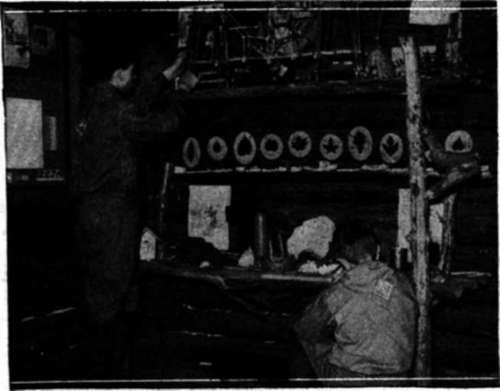
The Merit Badge Program grips the Scouts' interest. They explore many trails and meet experts, who are the Merit Badge Counselors.
Swimming Merit Badge is a prerequisite for Life Saving.
Requirements For Eagle Scout Palm Awards
The Eagle Scout Rank is the highest rank in Scouting but the following provision has been made for additional awards to Eagle Scouts:
The Eagle Scout who meets the requirements for five Merit Badges, in addition to the twenty-one required for Eagle Scout Rank, may be awarded a Bronze Palm; for ten, a Gold Palm; for fifteen, a Silver Palm; for twenty or more such combinations, of Bronze, Gold or Silver Palms as he may elect, to indicate the number for which awards have been made; provided, however, that no award of Palms may be made for more than five Merit Badges at any one time, and provided further that no award shall be made until after at least six months' satisfactory service as an Eagle Scout, as provided for in Clause 1 [The "Scout Service Requirement"] herein, and that subsequent awards may be made for intervals of not less than six months' service following the previous award.
It will be noticed that satisfactory service is a basic requirement of each award leading to and including Eagle Scout Rank and the Eagle Palms. The act of meeting Merit Badge Requirements, in itself, is not enough to achieve recognition. It must be accompanied by unselfish service in Scouting.
Procedure For Star' Life And Eagle Advancement
To aid the boy toward the attainment of higher ranks in Scouting he should be given not only encouragement, but also the opportunity to practice the things called for. Lay stress upon his service and his living of the Scout Oath and Law, place him in positions where he will have to exercise his leadership abilities.
Then, when the Scout has earned the necessary Merit Badges, go carefully over his record, and if you feel the boy is prepared to receive his next rank, give him the proper application form to fill in. Review the application, check it to see that it is correct, approve it and submit it to the Local Council.
The Board of Review receives the application as approved and secures, in such manner as it may determine wise, from those who may be in a position to know from personal knowledge, from the Scout's parents, school teacher, employer, pastor, etc., concrete evidence that the Scout has truly met the "Service Requirement."
The Court of Honor. A Star, a Life, and an Eagle Badge to be pinned on three fine Scouts. Here is public recognition. It spurs them on.
If satisfied, the Board makes arrangements with the Scoutmaster to have the Scout appear for final review of his application and credentials and the award of the Badge at an impressive public ceremony.
Scout Advancement Procedure
(Based upon Troop Plan of Scout Advancement. Subject to policies of your Local Council.)
Rank | Preparation by: | Examination by: | Review by: | Award by: |
Tenderfoot | Patrol Members | Scoutmaster | Scoutmaster | |
Second and First Class | Patrol Members, Junior Leaders (Counselors) | Troop Leader (Junior Assistant Scoutmaster or above) | Troop Board of Review* | Troop Court of Honor* |
Merit Badges (not a rank) | Troop Members, Merit Badge Counselor | Merit Badge Counselor | District or Council Board of Review† | District or Council Court of Honort |
Star, Life, Eagle Ranks and Eagle Palms | District or Council Board of Review | District or Council Court of Honor |
* Where Council Plan of Scout Advancement is used, the Second and First Class review and award occur at District or Council Board of Review and Court of Honor, respectively.
† A few Councils only have been given permission to conduct Authorized Experiments in which Merit Badges are reviewed and awarded by Troop Board of Review and Court of Honor.
Continue to:


My Books

