


Cooking Procedure
Description
This section is from the book "Handbook For Scoutmasters. Volume 1 & 2", by Boy Scouts of America. Also available from Amazon: Handbook For Scoutmasters.
Cooking Procedure
The Troop Leaders' Council decides whether the Troop shall cook by Patrols or whether one Patrol at a time is to cook for the whole Troop.
Of all features connected with Troop camping, this may create the greatest amount of arguments. So let us stop a moment and see what the argument is about:
Those in favor of cooking for the whole Troop will insist: that the commissary is easier to handle; that less equipment is needed; that less fuel is consumed; that fewer boys are occupied at any one time with cooking; that supervision is easier.
Those in favor of cooking by Patrols will insist: that it is the logical development of the Patrol Method; that a possible accident to a meal is less serious; that boys are automatically trained in advance for this type of cooking on Troop and Patrol hikes and short-term camps; that cooking for a Patrol of eight is comparatively simple, but for thirty-two an appalling task for youngsters; that each boy will get more practice in cooking; that it provides a friendly rivalry between Patrols for the "best prepared meal of the day."
If it were just a matter of convenience, the people in favor of Troop cooking would almost certainly "have it." But it isn't! Cooking in camp can be either one of those drudgeries that just has to be taken care of, or a very great joy—usually it is the latter.
By having the Patrols cook for themselves you strengthen the Patrol unity—by taking a Patrol off to do Troop cooking you break up the Troop for special inter-Patrol activities. In Patrol cooking, every boy is given a chance for practice by rotation of duties—in Troop cooking a couple of boys of the Patrol will do the cooking every fourth day, with another couple peeling the discouraging heap of potatoes; and in all possibility the same boys will be doing the same jobs the next time it is the Patrol's turn.
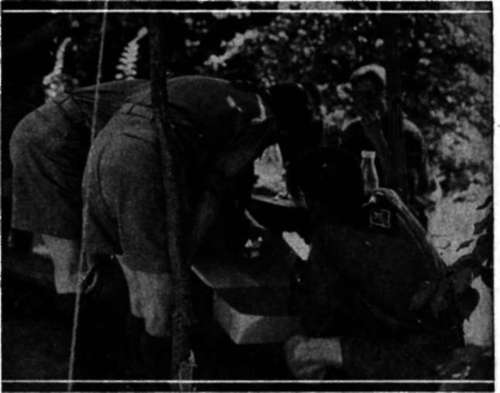
Eight pieces for eight hungry Patrol members. Their dining table under the tent is a happy meeting place three times a day.
By Patrol cooking all the Patrols go along together on the same time schedule—by Troop cooking three Patrols will be hanging around waiting, often to the desperation of the cooking Patrol when for some reason or other it is late in finishing.
Patrol cooking carries over into the Troop's complete yearly outdoor program—Troop cooking is unsuitable outside of the long-term camp.
So, consider the problem from all angles before you make your final decision, and remember the words of the Chief Scout of the World: "Patrol cooking is bound to be useful and valuable—because I am not looking merely to the successful camp, but to the making of self-reliant resourceful men."
Food Deliveries In Camp
As soon as camp is erected and the store tent is put up, the Assistant Scoutmaster is ready to move in his staples. As far as the rest of the foodstuff is concerned, it is possible to get along with two deliveries every day if properly planned.
(1) First Delivery—early in the morning, of milk only, which should reach the Troop at a temperature not higher than 50 degrees (better 40-45 degrees), and should immediately be placed in the Patrols' primitive refrigerators. If ice can be secured so much the better.
(2) Second Delivery—in time so that the Patrols may have the material with which to start dinner immediately upon coming up from the afternoon swimming period. This delivery will also include the breakfast and lunch rations.
Protecting Food In Camp
It is a well-known fact that food, its preparation and service, offers an excellent medium for the passing along of disease and, therefore, every known precaution must be taken to avoid these possibilities.
In buying food, the Assistant Scoutmaster in charge must be particularly careful to avoid purchasing meat that is not fresh, milk that is not pasteurized, canned goods with swollen ends, and all exposed foods which might have been contaminated by dust, insects or rodents, such as bread, crackers, cookies, etc.
Keeping The Food
All food supplies should be stored in such a manner that they are not accessible to insects and rodents. This may be done, for instance, with items such as sugar by swinging them in a box or a bag from the ridge pole of the cooking tent.
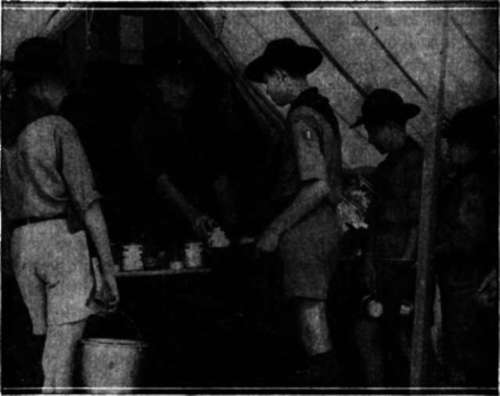
The Patrol Grubmasters line up for the clay's ration of food for their always hungry fellow members.
Coolers should be ready for use before perishable foods are brought into camp. Whether these will be of the springhouse type, a hole in the ground, or an evaporator hanging in the tree, will depend upon local conditions. Such coolers, without ice, cannot be expected to keep perishable foods, such as meat and milk, at a safe temperature for more than a few hours.
Meat dishes that are held over from one meal to the next should be properly refrigerated. Where this cannot be done, it should be recooked before using.
Potatoes and foods in which potatoes are mixed, such as meat filling, spoil very quickly and cannot be carried over with safety from one meal to another, unless they have been kept in a cooler where the temperature is less than 50 degrees.
If it is planned to make potato salads or filling using potatoes, they should be cooked immediately before use.
Clean Dishes
Dishes used for the preparation and serving of food, including cutlery, should be washed thoroughly with soap and clean water and then placed in water close to the boiling point to be rinsed and sterilized for a period of two minutes. This can be done by placing them first in a net bag or wire basket and then lowering that into the hot water vessel. Dysentery is frequently caused by rancid grease on dishes.
Dish towels should not be used for the drying of any kind of a food receptacle or cutlery, because it is impossible to keep them clean.
When taken from the boiling water the dishes will dry as a result of the heat to which they have been exposed. Cutlery may have to be placed on top of the stove in a pan to dry.
Dishes after washing should be protected from flies, rodents and dust by being placed in a covered receptacle, such as a box or closet, and kept there until such time as they are to be used.
Clean Cooks And Clean Kitchens
Cooks should be scrupulously clean, scrubbing up thoroughly before, while and after the meals have been prepared. The cleaning of the finger nails is very important. A white apron for the cook and his helpers, and a white cap for Chief Cook of the day, will add a touch and will develop a pride in cleanliness that is important and valuable. These white uniforms should be kept white.
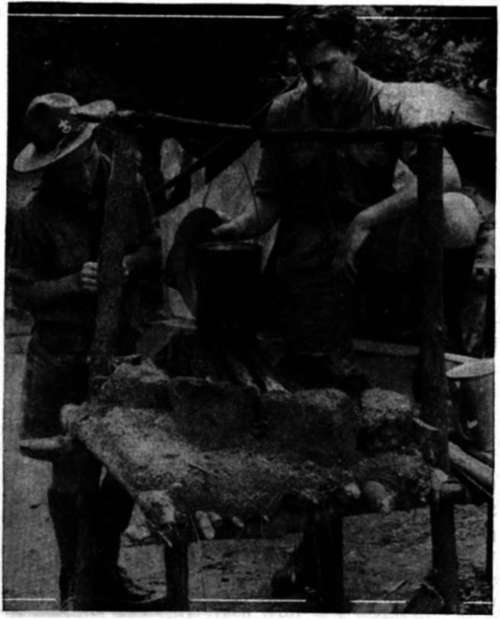
Clean hands, clean food, clean dishes. Palatable, well cooked food is quite an item in any healthy boy's life in camp or at home.
A generous supply of hot water heated to a temperature close to the boiling point is most essential for a clean and healthy camp.
The kitchen serving tables, eating tables and benches should be scrubbed thoroughly with soap and water following each use. Every particle of food which will attract flies should be removed and disposed of preferably by burning. If incineration is not possible refuse should be buried in such a way that it cannot be dug up by animals.
A camp kitchen will, of course, be a considerable distance from the camp latrine, garbage pit, and incinerator.
Tin cans should be burned and then crushed and buried. Open cans left on the ground breed mosquitoes, attract flies, are unsightly and also create an accident hazard.
Menus And Recipes
The menus and recipes in the following pages have been developed by members of the staff of the Boy Scouts of America in consultation with outside experts and have been carefully checked to be sure that they meet dietary standards and that they are, at the same time, of a character which permits their being used effectively by Scouts in camp under competent leadership.
While these menus will be found satisfactory for many parts of the country, local dietitians should be consulted in working out meals that are especially suitable for your locality.
As will be seen, each menu is designed for ten campers as a matter of convenience in figuring quantities for any number below or above this standard figure. If, for example, a Patrol consists of six boys, you will divide the quantities shown by ten and multiply by six—or in other words: multiply by the decimal 0.6.
To Have Meals Served On Time
1. Issue instructions to each Patrol daily, showing exactly what is to be prepared for each meal.
2. Remember that time given in the recipe is the time ordinarily required to prepare the dish.
3. Give actual menus for items to be cooked. Start with instructions on what to do first, then step by step until the meal is served, even to actual time fire must be kept going.
4. Remember that dish water must be heating while meal is being served.
As Patrols become more experienced, they will develop judgment as to time required, but at first they must be given help in arranging their time schedule.
The following menus have been developed as a guide to the Scoutmasters in purchasing and developing meals for camp. It is admitted that they are not the best that could be served, but consideration has been given to the fact that in many camps it will not be possible to secure fresh fruit and vegetables and that transportation facilities may not be adequate for carrying a large variety of canned and staple goods. Local conditions may make it desirable to make changes in these menus.
They have been submitted to dietetic experts and have been approved as affording a good, wholesome and varied diet for boys of Scout age engaged in an active recreational program.
Continue to:


My Books

