


Long-Term Camping. Continued
Description
This section is from the book "Handbook For Scoutmasters. Volume 1 & 2", by Boy Scouts of America. Also available from Amazon: Handbook For Scoutmasters.
Long-Term Camping. Continued
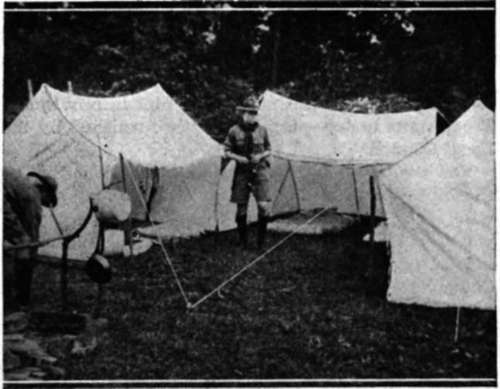
Here are handmade, homemade, Scout-made, modified Baker tents, set up for a Patrol Camp. They cost little and were not hard to make.
But before we discuss in detail the planning for and conducting of a Troop Camp, we shall pause to explain more fully the types of camping that are made available by the Boy Scouts of America.
Local Council Camping
For Scouts who may not be able to attend your
Troop Camp and for those who may properly desire more extended Scouting experience in addition to that furnished by the Troop, most Local Councils offer the opportunity for boys or Patrols from various Troops to attend the Council Camp and enroll in provisional Troop units under camp leadership furnished by the Local Council.
You should make inquiry from your Scout Executive in order to be able to advise boys and parents wisely as to the time and conditions under which your Scouts may enjoy this added camping experience in keeping with the camping procedures of your Local Council.
Recognized Kinds Of Troop Camps
Two types of Troop camping have been described above rather fully, namely, the Inter-Troop Camp and the Independent Troop Camp, both of which are conducted by chartered Troops under their own Scoutmasters and Patrol Leaders. In addition to these two types, we also find Provisional Troops and Semi-Provisional Troops organized within a Local Council camp. In order to clarify your understanding of the distinctions between these four types of Troop camping, we quote the official statement of policy on Troop Camping, as follows:
"1. The ideal condition is the Chartered Troop in charge of its own Scoutmaster, Assistants and Patrol Leaders, on its own exclusive site in the Council Camp, working in cooperation with other Troops and then-leaders, and each having the assistance and supervision of the professional staff provided by the Council to coordinate and to supplement the leadership of the regular Troop officers by furnishing additional health, safety and technical personnel.
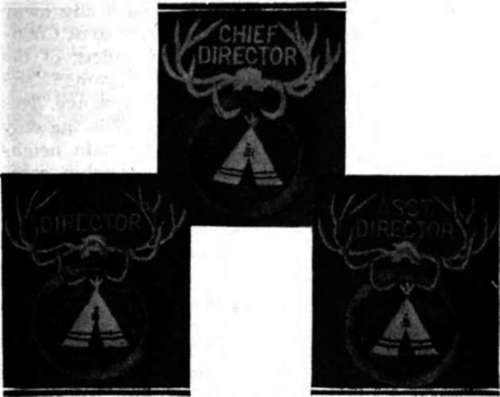
These badges are for men who have earned them by attending special Camp Training Courses. They know Camping thoroughly.
"2. The next best condition is the Provisional Troop on its own allotted site in the Council Camp, in which Patrols are made up of boys from the same Troop with their own Patrol Leaders, the Troop retaining its identity as such, but with a qualified Scoutmaster and Assistant appointed by the Camp Director to serve during the time the Troop is in camp. In such a Troop there may be Patrols from two or three different home Troops which are combined for the sake of economy and convenience in operating by the Camp Director.
"3. The Semi-Provisional Troop—in which Patrols are recruited indiscriminately from campers who are members of many home Troops with the Troop officers, professional or volunteer, provided by the Camp.
"4. The Independent Troop Camp on a site away from other Troops and without the presence of Council officers other than the volunteer leaders of the Troops—the Council staff giving encouragement and such supervision as can be given at long range. This situation is not considered as ideal but it is the only practical solution of the problems of certain neighborhood situations, and with trained leadership, careful planning and Council supervision may be entirely satisfactory."
Planning The Troop Camp
Training of leadership and boys and securing the needed equipment constitute the two major items in preparing for the Troop Camp.
First of all, you—the Scoutmaster—and your Assistants will have had the opportunity to participate in Local Council or District Training Courses, specifically designed for Troop camp leadership. Here you will receive full training in all the features involved, and also the advice, encouragement, and inspiration of other Scouters, already masters in the art of Troop camping. Participation in such courses cannot be urged too strongly. It will make fun of camping and create pleasure in leadership.
The training of boys will take place on numerous Troop and Patrol hikes and in Troop and Patrol short-term camps. Here the boys will have learned how to organize the Patrols for camp, each boy with his specific duties, how to set up camp, how to make themselves comfortable and how to cook for the Patrol group along the lines suggested in the Handbook for Patrol Leaders. The leaders will have learned of the activities especially favored by the Scouts, and which boys may be depended upon to carry special leadership and assignments.
Who Plans The Troop Camp
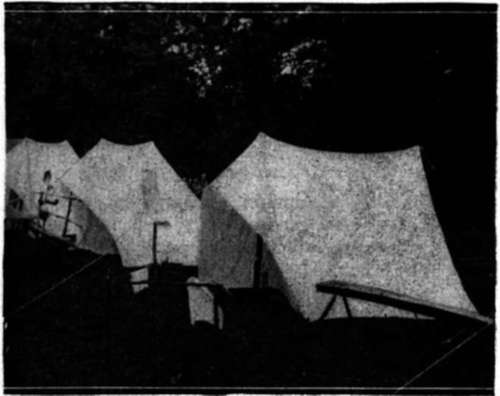
"Scout and mother made" modified forester tents gave excellent service to this Patrol last summer. They camped with their Troop.
During overnight camping expeditions the Patrols and the Troop will have found out what further equipment is needed, and will have had time to make it or procure it in advance of the summer adventure.
Then, as the time is ready—and that i6 as early in the year as March or April—the Troop will start its: detailed planning.
Since it is definitely the responsibility of the Troop Committee to secure "suitable opportunity for the members of the Troop to spend one or more weeks in camp . . ." and also definitely the responsibility of the Troop to provide the necessary leadership for the venture, a joint meeting should be called of all involved where the first plans may be sketched out, as to type of camp, camp site, general program and leadership. From this point on, the Troop Leaders will plan the camp and will secure from the Troop Committee desired cooperation and specific help in carrying out its details.
Distribution Of Leadership
To facilitate the planning it is important that leadership duties be assigned early in the game. The following suggested set-up, developed by Harvey A. Gordon, may be used:
The Scoutmaster is the director and policy-determining leader of the Troop. He is familiar with Scout camping standards. Before camp he works with the Troop Committee, contacts Scout parents, develops the boys' enthusiasm about the Troop camp. During camp he is the person in charge, but executes all work through his Assistant Scoutmasters, Senior Patrol Leader, Junior Assistant Scoutmaster, and Patrol Leaders.
The first Assistant Scoutmaster may be responsible for the physical arrangements. Before camp he directly supervises the work of the Troop Quartermaster and aids him in getting the necessary equipment together. He works out the menus and the commissary and secures transportation to camp. During camp he checks on the setting up of camp and guides the work of the Service Patrol of the day. He orders, receives and distributes commissary supplies, and is in general charge of sanitation, first aid—in fact all things relating to the physical comfort of the Scouts.
The second Assistant Scoutmaster may be responsible for all camp program and activities. Before camp he works out with the Junior Assistant Scoutmaster a well-planned program of activities. He gathers a suitable collection of games, contests and Scoutcraft stunts, lays out special features and demonstrations and secures the equipment necessary to put over the activities, such as balls for games, Indian make-up, archery tackle, etc. During camp he guides the work of the Program Patrol of the day, leads hikes away from the camp site, is in charge of swimming, boating, Scoutcraft demonstrations and examination, morale, and all other items having to do with the mental state of the Scouts.
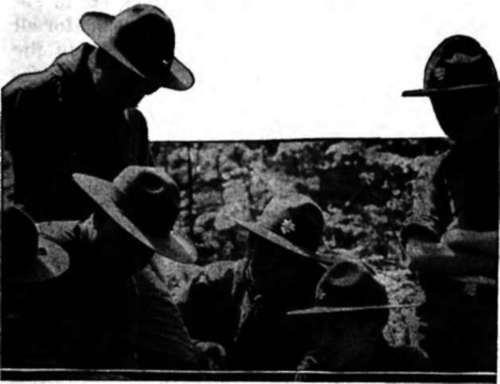
Leadership is distributed in Troop Leaders' Council. A friendly gathering where plans are made that blossom into activity.
The Senior Patrol Leader is the junior leader. Before camp he aids the Patrols in getting needed training, in securing special equipment, in working out program features which the Patrols are desirous of presenting, and helps the Patrols in general to get ready for camp. During camp he is responsible for all routine matters, such as calling the Patrols in the morning, having the Troop ready for special gatherings, including Flag ceremony, Scoutcraft and game periods, camp fires. He sees to it that details assigned to Patrols are carried out and on time. Scoutmaster and Assistants pass all orders to the Patrols through the Senior Patrol Leader, who in turn deals only with the Patrol Leaders.
The Patrol Leaders are the real leaders of their respective Patrols. Before camp they develop a complete camp organization plan for their Patrols as indicated in the Handbook for Patrol Leaders, and train their boys according to the suggestions of that manual. They encourage their boys to go to camp and work with them on all necessary pre-camp details. During camp they lead their Patrols throughout, assign duties to Patrol members, and see to it that the Scouts participate in all planned activities.
The Assistant Patrol Leaders prepare themselves to carry on the work of their Patrols in the Patrol Leaders' absence, and to cooperate with the Patrol Leaders in such ways as may be requested.
The Troop Scribe helps before camp to get out all notices to parents and boys. During camp he is possibly the Troop historian, and as such writes the official log of the camp and makes up the "daily adventure sheet" for reading at the camp fires, unless some other Scout is better fitted temperamentally for this specialty.
Schedule Of Procedure
Before details are decided upon, a general plan of procedure should be discussed and laid out, along the following lines, adapted from Jack Blunt:
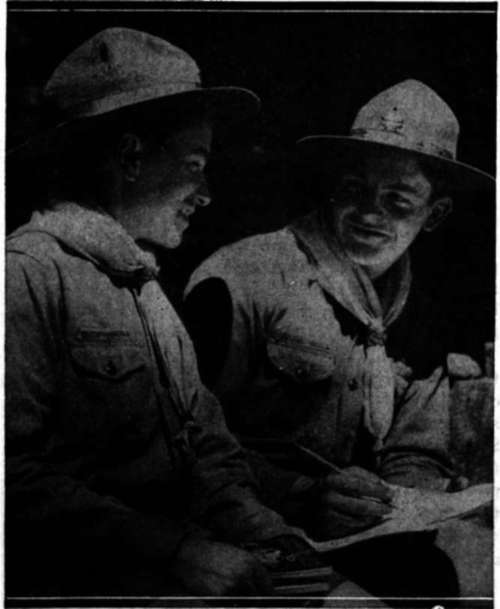
Loads of planning to be done, with many discussions between the Senior Patrol Leader and the Patrol Leaders.
At The Beginning Of The Year
1. Start a camp bank, with a member of the Troop Committee in charge.
2. Begin general promotion of the camp and get everybody enthusiastic about it.
Four Months Before Camp
1. Take up matter with the Local Council and get its approval to proceed.
2. Decide upon the place and date of the camp.
3. Announce date to Scouts, so that working boys may secure their vacation at the right time. Many firms make arrangements months in advance.
During Last Two Months Before Camp
1. All Troop and Patrol activities should feature preparation for the summer camp.
2. Send out first camp notice to parents, giving place, date, cost, time when camp fees must be paid, and a general idea of the camp and its value to their boy. Attach application form and health certificate to be filled out. If possible, call a parents' meeting.
3. In the case of an Independent Troop camp investigate camp site, check swimming facilities, have drinking water tested. Make local contacts. Ascertain address of doctor and hospital, nearest church for Sunday services, nearest grocery, butcher, dairy, farmer who may sell vegetables. Contact with Scout people of the neighborhood in regard to local attractions and danger points.
4. Discuss menus for camp with some of the Scouts' mothers.
During Month Before Camp
1. Overhaul camp equipment. Write out list of needed equipment as soon as the number of Scouts camping is known. Secure needed new items, and repair what needs to be repaired.
2. Visit parents of Scouts who have not signed up for camp. This may be placed in the hands of the Troop Committee. If it is found that economic reasons interfere with the boy's going to camp these should be overcome.
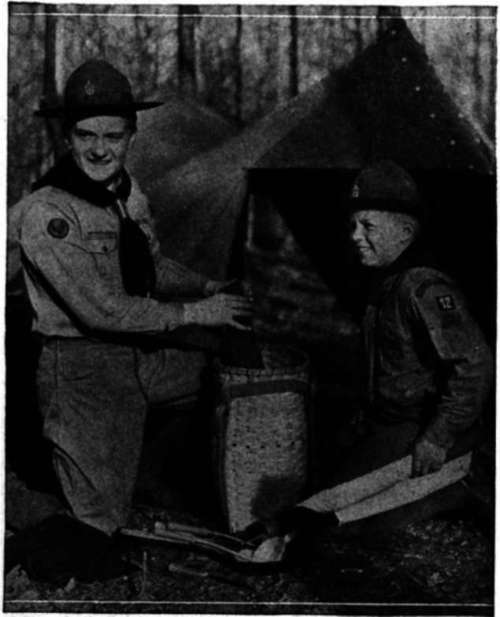
The last couple of months before summer camp all Troop and Patrol activities feature preparation for the event.
3. Send out second camp notice, giving list of personal equipment required.
4. Secure necessary transportation facilities.
5. Send to the Local Council completely filled in application, including lists of boys and leaders, commissary and program.
6. Interview with local physician to secure his willingness to give health examinations and to visit camp one or more times while the Scouts are there.
Ten Days Before Camp
1. Send out final camp notice, giving transportation arrangements, including where and when to meet, food to be brought for journey to camp, address to which letters may be sent, announcement of visitors* days.
2. Finish camp menus, work out food list for staples and for first couple of days in camp, and send to local tradesmen with instructions for delivery (or send to Local Council's commissary officer).
3. Finish program of activities, with emergency ideas for wet days.
4. Collect camp fees. Draw out necessary camp funds from bank.
5. All Scouts and Scouters given health examination. Use Forms 952 and 952A.
A Couple of Days Before Camp
1. Have inspection of personal packs and Patrol equipment.
2. Make final check of special Troop equipment.
Finally: You're Off
Continue to:


My Books

