


Stone Borer
Description
This section is from "The American Cyclopaedia", by George Ripley And Charles A. Dana. Also available from Amazon: The New American Cyclopædia. 16 volumes complete..
Stone Borer
Stone Borer, a name given to several bivalve shells, especially pholas (Linn.) and lithodomus (Cav.), from their power of boring into the hardest rocks. The pholadidae (Gr. φωλέιν, to hide in a hole) are true bivalves, and have two accessory plates in the neighborhood of the hinge for the protection of the dorsal muscles; they belong to the group siphono-phora (Gray), or those having long respiratory siphons, united for the greater part of their length; they are all burrowing animals, penetrating the hardest substances. The shells are usually elongated, gaping at one or both ends, and closed by two adductor muscles; the foot is large and powerful, and the mantle is closed; they are found in all climates. The typical genus pholas is often of considerable size, with a white, hard, rough, but very brittle shell, rendering it an interesting question how it can perforate a solid rock; the operation is supposed to be performed by a rotatory motion of the shell effected by the powerful foot.
The date shell or piddock (P. dactylus, Linn.), about 2 in. long and G or 7 in. wide, is found along the European coast, mostly in calcareous rocks; it is eaten along the Mediterranean. It is very luminous, and hence some have supposed that its excavations may bo partly due to electrical action on the sea water. The smaller P. Candida (Linn.) is used for bait in England. The P. crispata (Linn.) is found along the coasts of our middle and southern states. Many fossil species are known. The family of veneracea, of the same group, are also stone borers, principally by means of the foot. - Among the asiphonate bivalves, the most remarkable stone borer is the lithodomus lithophagus (Cuv.); it is commonly found in holes which it has excavated in calcareous and coral formations; it is the sea date shell of the Mediterranean, and is a delicate article of food. Its perforations have served as important indications of the change of level of the sea coast in modern times; the columns of the temple of Serapis at Pozzuoli are perforated by these shells at a considerable height above the actual level of the sea. - Another bivalve, coining near the clams, generally considered a stone borer, is saxicava (Lam.), which appears under such a variety of forms that two genera and at least 15 species have been made of the single representative, S. rugosa (Lam.); the young symmetrical form constitutes the genus hiatclla (Bosc). It is found in almost all parts of the world, largest in the arctic seas, in crevices of rocks and corals, assuming very exactly the shape of the cavity which contains it; it occurs from low-water mark to the depth of 140 fathoms; it is found fossil in the miocene and glacial deposits.
It has been questioned whether saxieava is the excavator of the holes in which it is found, and the subject of the mechanism by which the stone borers operate is by no means well understood. - Sea urchins also may in many instances be called stone borers, the excavation of their cavities being effected by the constant action of their spines, and perhaps also by the vibratile cilia of their ambulacral tubes and suckers. It is conceivable, if not probable, that the continual action of soft vibratile cilia may excavate holes even in the hardest rocks.
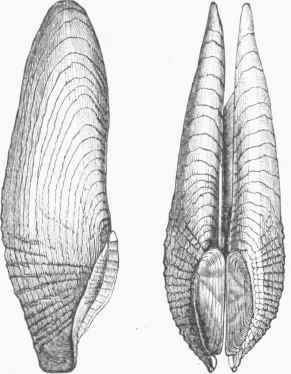
Date Shell (Pholas dactylus).
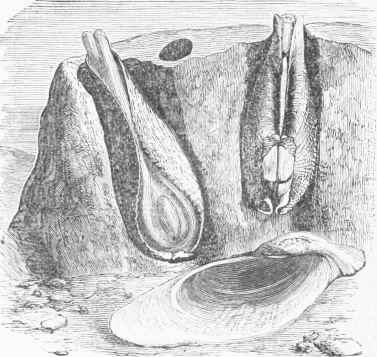
Stone Borers (Pholas dactylus) which have hollowed out shelters in a block of gneiss.
Continue to:


My Books

