


Yaupon
Description
This section is from "The American Cyclopaedia", by George Ripley And Charles A. Dana. Also available from Amazon: The New American Cyclopædia. 16 volumes complete..
Yaupon
Yaupon, an aboriginal name for ilex Cassine, a North American shrub which derives its specific name from cassena, by which it was also known to the Indians. The characters of the genus ilex are given under Holly, this species, like that, belonging to the section with evergreen leaves. It is a slender shrub growing 8 to 12, and sometimes 15 ft. high, with short, spreading branches, which often terminate in a sharp point or spine, on which account it has been proposed as a hedge plant. The leaves, seldom over an inch long, are oval or oblong, obtuse, thick and shining, but without the large spiny teeth of those of the holly, the margins being merely scalloped by small rounded serratures; the flowers and abundant scarlet fruit much as in the holly. This species is found in light sandy soils from Virginia to Florida, and never at any great distance from the coast; it has proved to be hardy as far north as Philadelphia, and is worthy of cultivation as an ornamental shrub wherever it will endure the winters. The Indians held it in high esteem, and the early travellers in the Carolinas mention its leaves as an article of considerable traffic between the coast tribes and those living further inland.
An infusion of the slightly roasted leaves produces effects similar to those of the Paraguay tea (see Mate), which is another species of ilex, being at first exhilarating if taken in moderate quantities, but in excess acting powerfully as an emetic, diuretic, and purgative. The Indians, especially those of the Creek nation, made use of the infusion, under the name of "black drink," in their most solemn ceremonies. A very strong infusion being made for state occasions, this was drunk by the men only; its first effects were those of a stimulant, but as the quantity taken was increased, one after another yielded to its emetic powers, and the ability to resist these the longest was regarded as an indication of superiority. Excessive vomiting was considered necessary to a proper purification for their ceremonials, and the drinking was continued until the tea was rejected unchanged in appearance. On account of its emetic properties the shrub has been called /. vomitoria, whioh name, however descriptive; cannot supersede the older I. Cassine. In North Carolina, according to Barton (" Collections "), the people make use of it to purify and improve brackish water, a few leaves being boiled in it for a short time.
Where the plant grows naturally its leaves are used as a domestic medicine, to act as a diuretic, emetic, or purgative, according to the quantity administered. They are also used in moderate quantities as a substitute for ordinary tea.
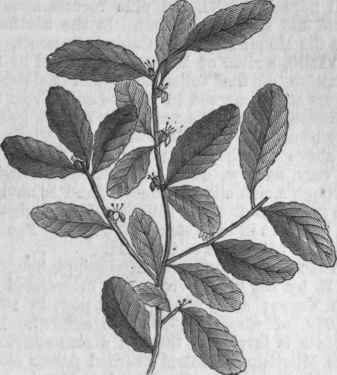
Yaupon (Ilex Cassine).
Continue to:


My Books

