


Ocelot
Description
This section is from "The American Cyclopaedia", by George Ripley And Charles A. Dana. Also available from Amazon: The New American Cyclopædia. 16 volumes complete..
Ocelot
Ocelot, an American group of medium-sized cats, of slender and elegant proportions, without tufts to the ears, and with more or less elongated and connected spots diverging in longitudinal rows backward and downward from the shoulders, of a yellowish color bordered with black. The common ocelot (felis partialis, Linn.) is about 3 ft. long to the base of the tail, the latter being about 15 in. additional; the general color is grayish, with large fawn-colored, black-bordered spots, forming oblique bands on the flanks; ears black, with a white spot below; chin and throat white, with a black bar beneath the former and another under the neck; two black lines on the side of the forehead and two behind each eye; under surface white, with irregular black patches; tail above black, with narrow bands of white. Specimens vary much in their markings, in the tinge of the tawny spots, in the chain-like character of the streaks, and in the spots and blotches on the legs. It is found in Brazil and Guiana, and in Mexico and the southwestern United States. The head is short, the neck long and thin, the body slender, tail moderate, and hair soft and not very thick.
It is called leopard and tiger cat in Texas and Mexico, is rather nocturnal in habit, and climbs trees in pursuit of small animals and birds; though active and muscular, it is easily tamed, and is gentle and playful in captivity, unless fed on raw meat exclusively; it is very graceful and quick in its movements, and when pursued takes to a tree; it is seldom seen on the open plains, preferring woods and thickets. From its smallness, it is little to be feared by the herdsman; but from the beauty and value of the skin, it is always killed when an opportunity occurs. In the linked ocelot (F. catenate II. Smith), by many considered a mere variety of the last, the markings are more lengthened, the ground color more reddish, and the body and limbs stouter. The long-tailed ocelot (F. macrooura, Neuwied) is often grayish tawny yellow, paler below, with irregular unenclosed longitudinal markings on the body; of a total length of 44 in., the tail forms about 19, and is semi-annulated, black at the tip.
Another allied species, inhabiting, like all the above, South America, is the margay (F. tigrina, Linn.); it is 18 in. long, with a tail of 8 in.; the color is tawny yellow, with black lines and bands upon the head, neck, and throat; the open spots of the body enclose a reddish centre, and are surrounded by a black line; the limbs are spotted and the tail ringed with black.
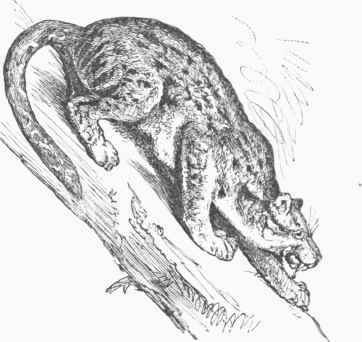
Common Ocelot (Felis partialis).
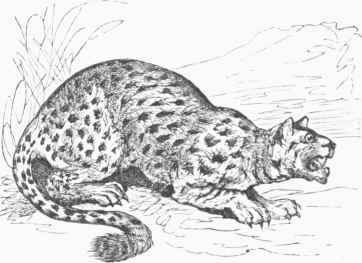
Margay (Felis tigrina).
Continue to:


My Books

