


Paca
Description
This section is from "The American Cyclopaedia", by George Ripley And Charles A. Dana. Also available from Amazon: The New American Cyclopædia. 16 volumes complete..
Paca
Paca, a rodent of the agouti family, the only well determined species of the genus coelo-genys (111.). In this genus the zygomatic arch is enormously developed, the superior maxillary portion presenting a large hollow beneath, giving the skull somewhat the appearance of a snapping turtle's; the outside of the arch in the male is wrinkled and roughened with small wart-like confluent excrescences, growing rougher with age; the malar bone is deeper than long; the molars are longer than broad, the crowns having four or five deeply indenting folds of enamel, and the incisors are slender. The G. paca (Rengg.) is about 2 ft. long, stout-bodied, with short limbs; the head is large and broad, with an obtuse hairy muzzle; the eyes large; the ears moderate and sparingly clothed with hair; feet naked below, five-toed, the inner toe very small, and with broad nails except on the inner; the tail a naked fleshy tubercle. The hair is coarse, closely applied to the skin, of a brown color on the upper parts and limbs, and white below; three, four, or five longitudinal white bands on the sides, broken into spots; in some specimens the color is blackish brown above and yellowish white below, and in others more rufous. The mammre are two pairs, one pectoral, the other inguinal.
The zygomatic cavity is lined by a continuation of the skin of the face, and opens externally on the cheek; its use is not well ascertained; beneath this is a cheek pouch, opening into the mouth in front of the molars. They inhabit South America from Cayenne to Paraguay, and are sometimes found in Peru east of the Andes, and in some of the West Indian islands. They are generally seen singly or in pairs on the borders of the forests and rivers after sunset, remaining concealed during the day in burrows which they dig like rabbits; the food consists of leaves, fruits, and tender plants, and sometimes sugar cane and melons; they are good runners, swimmers, and divers; cleanly in habit', the flesh is fat and well flavored. A fossil species is found in the caves of Brazil.
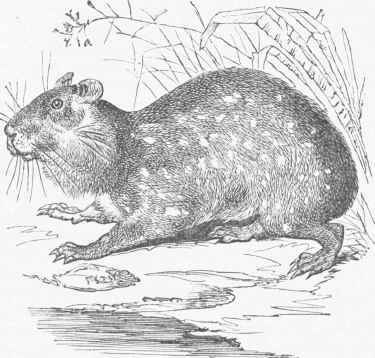
Paca (Ccelogenys paca).
Continue to:


My Books

