


Pau
Description
This section is from "The American Cyclopaedia", by George Ripley And Charles A. Dana. Also available from Amazon: The New American Cyclopædia. 16 volumes complete..
Pau
Pau, a town of France, capital of the department of Basses-Pyren6es, on the right bank of the Gave de Pau, 410 m. S. by W. of Paris; pop. in 1872, 24,800. It is delightfully situated on a precipitous height, regularly laid out, and well built. The charm of the scenery and the mild and healthful climate attract to Pau many visitors, especially in winter; and there are three Protestant Episcopal churches and a Scotch Presbyterian church. Linen cloths, celebrated as toiles de Beam, and fine table cloths, tapestry carpets, and cutlery are manufactured; and the place is noted for its Jurancon wine. - Pau was founded in the 11th century; a vis- • count of Beam built a strong castle on the top of a hill, and having marked the limits of .the ground with stakes or pans, the town took the appellation. In the 14th century the castle was rebuilt by Gaston Phoebus, count of Foix, and the place became the chief town of Bearn. Near the place Royale in the centre of the town, with a statue of Henry IV., is a fine promenade, and a park is formed by a natural terrace along the right bank of the Gave, well wooded and shaded, and connected through a square planted with trees with the castle. The latter is the most conspicuous edifice of Pau, and is remarkable for great historic associations.
It was the birthplace of Henry IV., and his cradle and other relics are preserved in it. The castle was sacked by the revolutionists in 1793, and restored under the reign of Louis Philippe, Charles XIV. of Sweden (Bernadotte), a native of Pau, giving magnificent presents for the apartment leading to the chapel.
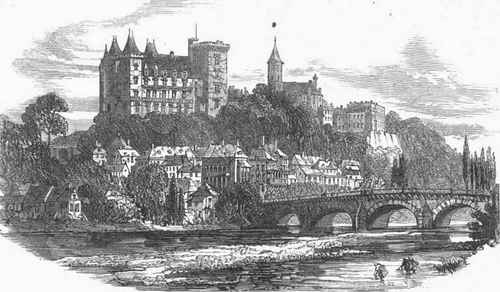
Castle of Pau.
Continue to:


My Books

