


3085. Decanting, Straining, And Filtering Of Liquids. Part 2
Description
This section is from the book "Facts Worth Knowing", by Robert Kemp Philip. Also available from Amazon: Inquire Within for Anything You Want to Know.
3085. Decanting, Straining, And Filtering Of Liquids. Part 2
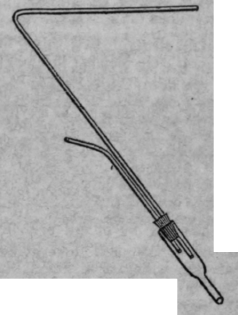
CO whole will then have have the appear ance represented in Fig. 3, and will form an exceedingly useful, and very convenient syphon. 3094. In emptying large stone bobles or carboys, the following plan. may be had recourse to: - Perforate a sound cork with two openings by a rat-tail rasp, and fit, air-tight, two tubes bent as in Fig. 4. On blowing through the upper, the liquid will be forced to ascend and run over the bend of the other, which will then act as a syphon. This plan is exceedingly useful ' in emptying carboys of corrosive liquids, as oil of vitriol, etc.; and if all the joints are - as they should be - air tight, the flow may be arrested by closing the upper tube with the finger. In the figure the outer leg of the syphon is shortened to save space; in practice, it must be of sufficient length to be lower than the inner leg within the vessel.

Fig. 4.
3095. If a syphon is required frequently for decanting the same kind of liquid, it is found troublesome to be constantly filling it before each time of using; this trouble is obviated by the use of an instrument formed with legs of equal length, which are turned up at the ends, as in Fig 5; this having been filled, may be hung up in tl»e erect position, and the liquid will not escape, but on plunging one end into a liquid, it will be found immediately to flow from the other, provided that the latter is below the level of the surface of the liquid.
3096. The operations of straining and filtering are frequently required in domestic manipulations, and the apparatus employed usually consist of sieves and a jelly-bag. As, in many other instances, it will be found advantageous to import several contrivances from the laboratory to the kitchen, one of the most useful (because the most simple) strainers consists of a square frame, formed of four pieces of wood nailed together at the corners, with a piece of calico, linen, or canvas, of suitable fineness, tacked to the four sides; this strainer is particularly useful in separating any solid substance - as the residue in making wines - or if grated potatoes are put on one made of coarse cloth, the starch can be readily washed through, leaving the useless portion on the strainer; the cloth should not be tacked very loosely, as it bags down when any substance is put on it, and the liquid runs away below from the centre. This strainer is a most useful one; it is readily made, of any degree of fineness, and of any size; and it also possesses the great advantage, that, if necessary, the tacks fastening the cloth can easily be withdrawn, when the substance remaining can be rolled up in the cloth, and tightly squeezed to express the last portions of liquid, which are frequently the most valuable.
3097. In cases where a finer filtration is required than can be obtained by means of a cloth, as in cleaning turbid wine or spirit, the use of filtering paper is recommended; this paper is merely a stouter kind of blotting-paper, thick varieties of which answer very well for domestic purposes; it is most simply used by taking a square piece, folding it into half - by bringing the two opposite edges together - and then folding the oblong so obtained across its length; by this means a small square is obtained, one quarter the original size, which may be opened into a hollow cup, having three thickness of paper on one side, and one on the other; this is to be placed, with the point downwards, in a funnel, and the liquid poured in; and as soon as the pores of the paper are expanded by the moisture, it will be found to flow through perfectly clear; care must be taken in making the filter, not to finger it much where the two foldings cross each other, as a hole is readily made at that part, and the filter spoiled. The objection to this simple contrivance is, that from its flat sides applying themselves closely to those of the funnel, the flow of the liquid is impeded, and is, therefore, slow. This effect may be obviated by the use of the plaited filter, the construction of which we will endeavor to describe.
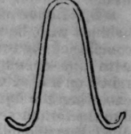
Fig 5.
3098. A square piece of filtering, or stout blotting-paper, is to be doubled, and the oblong so obtained is to be again folded in half, when if the last fold is opened, it will have the appearance of Fig. 6. From the corners b b, folds are to be creased in the direction towards a, but not reaching it for half an inch; these are indicated by the dotted lines, which divide the doubled paper into four triangles, each of which is to be again folded into eighths, and care must be taken that all the folds are made the same way that is, projecting to the same side of the paper. When complete, the doubled and creased paper will appear as in Fig. 7. Now divide each eighth in halves, by a fold in the opposite direction to
Continue to:


My Books

