


3085. Decanting, Straining, And Filtering Of Liquids. Part 3
Description
This section is from the book "Facts Worth Knowing", by Robert Kemp Philip. Also available from Amazon: Inquire Within for Anything You Want to Know.
3085. Decanting, Straining, And Filtering Of Liquids. Part 3
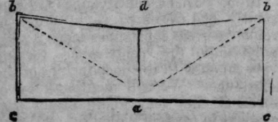
Fig. 6.
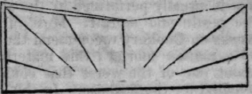
Fig. 7.
those previously made, when it will be found that the whole will readily fold up like a paper fan; the projecting loose ends which are formed by the corners b, should be cut off, and the double sides separated for the first time by blowing them apart, when the whole may be readily opened out as in Fig. 8.
3099. In making this filter, which takes a much less time than to follow the description, two precautions are requisite. The folds should be made at once with one firm pressure, and not with a series of rubbings; and all the creases should stop short of the middle, other wise a hole will be made at that point long before the filter is completed. The advantages of this filter are, that it exposes a large surface for the liquid to pass through; and from its only being in contact with the funnel where the angles project, the current flows away readily.
3100. The best means for filtration of water, and the construction of water filters, will be treated of when we speak of the "domestic manipulation" connected with that liquid.
3101. Dividing, Powdering, Grinding, &.c - The operations of chopping, powdering, grinding, etc, are so frequently required in cooking, and the other branches of domestic economy, as to render any description of their utility wholly unnecessary; and we may therefore confine ourselves to describing the best means of accomplishing the object desired. Powdering is usually performed by the aid of the pestle and mortar. Most of the works on Cookery recommend the use of a marble mortar; this material is about one of the worst that could be selected for the purpose. In the first place it is expensive; secondly, it is rapidly corroded, even by the weak acids used for food; thirdly, it is readily stained by oily substances; fourthly, it is absorptive of strong flavours, imparting them readily to the next substance pounded; and lastly, it is brittle, and even if not broken, is not calculated to withstand much wear. By far the best material for the purpose is the wedgewood ware; mortars made of it are cheaper, cleaner in use, and stronger than those of marble, and are not corroded by acids or alkalies - their pre-eminence is so great, that they are invariably used by druggists.
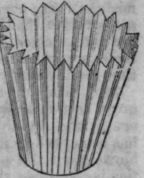
Fig. 8.
3102. The act of powdering requires great tact and practice to perform it neatly and rapidly. After the object has been broken into small pieces by blows from the pestle, a grinding action is required; this should at first be given by striking the fragments, not in the centre of the mortar, but towards the side furthest from the operator; the pestle, by this means, grinds over them in its descent to the centre, and much more rapidly accomplishes their division than if mere blows are given. After the object has been divided to a certain extent, blows are entirely useless, and a grinding in circles becomes requisite; if the circle is confined to one part of the mortar, the same portions get rubbed over and over again, the others escaping; this is avoided by constantly and regularly altering the size of the circles.
3103. If they are commenced in the centre, they should gradually increase in size until the sides are reached, and then contract again, and so on. By this means the whole of the powder is brought under the action of the pestle, and the operation is much quicker than if performed at random. One great fault usually committed in powdering, is the endeavor to operate on too large a quantity of material at one time. The operation is much more rapidly conducted if small portions are taken; and if the material is tough, and contains much fibrous matter, the process may be very much shortened by removing those parts which are sufficiently powdered, by sifting from time to time through a sieve. This may be objectionable, however, from the fine powder escaping into the air; in this case, the following contrivances will be found useful:
3104. A cylindrical tea-canister of the requisite size is taken, with a loosely-fitting lid (or if tight, the lid may be enlarged by four slits being made partly up the sides); a bag of lawn is dropped into the canister, the top being turned over the edge; the powder to be sifted is put in the bag, the lid put on, and by tapping and shaking, the finest portions pass into the canister without any escaping into the air - a point of very considerable importance where the powder is irri-tating or expensive.
3105. Various contrivances are con stantly had recourse to, in order to render certain substances more readily pulverable, the contrivance varying very much with the peculiarities of the substance. We will mention a few of these, as they may afford useful suggestions in cases of difficulty. All vegetable, and many mineral substances, are much more readily powdered after having been thoroughly dried; so far is this process carried, that many drugs are dried so as to lose fifteen per cent, of their weight before powdering. In proof of the utility of the drying, let any person try to powder a piece of whiting as it comes from the oilman's; it will be found to cake together, and be not readily powdered; if dry, however, it powders with the greatest ease.
Continue to:


My Books

