


3085. Decanting, Straining, And Filtering Of Liquids. Part 4
Description
This section is from the book "Facts Worth Knowing", by Robert Kemp Philip. Also available from Amazon: Inquire Within for Anything You Want to Know.
3085. Decanting, Straining, And Filtering Of Liquids. Part 4

Fig. 9.
3106. After drying, substances should not be exposed to the air, but, unless they are of sueh a nature as to be softened by heat, are better operated on whilst still warm. Flints are more readily powdered by being heated to redness, and quenched in cold water; charcoal, for tooth-powder, whilst still warm from drying. Gum can only be powdered whilst perfectly dry. Camphor, which is with great difficulty powdered alone, yields readily if a drop or two of spirit is poured on it. Substances which clog together and cake under the pestle, are not uncommon; to these it is sometimes requisite to add sand, which may afterwards be separated-this prevents the clogging; but its use is often impracticable. Lime, if required in very fine powder, for dusting over plants to kill slugs, etc, is readily obtained by slaking it, when fresh burned, with boiling water; when, if too much water is not used, it falls into an exceedingly fine powder.
3107. Sal ammoniac, and some other saline bodies, are most readily powdered by dissolving them in as small a quantity of boiling water as possible, and stirring the solution rapidly as the water is boiled away, or as the solution cools. Before dismissing the pestle and mortar, we may allude to its use in mixing powders together, although a much more ready mode of doing this is with a sieve. Two or more powders stirred together, and passed two or three times through a sieve, are much more intimately mixed, than if rubbed for a long time in a mortar.
3108. Metals cannot be divided in a mortar; the most convenient mode of proceeding, if they are fusible under a white heat, is to melt them, and pour them whilst liquid into a pail of water, which should be lull, to avoid any spluttering, and the hotter the metal, the more filmy the particles. It is scarcely requisite to state, that the metal should be poured in a circle, so as not to collect at one place.
3109. Chopping is usually performed in the kitchen, with a large common knife; but is more speedily done by some of the improved contrivances similar to the following: The chop-ping-board should be made of hard wood, with the grain at right angles to the surface of the board, by which it is rendered much more durable than if they are parallel to it. The chopping-knives should be fixed at right angles to the handles, and may be either of the following patterns. If a large quantity of material has to be acted on,
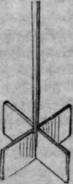
Fig 10.
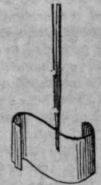
Fig. 11.
we would recommend a board as above, not less than three inches thick, and smooth on both sides, so that either may be used, of the requisite size - say eighteen inches or two feet in diameter. On this should stand a loose bottomless tub, to confine the materials, and the whole resting on the floor, should be used with a knife, sufficiently long in the handle to be employed by a person standing erect, and it should have a small cross-bar for the hands, as shown in Fig. 12.
3110. Small chopping-knives are sold consisting of three blades rivetted to gether, and a very convenient one is made by fastening, at convenient distances, a number of flat circular disks sharpened at the edges, on to a central axis with a handle at each end.
3111. Many substances, such as stale bread, dried herbs, etc, may be very conveniently powdered by rubbing them through a wire sieve, of the requisite degree of fieness. Herbs intended for use in this way, should be dried as rapidly as possible, without being scorched, in small heaps, before the fire; parsley and others done this way, may be powdered, retaining their bright green colour and flavour, both of which are preserved if they are corked tightly in bottles, and kept in a dry, dark cupboard. The use of waxed paper to preserve dried powders in, or for tying them down in jars, or generally as a very good substitute for bladder, will often be found convenient. It is readily made by laying a sheet of smooth stout paper on a warm iron plate, as the top of a kitchen oven; on this place the thin tissue or other paper to be waxed; put a piece of wax on it, and as it melts, rub it over, spreading it evenly. One end of a cork, covered with two thicknesses of linen, answers very well for a rubber. If a hot plate is not at hand, the sheet of paper may be held before the fire, and rubbed over, as it warms, with the cut edge of a cake o." white wax; but this requires the co-operation of two persons.
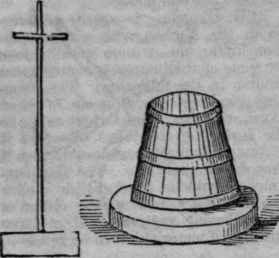
Fig. 12.
Continue to:


My Books

