


Advice To Beginners. Continued
Description
This section is from the book "The Art Of Golf", by Bart W. G. Simpson. Also available from Amazon: The Art of Golf.
Advice To Beginners. Continued
In the laudable endeavour to drive far (and no man should ever accept the position of a weak player), the beginner has to stumble through many errors before mastering the secret of where and how to apply his force. There is one the beginner is certain to fall into. In order to get a good sweep at the ball, instead of causing his trunk to revolve on its own axis, he sways it back'over his right leg. One feels as if tremendous force were acquired in this way. So there is, but of the wrong sort - slow, ponderous, clumsy. Even a ball clean hit, and getting the full result of this swaying motion, does not go far. But it seldom is hit, and no more wonder than that it should be missed if struck at whilst the player is walking. Swaying thus is a standing walk, a term which may be objected to, although it ought to be as intelligible as the accepted phrase, a
' standing jump.' It is perhaps as well to advise young golfers to have both hands close together; at all events, it is but fair to warn them that every inch which separates them takes ten yards off the length of their shot.
These few hints are ample theoretical equipment for many months. But the beginner will get many more, to which I advise him to turn a deaf ear. Every old hand will be anxious to persuade him that his own last crotchet is the one thing needful. He will be told that the great point is to keep his hands tight, or not to keep them tight, or one slack, his elbow in, or his elbow out, to let the club follow the ball, or his arms follow the ball, etc. etc. Naturally he thinks these people know. He tries one and all, getting as confused as if he were selecting a new religion. The fact is, there are more bad teachers than good, and if the beginner must have advice, let him consult a really first-class player, who will probably tell him he knows nothing about grips, or elbows, or following, and that all he has to do is to stand firm and smite hard.
If the beginner is liable to be confused by his friends, his danger is much greater from his caddy. The former only give advice when it is asked, the latter volunteers it, and insists. There are such things as good professional coaches. On the whole, it is better not to allow your caddy to interfere. Most of them advise a thousand and one things within the hour. They feed babes with strong meat, and expect to, or at least try to, make them full-grown golfers within an hour. Besides things good enough in themselves if they could be digested, two pieces of advice which they mostly insist upon are positive poison. One, already spoken of in the last chapter, is that the player should rise upon his left toe. The swing not yet being so full and free as to tear the heel from the ground, by acting on this advice the beginner is simply left with a few spare inches of leg which he does not know what to do with. He may double them under him out of the road, but most likely he will use them to sway his body away back over the right leg, his caddy thus actually encouraging him to commit this common and fatal mistake of beginners. The other is, insisting on the right thumb being over, not on, the club. If (which is likely enough, as we have seen) the beginner is holding his club as uprightly as possible, both hands too much under the club, it is absolutely impossible for him to strike at all if he obeys. His grip well over, he may do it; but ought not to unless it is natural - perhaps not even then, as at this early stage it foreshadows an intention of driving with the wrists, and opens the way to these wanderings of the club round the hack - these so-called long swings of which I have already said a good deal.
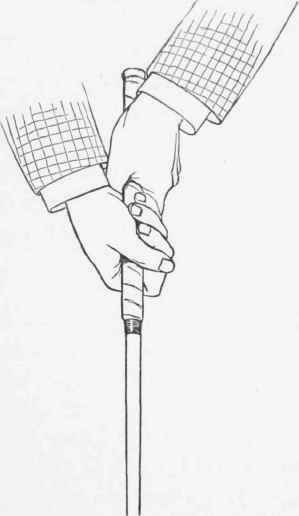
Fig. 10. - Unequal Grip, right hand ' under."
Leave the thumb where it is. By degrees, if the player allows himself to acquire his art without prejudice, it will slip into its proper place, getting out of the way to allow a fuller swing. But at first it is needed to guide the stroke, and if not allowed to be used, the beginner will effect his purpose by some other means, perhaps burying his club in his palm so as to work with the end of the second joint instead of with the point of the thumb. This inevitably 'turns in the nose' of the club, and it breaks. His faith in his caddy costs many a beginner much money and many sad rounds, in which his set gets reduced to some irons and some headless shafts. It is lucky for his golf if in the end he rebels against the oracle. If he does not, his grip with the right hand is a difficulty ever after. It remains twisted, and to do any work at all, the body and legs have to twist too. For some time the beginner (I am speaking of men, not boys) makes marked and regular progress, until suddenly one day there is a break-down, which crushes his sanguine hope that his march towards perfection was to be smooth and rapid. It is the first of many which will occur from time to time so long as he is able to hold a club. To avoid them altogether is impossible, but their number may be lessened, their severity checked, by wisdom and care. When the beginner is getting on swim-mingly, let him not be carelessly confident, for pride goes before a fall. Nor when his driving is very satisfactory ought he to attempt to note what he is doing, so as to be able to return to it if a relapse occurs. This in itself is the beginning of backsliding. Golf refuses to be preserved like dead meat in tins. It is living, human, and free, ready to fly away at the least sign of an attempt to catch and cage it. It will confute your logic if you, as it were, stand aside and try to produce it by causes. With patient attention to hitting, not relaxed even when we are in the full pride of good play, our relapses will be fewer and less severe; but there is no means by which we can secure uniform progress. In proportion as the wave of advance is great, so will be the back draught. Let not the learner be discouraged by it, and begin to doubt lest the tide has turned. Golfers often speak of their game. The best the learner has ever played is his game, even supposing it is a third better than what he has relapsed to. It will come again soon, unless, indeed, he begin to ask, 'What am I doing wrong?' 'How did I stand?' 'I low did I swing then?'
It is impossible to say how good a player a man may become; but every beginner ought, as much as possible, to play with better golfers than himself. He will unconsciously by that means aim higher. It should be his ambition to beat somebody, and, having done so, to attack a still stronger adver-sary. Many half-crowns will be lost in the process, but what of that? It is cheaper and pleasanter than to employ a professional coach.
In the early manhood of his golfing-life, the earnest and promising player's mind is apt to be much exercised as to the weight, length, lie, and spring of his club. He will feel sure that a best club for his style is to be found, and to find it will for some time appear a matter of the last importance. After many experiments, he will be in possession of a mass of conflicting evidence, and a box full of clubs more remarkable than useful. From extreme hope and faith he will fall back into a condition of dogmatic unbelief. He will try to use any club - even the rubbish accumulated in his days of faith. Truth lies between these two extremes.
In the matter of lie, a tall player's club ought to be upright, a short man's flat. The reason is that for all sorts and sizes of men about 3 feet 6 inches is the proper length. That a longer club will not drive further, that a shorter one drives as far, is proved to be true. Theoretically, the long club reaches the ball with greater velocity, but as each inch adds to the difficulty of being accurate, it has to be taken easier. It is not your strong man who can wield a long club; on the contrary, it is your pocket Apollo, whose long driving is
ADVICE TO BEGINNERS. 9l due to precision and neatness. An exceptionally short club, on the other hand, can be, and instinctively is, swung with much more force. The objection to their general use is that they break a man down, not so much from the fatigue of overexertion as from the loss of self-control which results from it.
As for weight, so long as the specific gravity and the absolute weight of the head are both greater than these qualities in the ball, the carry will not be affected. Within these limits the lightest club will drive the longest ball, because it can be swung more swiftly than a heavy one (with what lightning accuracy one sweeps off daisy heads with a walking-stick !). The danger with a very light club is that muscles having so little strain are apt to grow frisky and wanton. Theoretically, therefore, a heavy club ought to steady a wild, pressing player. It does not do so. It ought to act as a bit in his mouth. He takes it in his teeth. Practically, the golfer with an ambition for lead handicaps himself terribly. He cannot play easily in proportion to the weight of his weapon, for part of his ambition is sure to be to drive a long ball. This he will do occasionally; but he must hit perfectly clean, or else make an egregious foozle. There is no reserve force in him if he sclaffs. His club sticks in the mud, or is twisted out of his hand. To avoid the ground he is apt to top. Sometimes, when he does hit clean, the club runs away with him to the right or left. And all this on account of a crude, erroneous idea that the heavier the club the further it will drive. It is a mistaken idea, otherwise the man who could swing a 16-lb. hammer would beat the record. It is evident that even Goliath would have made a very feeble shot with such a club or with his own; but with a Philp he might have outdriven the champion.
The spring of a club has more to do with comfort than with carry. Nobody likes stiff shafts. Many charges are laid at their door; the only just one is that they jar the hands. Each man will drive, not further, but better, with the club he likes best. A ' fozy' handle will do very well if you have a sweeping', scythe-like swing. If your style is jerky, such a shaft, or one with the spring under the rind, will prove itself useless to you at once; the club or the jerking must be abandoned. For all kinds of forcing players (those who let in when they get to the ball), the spring must be confined to the neighbourhood of the skeer. If you wish to compel yourself to drive easily, buy a 'wabbly' club; it will either teach you or top your ball. It is pleasanter, however, to play without a master.
ADVICE TO BEGINNERS.
In short, my advice is - use a stiff club, whatever your style, with just enough elasticity to make the ball go off sweetly, and give up all idea that spring here or spring there will make you drive further. If you don't want to abandon this notion, no matter. Your club with an ideal spring may drive further on account of your confidence in it.
Continue to:


My Books

