


Chapter III. Advice To Beginners
Description
This section is from the book "The Art Of Golf", by Bart W. G. Simpson. Also available from Amazon: The Art of Golf.
Chapter III. Advice To Beginners
The beginner who has read the foregoing chapters will be apt to re-read the first sentence, and to agree with those who complain that accuracy is almost impossible with so many things to remember; or, if he sees that it is not intended he should think of them all, he will still be puzzled to understand which are the elementary, which the more advanced, instructions. Accordingly I propose in this chapter (even at the risk of some repetition) to write a little sermon for the young player.
Let the beginner shake himself down naturally before the ball, and hit. Till he has done this for a good many days, no advice has either use or meaning. During this first stage it is probable that he will be quite delighted with his driving, and with good reason. His attention being entirely directed to hitting - his curiosity about how to hit not being so far aroused - he makes good shots. In many respects a man naturally attacks the ball in the proper way. He stands up, stands firm, docs not force; and although his swing is of course stiff, it is not artificial. From the very first some players, however, make the mistake of treating the ball as a heavy object, whilst in reality it has, for practical purposes, no weight, and ought to be swept away, not jerked. In a bunker or a hard hole it becomes heavy, and nothing will do but a jerk; but from the turf the problem is to shave it cleanly off. Again, early cricket, and many other games with balls, start most beginners on their golfing career with a wrong grip. The handle of the club is opposite the third waistcoat button instead of being as low as the length of the arms naturally let it go. They wish to drive as much in cricket form as the shape of the club will allow. Not that any one thinks of literally golfing with a straight bat. They are freed from that restraint, and enjoy swiping across the wicket. But this cannot be allowed. A bad cricketing style is not a good golfing; one. The beginner must learn that golf is the very opposite of cricket, that he must get his hands as much down at it as up at the other. He must use his club like a scythe; must sweep, not strike the ball. In my opinion the extent to which the player gets his hands over the club cannot be exaggerated. To have them well over is a sine qua non of an easy style. Beginners and others do not like the position until they have proved it, until patience and experience convince them that the grip which is most convenient for catching the ball a hammer-like thud is not the best either for far or sure.
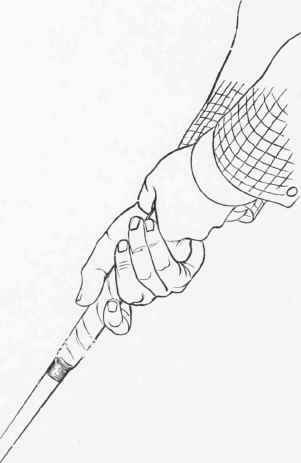
FlG. (8. - Hands too far ' round' or ' wider.'
I say, 'until they have proved it.' Lucky for them, if they ever do. A very large percentage of players live and play and die with their knuckles pointing too much towards the ground, with the club at too obtuse an angle with their arms, and consequently without the possibility of ever having a perfect swing (Figs. 8 and 9). Seen from the front, a perfect player's arms and club appear at the angle to each other shown in Fig 6. Imperfection lies between that and a straight line from shoulder to club head. Why getting the knuckles too far round is so common, so almost

Fig. 9. - Hands too far ' round' or ' under.
/ universal (see Figs. 8 and 9), is (besides that it gives the hammering power already referred to) that it prevents the wrists being used, and leads quickly to fairly steady driving, whilst the true position enables them to be employed, with consequent feeble and uncertain hitting. I would therefore strongly impress upon beginners the advisability of having their hands well over the club - of becoming steady by keeping their wrists taut, rather than by so gripping the club that their joints cannot bend. I say ' hands.' It should rather be ' hand ' - the left hand. The right will look after itself. If the tyro acquires a grip which prevents him seeing his left knuckles, and which shows him instead more than the first joints of his fingers (compare Figs. 7 and 9), if his club handle point to his waistcoat instead of well below that grarment, there is no reason why he should not become an effective, but he never will be a pretty, driver - a true, full style of the orthodox sort is impossible. The fault must be compensated by either a short, a broken, an overhead swing, or by some other modification, pronounced or slight in proportion to the cause. Let any one grip in this way, swing a club back to his shoulder, examine the constrained position of his right wrist, and he will see that one of these things is inevitable.
If he acquire a grip as in Fig. 10, it would be hypercritical to interfere As I have said, great latitude may be allowed to the right hand in this matter, particularly if it grasp loosely. But should any one be so misguided as to hold disproportionately in the opposite way that is, with the right hand over and the left under - farewell to all chance of even passable driving.
It is not generally till after the first week that the golfer begins to think about his game - to wish to know how it is done, in order that he may improve. With these inquiries his troubles begin, and let us hope that, with patience and common-sense, he will get through them without crippling his style,
He will soon hear on all sides, 'Keep your eye on the ball.' Of course one must see the thing which is to be struck; but it is a mistake to insist upon it as if it were very difficult. If the beginner glares at the ball too determinedly it will mesmerise him, so that the hammering will be a distraction, and cuts from former tops appear to be fatuous mouths smiling derisively.
Then it comes to be a question with the beginner whether he ought to go in for a full or for a half swing. If he must have an answer - if he must have a name for, and an ideal on which to mould, his blow, let it be a half swing. It will be some time before his unpretending thump can be classed at all; but no matter. It ought to be more like a half swing than anything else; it will grow into that, and from that into a full one, unconsciously, as the fetters of awkwardness fall from his limbs; but if he try for a full swing at once, he will not get it, - he will merely acquire the habit (difficult to correct later on) of allowing his club to wander aimlessly about his back and shoulders.
Continue to:


My Books

