


Chapter IX. Of Putting
Description
This section is from the book "The Art Of Golf", by Bart W. G. Simpson. Also available from Amazon: The Art of Golf.
Chapter IX. Of Putting
To the beginner putting seems the least interesting part of the game. It feels mean to go dribbling and creeping up to a little hole, whilst a teeing-ground, from which you may drive the ball unknown distances into space, is ready close by. The rabbits in the bents mock at it, rushing into holes of about the same size at headlong speed, and with perfect ease. Like other things, essentially foolish in themselves, such as preaching, pleading, feeling pulses, etc., putting becomes attractive in proportion to the skill acquired in it. The young player will tell you that he cannot putt a bit, as complacently as mankind in general compliment themselves on having bad memories. Not so the experienced golfer. His putting is a feather with which to tickle his lug.
That putters, like poets, are born not made, is a common fallacy which prevents many from becoming masters of the art. It is also a general opinion that to putt you only require to putt, and that there is nothing easier than to do so with the middle of the club. If you heel, toe, top, or draw a putt, you are accused of gross, wilful carelessness. The miserable man whose driving has gone wrong sets to work to amend his style. The putter at fault blames himself for not using his eyes more carefully, or else he gives up for the day, on the ground that his liver is out of order. There is here a fallacy. I do not say that one ought not to consider a semi-miss with a putter wicked, but it is not worse than the same crime with a play-club - nay more than failing to thread a needle is clumsier than missing a nail with a hammer. Nay, in my opinion, it is not so bad. Of the two, to hit clean with a driver is the easier operation. With the latter the main thing is to lay on. There are fifty styles in which this can be done, whilst, with the former, there are at most two or three.
Plate XIX.
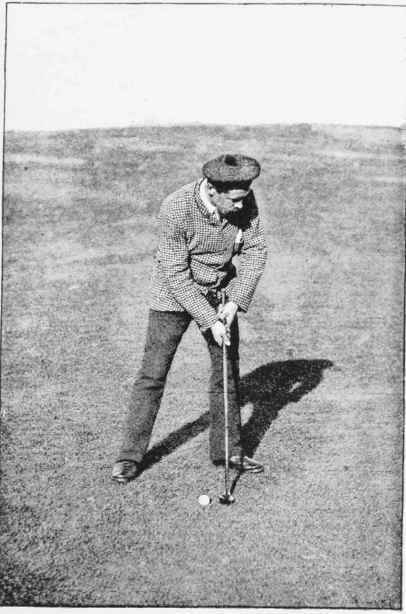
PUTTING ( 1 ).
Plate XX.
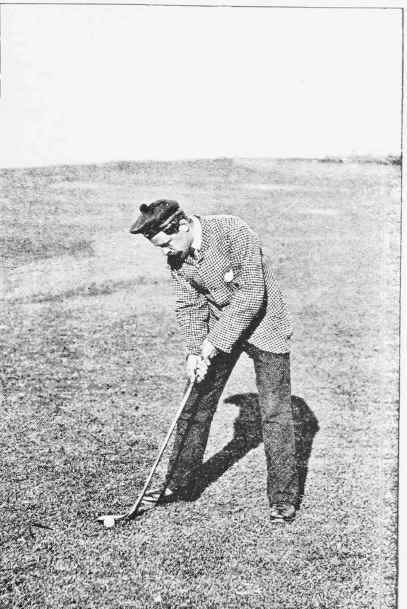
PUTTING (2 ).
Besides, for putting, a well-balanced club is absolutely essential. I am inclined to go further, and add that it must be made of wood. It is true that some hole out wonderfully with cleeks, others even with irons. But, by the shade of many a lost match, they are bad when they go off! Many men always putt with wood; few, never. The user of iron admits the inferiority of his weapon by carrying a putter to fall back upon when his fancy club fails him.
I have just said there are, at most, two or three attitudes in which good putting is possible. I am inclined to be more dogmatic, and to assert that there is but one. The player must stand open, half facing the hole, the weight on the right leg, the right arm close to the side, the ball nearly opposite the right foot. To putt standing square, the arms reached out, is as difficult as to write without laying a finger on the desk.
The idea that a putt is merely a shorter approach shot is one which must be got rid of. Approaches are played with a swing, longer or shorter, according to distance. A putter is not swung, but passed over the ground. It is a common thing for a professional caddy, under special circumstances, to put an iron into your hand near the hole, and to say, ' Play as if you were playing with a putter.' Those who apprehend the shot know that they are to give the ball a sort of push. Many players, however, putt with a swing. It is necessarily a very short one, and they are popularly described as 'nipping their putts.' From start to finish of a properly played putt there must be no free play of muscle. The putter must be guided all the time it is in motion, as much as the artist's pencil in drawing a straight line. In time, and by practice, driving may become partly mechanical, and balls be clean hit almost unconsciously. You may become a driving but not a putting machine. Matter can be fashioned into a clock, but not into a portrait painter. It is because: holing-out is a human act that none ever become infallible for even the shortest distances.
Within narrow limits there is a choice of styles of good putting. It may be done entirely from the wrist, from the shoulder, or by a combined use of all the arm-joints. It matters little which of these manners be adopted, so long as it is adhered to and persevered with in prosperity and adversity. But, however old a player you are, however good in other respects, if you are putting with a jerk or swing, a fresh start would be worth while.
A great secret of steady putting is to make a point of always 'sclaffing' along the ground. The best putters do this, although it is not evident to an onlooker, the noise of the scrape being inaudible. To be sure of the exact spot on the putter face which is invariably to come in contact with the ball, is, of course, essential to the acquirement of accuracy. If you play to hit clean, your putter must pass above the ground at varying heights, as it is impossible to note how much air there is between it and the turf. In the other way you feel your road. But the greatest gain from treating putting as a sclaffing process is the less delicate manipulation required when short putts are in question. At a foot and a half from the hole the clean putter often fails, from incapacity to graduate inches of weakness, whilst the sclaffer succeeds because he is dealing with coarser weight sensitiveness.
Although every golfer theoretically accepts it as politic to play for the back of the hole, yet few putt as if they thought it was. The majority treat the hole as a place more difficult to get into than it really is. They seem practically to believe that a putt one ounce too strong, or one hair's-breadth off the line, must be out. Consequently many short putts are played so timidly that they are six inches off the line, or within six inches of the goal. Now the fact is, that (from short distances) the hole is pretty big, and from all distances it is capable of catching a ball going at a fair pace. I admit that more putts of over two yards must be missed than are held, because a putting-green is not a billiard-table; but many more would go in than do if players credited holes with a little of that catching power which they really possess. Some one says I mean nothing more than that a putt should be played ' for a foot past,' as the caddies advise. I do mean more. I object to that phrase. It should stand ' Play to be in and at the proper pace - namely, so hard that, if straight, you are in; if not straight, that you will be, not one, but two feet past.' With this faith in the hole, putts of a yard or under are very easy. Any pace between what will take the ball the exact distance, or two feet past, will do. Practically, in other words, the player does not require to think of the pace, and can give all his attention to direction. The putter who plays thus boldly has much to endure in the way of persecution and ridicule. If, from a distance, he strike the hole and fall in, it is called a fluke. His short putts are laughed at as gobbles. He is assured that had they missed they would have been out of holing. There are two answers; first, they do not miss the hole; second, if they did, they would only be out of holing for the dribbler who sneers at them. It is the inveterate practice of dropping putts over the edge of the hole which makes it necessary to discuss and study the line so carefully, and causes the power of calculating the effect of the minutest undulation or obstruction to be highly necessary. A man whose habit it is to play for the back of the hole at all times will seldom have any difficulty about his line. He will not require to crouch down and take note of obstructions which are scarcely visible. Anything that will turn his ball aside, and compel him to play with bias, will be visible to the naked eye. There will be no need to settle whether he is to take his caddy's line or his own - whether he must start an inch to the right, playing weak, or two inches to the left, playing weaker, or off the heel, or off the toe. Of course, it is very pretty to see a ball meandering into a hole; but, in most cases, it is quite an unnecessary treat, given gratis to the onlookers. Consulting with caddies has much to do with each putt being treated as if it were a thing by itself. If their advice as to the line and strength be followed, and the putt comes off, it is supposed (and they like it to be supposed) that there was no other way of doing it. Naturally, too, they do not advise the easiest way. A roundabout road is more interesting to them, and adds, moreover, to their importance. The simple-minded caddy, who always sticks down a pointer in the direct line between the ball and the hole, is credited with doing so from lack of understanding of lines altogether. But his advice is nearly always the soundest.
Continue to:


My Books

