


Of Approaching. Part 4
Description
This section is from the book "The Art Of Golf", by Bart W. G. Simpson. Also available from Amazon: The Art of Golf.
Of Approaching. Part 4
A style of approach often employed is running the ball with the iron, either along the ground, or very little above it. When this is attempted, it is customary to turn in the club face. By so doing, the player gets the sentiment of his intention; but that is all. The turning of the iron alone will not run a ball. The essential thing is that the player be well over the ball, and his hands slightly in advance of it - in fact, just as far from the 'juste milieu ' at one side, as they are at the other when he attempts to ' lay back ' the iron. (See Plate XVI.) It is necessary to point out that the position of the hands, not the turning in of the club, is the essential thing in this shot, because, although doing the latter inclines one to the former, the one is quite possible without the other. (Let me observe parenthetically that merely turning the toe of a club, in or out, is of no effect in any shot, except to convert a properly made tool into a bad one. Placing the club out of its proper position is simple folly, unless it be part of the result of the mode of address, not an isolated contortion.) Our player, then, has taken his position for a skimming approach. His hands are well in front, the club face turned in - not to keep the ball low, but partly because it now naturally lies that way, partly because that way of resting it makes it a more upright club for the nonce - and uprightness, we have seen, is conducive to low trajectory. A common mistake is now to jerk - the thing, of all others, which ought not to be done. Jerking raises a ball. The club should rather be dragged, the wrists rigid, the grip excessively firm. From rough ground near the hole, or on a bad putting-green, this shot is very useful. Many prefer it to an ordinary loft at shortish distances, the latter being more difficult within, say, thirty yards than when the player has further to carry. There are some who employ it for all approaches, and with good effect too. These you may recognise by their stance, which is often square or even in front.
Plate XVI.

RUNNING IT WITH AN IRON (1).
Plate XVII.
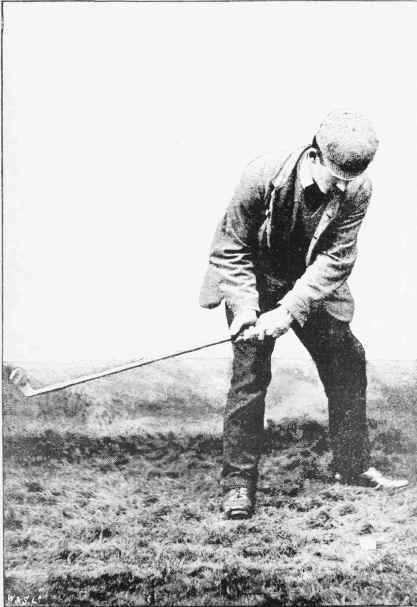
RUNNING IT WITH AN IRON (2 ).
There are four clubs used for ordinary approach work - the putter, the cleek, the iron, and the mash)-.
The first, of course, can only be used on very flat ground. Long putts, and the putters thereof, are much despised. A putt of sixty yards laid dead causes anger or laughter, according to the temper of the adversary. But I am bound to say that those who are well practised in ' skelping' often call forth the exhibition of one or other of these forms of emotion. The worst of this mode of approaching is that, sooner or later, it undermines the constitution of the most delicate and valuable club in the set; whilst to carry two putters - one as a whipping-boy - is unwise. They cannot be made exactly alike, and, even if they are nearly so, hesitating between the two at intermediate distances is apt to put a player's putting powers out of gear.
Cleek approaches do not lay your respectability open to doubts like long putts, which have the same odour of meanness as the ' sneak' of boys' cricket. Although for the most part low, they are not absolutely crawling things. They have one distinct advantage over iron approaches. The cleek, lofting low, can be used at greater distances than the iron, thus bridging over that rather wild country which lies between a full cleek or spoon shot and the approach proper. But the cleek has little else to recommend it as against the iron, which, played with equal skill, is in most circumstances more effective. The least hillock will catch and kill a cleek approach, whilst, even in the absence of such obstructions, the run at the finish is necessarily so long, that the chances of stopping or turning bumps are greatly increased. Some people will object that there is as much chance of a lucky as of an unlucky fall. This is not so. Nature does not smile upon golf. Being inanimate, she is more apt to oppose obstruction than to further motion. The cleek approacher is consequently proverbial for grumbling at his luck. When the worm cast turns his ball, he is the worm that turns. Moreover, the trajectory of a cleek shot is so low, that the least shade of top will prevent the ball from rising at all, and then it will cling to the ground and go half-way. From an iron, a shot one degree too low is still in the element it was meant to traverse, not in grass, which has double as much resistance. ' But my cleek is as much lofted as an iron,' is what one often hears. No doubt it is. Most cleeks are. It is not the difference of lay, but of shape, which governs their respective lofting powers. A cleek, to loft as high as an iron of the same lay, would require to be thicker on the sole than they usually are, and as sharp as a knife on its upper edge. Even then its height of loft would be very uncertain. The change in thickness of metal from below upwards being so sudden, a microscopic variation in the height of impact would materially alter the amount of loft. In short, it is the depth of face, not the lay, which causes the difference in execution between a cleek and an iron. Certainly a more lofted cleek might be used. But such a weapon would in no respect be better than an iron, and would have the drawback of all laid-back clubs, a subject already noticed.
For approaching, the iron is on the whole the best club yet devised, and the one most in favour with players. It is supposed to be a very difficult thine to get a good iron. This is not the case, although it is very common to see men owners of, and proud of, very bad ones, which vastly increase their difficulties in approaching. This is because they set their affections on a wrong style of club. It is usual to carry two irons - a heavy for driving, a light for approaching. This nomenclature sets men on the wrong scent from the beginning. The two ought to be called the driving and the approaching iron, without this (as I hold erroneous) dogmatic reference to their comparative weights. Whether a driving iron ought to be heavy or light, or whether it ought to be carried at all, is a matter for individual taste to decide. But there is no greater mistake than to have a light ' light iron.' To say what weight it should be is impossible, so much depends upon the player's style and build. Roughly, it may be stated, however, that an iron lighter than a driving cleek is simply a useless toy. Error in the direction of heaviness, whilst less common, would be less fatal. The lay of an approaching iron, as well as the weight, is a matter of importance. If too straight in the face, it either will not carry over bunkers and hazards, or else its owner will be led into a habit of jerking, in order to make it do so. On the other hand, a much lofted iron is very difficult to use. Unless the ball be struck with absolute precision, it either digs into the ground, or hits with its edge. A medium amount of loft is best. By merely looking at the club, it is impossible to decide whether its lay is right or not. An upright club for the same work requires more pitch than a flat one, experience proving that (as already insisted on) the more upright a club is the lower its trajectory. Again, the thicker the sole is in proportion to the top, the higher it will send the ball. The proper way to decide whether an iron has the right lay or not is to try it. If a half-topped shot travels further than a lofted one over ordinary turf, the club has too much pitch; if the opposite happens, it has too little. However pretty an instrument, to whatsoever great man it may have belonged; reject it, and pick a new one out of a shop.
Continue to:


My Books

