


Chapter VIII. Of Approaching
Description
This section is from the book "The Art Of Golf", by Bart W. G. Simpson. Also available from Amazon: The Art of Golf.
Chapter VIII. Of Approaching
When the player's ball is within less than a driver shot of the hole, approaching commences, and new qualities - the sense of weight, how to weigh it, appreciation of distance, etc., - are called into requisition. The least amount of difference between driving and approaching exists when the distance is still so great that a full shot from a cleek or an iron is advisable. Some players find it easier to drive with wood than with iron; but this is not because the latter should be wielded in a different way. The difficulty is either sentimental, or due to some false attitude of mind. A feeling that an iron club will sink into the ground, or the opposite view, that it is more capable of cutting through it, may incline a man on the one hand to top, on the other to puff the ball. A man's iron shots may go too high because he lays the club unnaturally back, or because, looking upon it as more powerful than a wooden club, he, intending to hit harder, swings too quickly, therefore too straight up and down, therefore lofts too high. These results are not clue to the clubs, but to the player's treatment of them. There is one real difference, however, between wood and iron. A golfer who is inclined to cut the ball will find his tendency to swerve to the left greater with the latter, probably because of the more polished face. Long driving with iron clubs is the result of clean hitting, as with wood, except sometimes in the case of beginners, many of whom congratulate themselves on what should be a cause of regret and a hint that something is wrong - namely, that they drive as far with a cleek as with a play club. This something is the possibility of treating the ball as a heavy object with a cleek, and so treating it effectively. A jerk with iron endows it with something of the elasticity of wood. But a jerker can never reach a first-class standard of steadiness. This will dawn on the beginner as he improves, and his jerks will be reserved for cupped balls.
Plate l X.
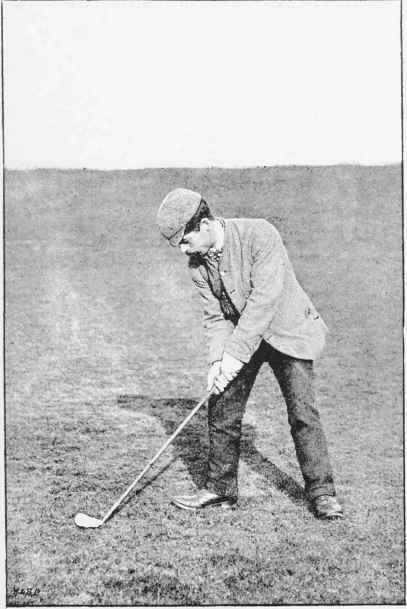
ADDRESSING FOR AN APPROACH SHOT.
The nomenclature of true approach shots - those requiring less than a full swing - is somewhat indefinite. Half, three-quarter, quarter, wrist shot, etc., mean each something- to players who employ the terms, but they have no generally recognised manner nor status. It cannot be laid down that if a full shot goes a hundred yards, a quarter shot goes twenty-five, etc. Nor is there even an approximate law regarding the number of inches the club ought to be drawn back in order to propel the ball an equivalent distance in yards. All that can be done is to give a few general hints as to how to do it, and how not to do it. The sense of weight must be exercised and cultivated by each player for himself.
One rule, without exception, is that no ball, however near the hole, should be played weakly. Even the shortest of all approaches - styme lofting - can only succeed if the ball is swept away, the grip tight, the muscles taut. A weak tap, however long or short the distance, will prove uncertain and disappointing. The length of swing, not the firmness of sweep, should regulate the carry.
The attempt to play an easy full shot is generally recognised as a mistake, and most men consider it wiser to cover the distance with a drive from a weaker club, or an approach shot from a stronger. When it comes to these last, however, the folly of attempting to ' spare ' is not equally acknowledged.
Longish approaches are sometimes attempted to be made by means of a half shot. That is to say, the player addresses the ball as in driving; but shortens his swing by getting his hands more under the club than usual, and by keeping all the joints above the diaphragm rigid. This mode of play is scarcely worth cultivating. I do not mean that those who always drive in this way and in no other, or those who, being bad at lull shots with irons, have adopted this style with them, ought to reform; but it is difficult to acquire as an occasional means for limiting the length of a drive. The muscles are apt to assert themselves in their usual routine, and a miss to result from the conflict of intention and habit. Nevertheless, half shots of this sort are frequently attempted with a cleek or an iron; but it is an indirect proof of their unsoundness, that no one ever seriously tries to play them with a driver.
Unless under exceptional circumstances, to be considered presently, there are thus only two proper modes of approaching' - by full drives from short clubs, and by what are called wrist shots. It will be found that the best players have no styles between these two. According to length of swing for various distances, they speak of quarter, half, three-quarter, or full approach; but these terms are used for their own convenience, and refer merely to longer or shorter shots played in the same style. A half to them means a half wrist, not the half spoken of in the last paragraph. Beginners and others ought clearly to understand that whilst they ought to have one style for driving", whether with wood or iron, successful wrist play is a new departure, and that effective approaches cannot be manufactured out of fragments of a full swing.
What, then, is a wrist shot? For one thing, it is a shot which ought not to be played with the wrists. Their usual name misleads many a beginner, and causes him to flounder hopelessly for years. To use the wrists alone is so neat, comprehensible, and compact an idea that he grasps it at once. He is conscious that using one set of muscles and joints alone, his sense of weight is more delicate. It will not take him long to learn, although it may be years before he is convinced that this is not the way to do it. It would be less confusing if approaches were called ankle shots. The ancients called them knee shots. It is to be deplored that, for no obvious reason, a term so tutorial became obsolete when baffys and feathers were superseded. Properly these joints are brought more into play than the wrists.
Continue to:


My Books

