


Of Approaching. Part 2
Description
This section is from the book "The Art Of Golf", by Bart W. G. Simpson. Also available from Amazon: The Art of Golf.
Of Approaching. Part 2
Without wishing to direct attention too emphatically to one point, it is nevertheless true that the left wrist joint has no part to play in good approaching, and must be rigidly restrained from taking any. Men who are masters of the iron may say this is nonsense, and of course they would spoil their play by keeping that or any other point too much in view; but it may easily be noticed that such persons do keep that joint rigid, even although many of them give a preliminary flourish. I say many; but also it may be noticed that, contrary to what is the case in driving, most do not. The rule is to put the club undemonstratively behind the ball, and at once to strike. To the tyro, then, if he is getting on well, I would say nothing; but if he is not, a perfectly stiff wrist will do much to reveal the secrets of approaching. Of course, too much attention to and misapprehension of this point (as of most golf secrets) may lead to faults. The player may make wrist-bending impossible by getting his hand under the club, or by laying the spare end of the shaft along his arm. He is also apt to tuck his elbows into his sides, and play as if they were strapped to his body, or, going to the other extreme in order to give his left arm free play, stick it out so far that the swing must be a slice. The proper position is easy - the left hand well over the club: there is to be no effort even if the muscles fail to do the work of bone. Probably an excised joint would not be missed. But it is effort, not elasticity of wrist, which would give the maimed man an actual advantage.
Plate X.
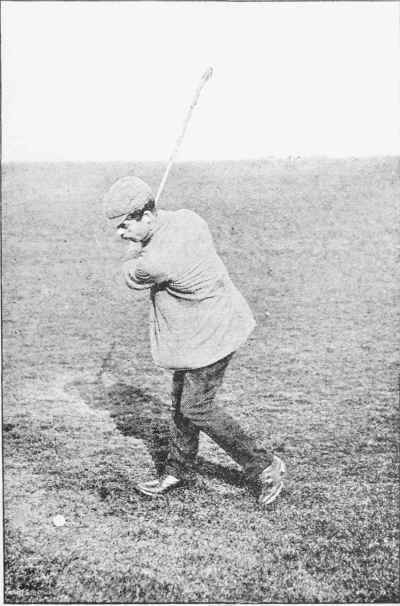
JUST WITHIN A WRIST' (1 ).
Plate XI.
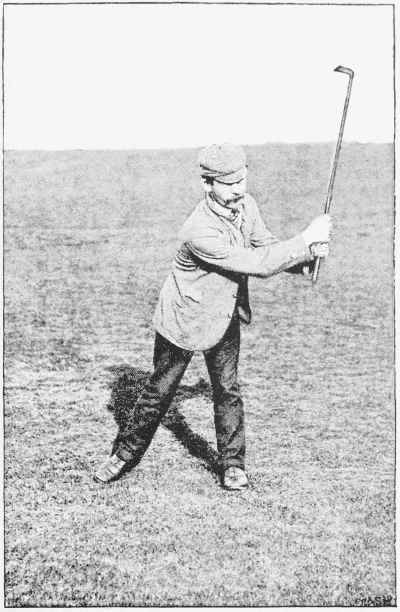
'JUST WITHIN A WRIST' ( 2 ).
As a rule, players talk and think more about the position of the right than of the left hand in approaching. They discuss whether the thumb ought to be down the shaft or over it, tight or loose. So long as the elbow is close to the body, these things do not seem to be matters of the slightest importance. Approachers of equal skill indulge in all the variations. Indeed, some are not constant to their own fancy, sometimes having the thumb over, sometimes down the shaft. As in driving, the position of the right hand is a point too much attended to, that of the left too little.
Whilst, as we have seen, in driving a good deal of licence is allowable in the matter of stance - some players placing their feet parallel to the line of fire, some with their back a little to it, some with their face - the last is the only proper position for approaching. One has but to take a club in hand, and the necessity for this will make itself evident. Let the experimenter actually pause after swinging back (say) two feet. Standing in the proper way, there will be no tendency on the part of the club to waver from its line. But let him stand square, or in front, and swing back the same distance: the position is stiff, and it is difficult to avoid describing a loop at the beginning of the return journey.
Assuming that the player has accepted the principle that the length of his approaches is to be regulated by distance of swing, he ought soon to become pretty accurate for distances from twenty-five to one hundred yards, one would think. Why men remain so uncertain is due to many causes. For one thing, they do not adhere to the principle. At short distances they are inclined to swing easily, which really means flabbily, and with a loose grip, or else to swing too little, and apply more force. At long distances they hit extra hard. Now, to acquire accuracy, it must be realised that at all distances the grip must be firm and the muscles taut; and that the ball will be reached with more impetus, and therefore hit harder for every inch the club is drawn back. The temptation to over-stiffen one's-self, and force for a long approach, can only be resisted by careful watching. There is a natural tendency to cover a little more distance by an ounce more of exertion - by quickening of the swing, rather than by an inch more of it - leading, if not checked, to a habit of jerking, which renders the regulation of distance impossible. This is a real difficulty; others are either self-made or due to ignorance. One of the latter, almost universal with tyros, is to attempt to scoop the ball up into the air. Nothing is more common than to see the face of the iron after the shot, held up as if for alms, whilst the ball is trundling along the ground. Let the golfer ever remember that it is the lie of the club, not a turn of the wrist, which is responsible for the loft. Some men can never make up their minds whether they intend to take the ball clean, or to shave off a little turf with it. Having made a good shot with turf, they regulate the swing accordingly, till (a foozle must happen sometimes, however one plays) they take too much, or make a good shot clean. It matters very little whether a player takes ground with him or not; but it becomes serious if he is hazy as to his intentions. Again, the custom of using sometimes a heavy iron, sometimes a light one, sometimes a cleek, sometimes trying to run the ball, sometimes to loft it very high, postpones the day when comparative certainty may be attained. What the player ought to do is to decide what club he will habitually use; whether he will take turf or not; note the height of his loft when he hits as he means to, and stick to this as his standard. This done, there ought to be nothing to think of, in nine shots out of ten, except the length of swing necessary to cover the distance, and accurate hitting.
The player who can make lofts from normal lies to within a yard or so of where he means, even although he foozles in complicated situations, overruns ticklishly-placed Bags, or fails to loft steep hillocks, is more effective than he who has as many styles, and as many irons, as there are holes in the green. A showy shot which comes off should be hailed as 'good fluke,' and its player ought to thank Providence instead of smiling round com-placently. Do I mean that one ought merely to thwack at the ball despairingly whenever it is in a difficulty? Certainly not. But if it seems feasible to play a fairish shot in a normal way, that is better than to attempt anything gaudy. If something exceptional must be tried, let it be as slight a modification as possible of orthodox play - let it be a deduction from it. Out of a cup one's natural inclination is to try to spoon the ball, from long grass to mow it, against wind to force it. The golfer ought to ignore cups, grass, or wind as natural features, reducing each to terms of yards. There are very few lies which it is not the best policy to treat in this way. So long as there is an even chance of getting the ball to within twenty yards of the hole by ordinary means, fancy shots ought not to be undertaken, for there is little doubt that the latter oftener fail than succeed. I do not mean that proficiency in the showier kinds of approaches is impossible. Many a player makes himself the talk of the green for a season by his marvellous power of lofting a ball so as to lie where it alights; but invariably the iron with which this is done breaks; or, in some other way, the proud owner of it loses his abnormal skill, and the last state of that man is worse than the first. His practice of approaching in the simplest way has been abandoned for this more fickle masterliness, and you see him topping, puffing, missing, with cleeks, irons, mashies, in the vain effort to strike out a new road to glory.
Continue to:


My Books

