


Of Approaching. Part 3
Description
This section is from the book "The Art Of Golf", by Bart W. G. Simpson. Also available from Amazon: The Art of Golf.
Of Approaching. Part 3
Plate XII.
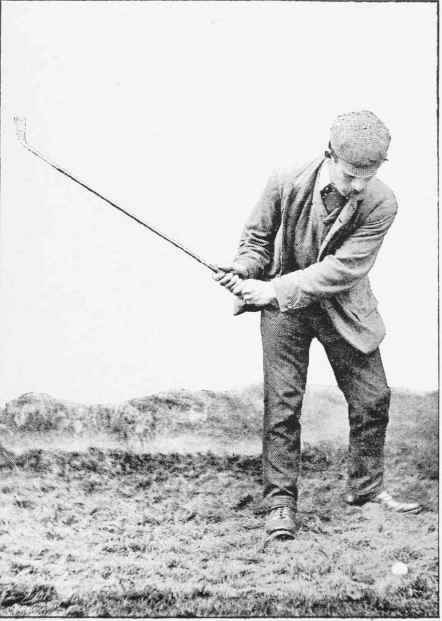
SIXTY YARDS FROM THE HOLE ( 1 ).
Plate XIII.
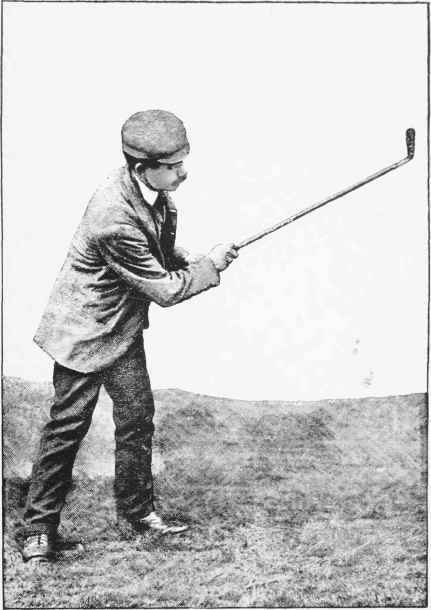
SIXTY YARDS FROM THE HOLE ( 2).
It may seem unnecessary to insist so much upon anything so self-evident as the necessity of adhering to one simple mode of approaching; but it is requisite, unless preaching is vain. The temptation to indulge in variations is almost irresistible. The devil seems to hover over the golfer, and ever to whisper in his ear, ' Try this,' or ' Try that.' He listens to the tempter. It would be so nice if he did chop it up in the air out of that hole, and lay it dead. ' It may rise,' he thinks, 'whilst it will only look like a fluke if it scuffles up within holing, played in the ordinary way.' He yields, tries, and odds are it goes but a few yards, eliciting the well-known cry of repentance, 'I ought not to have tried it.'
Take another case. The hole is just beyond a bunker. Playing properly, you must run past. The temptation to lay the iron back, or to put a spin on from the heel, or to deaden the tall by hitting off the point, or to employ some new system lately patented, is very great. That it is not the game is proved 1>\ the secret joy experienced when an adversary announces his intention of making one of these showy attempts. Even in a score game, six shots behind and three holes from home, the flames of hope begin to flicker in your sulky bosom.
Although rarer than golfers make them, there are occasions when fancy shots are worth trying. For instance, if a bunker is between us and the hole, danger beyond it, and no chance of even a half unless we are in in two, the ball must be lofted high or else spun. Some players, in these circumstances, use a lofted iron in the usual way, others try to lay back an ordinary one. Both shots are difficult; but, to my thinking, that with the specially made club is the riskier. It must strike the ball with absolute precision. If taken too thick, the shape of the club makes it dive into the ground, and puff the ball a yard; too clean, it will skim it a hundred yards with the force that would have lofted it fifty. Laying back the iron is not so uncertain if properly done. One way not to do it is to play an ordinary approach shot, the face of the club pointing upwards. A top is as certain as if, in driving oft the tee, you pose the lead instead of the sole of the play-club on the ground. Properly, the laying back is not done by rolling the club over on its heel, but by putting it on the ground in advance of the hands, and (this is the important point) drawing it back almost along the ground. So low must the swine be that if made full (which it never is for this shot), it would be round the waist instead of over the shoulder. In this shot the ball must be swept away, not cut or nipped. There will be a spin on the ball, but woe to the player who attempts to increase this spin with a turn of the wrist! There is no reason why great certainty in this shot should not be attained. Indeed, it is a favourite with many at from fifty to twenty yards, but its application is limited to clean lies, and lies in soft grass, as is the use of the lofted iron. It is useless to try it on a hard green, still more so from a bad lie. However tightly the club be grasped, the attitude is not adapted for forcing a ball. Attempted in a bunker, the result is almost invariably disastrous. A table-spoonful of sand is too much for the strongest arms. There is another fancy shot which differs utterly from the last except in respect of results. It may be played at all times instead of the other, whilst from a bad lie it is the only way I know of to loft a ball. In this shot the club is lifted more nearly straight up than in a normal one, crashing into the turf behind the ball. But there is more to attend to. Why many fail at this blow is that, when mother earth interferes with the completion of the segment of their circle, they submit. To succeed, the player must follow the ball, not in the same curve that he swept down on it, which is impossible, but as best he can. This best will be an ellipse. (See this shot illustrated, Plates xiv. and xv.) It is wonderful how beautifully the enemy will spout into the air. Among all these shots, which are loosely described as wrist-shots, this is the only one in which the wrists legitimately come into play. To get the club, as it were, round the corner, after the ground is reached, there must be a twist from them. The disadvantage of the shot is that, even from good lies, the distance is extremely difficult to regulate. It will fail altogether if anything but a strong blow be struck. Still many will remember the wonderful accuracy Jamie Anderson acquired in it some years ago, hitting a full blow at all distances, and regulating the length of his loft by the inches of turf he took behind the ball. In a bunker this shot is also useful (a niblick, or mashy, of course, being the weapon employed), better perhaps than the ordinary dig. By it a ball may, if necessary, be lofted higher, and, what is still more to the point.
Plate XIV.
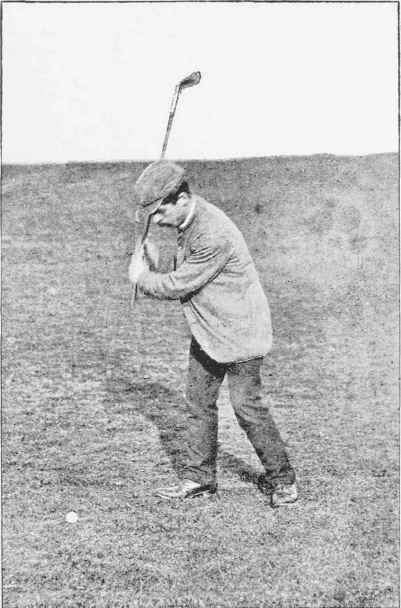
LOFTING HIGH ( 1 ). (See page 152.)
Plate XV.
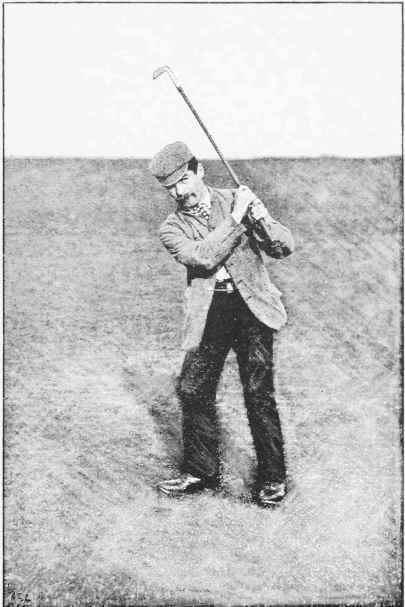
LOFTING HIGH ( -').
it will often be got out of a deep cup, in which the common thud would merely bury it.
When the ball is close to a straight face, a shot somewhat like this last may, in desperation, be attempted. The club is lifted nearly straight up, and brought down with a crash an inch or so behind it, as if the only intention were to split open the ground. There should be no attempt to follow. Sometimes (I say emphatically sometimes) the ball will spout up into the air in a marvellous manner. This shot cannot come off except out of loose sand.
Continue to:


My Books

