


Of Style IX Driving. Part 2
Description
This section is from the book "The Art Of Golf", by Bart W. G. Simpson. Also available from Amazon: The Art of Golf.
Of Style IX Driving. Part 2
Address. - After taking their stance, most players are in the habit of making some preliminary motions with their club before proceeding to drive. In some cases these flourishes are slight, in others more free: but, whichever they be, they are only reasonable and advantageous, if made to waken up the muscles and to let the hands settle to their grip.
With two many players, addressing the ball is merely an excuse for other thoughts. One will take this opportunity to scuffle round his ball, another to get nearer it or further from it, another to lift his toes and assure himself that his heels are well on the ground, another to look at his feet or the position of his hands, another to hunch up a shoulder, another to turn in a toe. In other words, the time during which the player should be getting concentrated on the work of hitting, many waste in thinking of the quackeries which they hope will take the responsibility of aiming off their shoulders. Some of those who thus waste the precious moments make no pretence of shaking themselves together. They stand stock-still. What are they thinking of? Are they bidding a fond adieu to the ball, shrewdly suspecting that the club head may not be passing that way on its return journey. Slowly and reluctantly at last club and ball part, when suddenly whack ! From others there are storm warnings. The club rises, and returns solemnly - Once ! twice! thrice! The player seems to say, ' I warn you, look out. Look out once! twice ! thrice! Very well, take that, and off you go !' Then there is the elbow twitch, which seems to say, ' I am just shaking my clothes loose to go for you, and getting my arms free to follow you.' It is a bragging kind of address, which threatens a strong blow, and is really preliminary to a weak one The confident twiddle which makes no pretence of aiming, but command-ingly points out to the ball the direction of the hole, and is followed by an angry quick swing, such as comes unawares behind a disobedient child, is not so sure to strike home as the blow it is compared to. Some twiddles are complimentary to faults which the player proposes to avoid. A long-, slow straight motion over the ball foreshadows a determination to follow it well. A stiff small one means that the player is bent on gripping tight. A quick jerky one betrays the intention of driving a screamer. There is the sanguine, the phlegmatic, the healthy, the headachy flourish, and a thousand more. None of these, except in so far as they suggest that the player has a right or a wrong idea as to how the fact of a palpable hit is to be accomplished, are essential. But placing the club behind the ball for an instant after them is essential, if the shot is not to be more or less bad. Although the address is usually a shadow of things to come, it is no guarantee of them. Free preliminaries are quite compatible with a cramped performance, and vice versa ... It may be said, then, Why not abandon them altogether? Why not place the club behind the ball, and strike at once? In these cases, where addressing the ball consists in merely making ornamental flourishes, or when they are gone through to give the player time to speculate on the chances of a miss, or to call up before his imagination a view of the bunker in front which he has just taken a last glance at, they would be better dispensed with. But, properly apprehended, they have their uses, some of which we have indicated: the chief one, I wish now to insist upon.
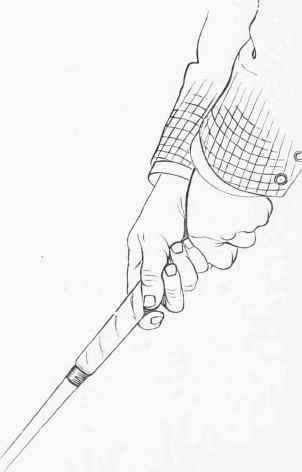
'How ought I to grip my club?' is a question which causes lifelong trouble to, and bars the progress of, many players. Addressing the ball means working their hands into some cramped position. They arrange the left hand tight, the right loose or tight, in the palm or in the fingers, under the club, over it, or with the knuckles pointing in some prescribed direction, according to whose disciple they are. There is scarcely a modification of holding with two hands which some one has not adopted as his grip, each giving its owner a sense of command over the club, so long as it is at rest, behind the ball. That a player should give attention to this important matter is right enough; but the mistake usually made is to get the hands into the most efficient position for dealing a heavy, instead of a swift blow, without reference to the most essential point in a grip - namely, that it be so arranged as to prevent the club either slipping or twisting in the palms during- any part of the swing. If a player gets his hands under the club-handle (sec Figs. 8 and 9) it is impossible to take more than a half swing with out letting go. If (see Fig. 10) he have the right more under than the left, and tight (a grip one is apt to adopt when a 'screamer' is contemplated), anything but a swing round the waist must bring the club-head back to the ball turned in (which is the secret of the screamer when it comes off, and also the cause of its failing so often).
If any one by chance has read this last paragraph carefully, he wall feel pretty certain that 1 am about to describe the proper position and tightness of each hand. But he will be wrong. On the contrary, my view is that players may take great liberties with their grip, - at least with that of their right hand, - without affecting driving. The club may be sunk in the palm, to save a sore finger, or held in the fingers if the palm be painfully horny, without prejudice to play, so long as it is so held as not to slip or turn one hair's-breadth throughout the shot. Nay! in the right it may be even allowed to turn. In fact, if a player grip as in Fig. 10, he must hold loose with the right, and allow the club to slip round if his swing be perfect, otherwise his wrist becomes locked. Of this a trial swing will convince any one. It is only possible with a grip as in Figs. 6 and 7 for the right hand to remain glued to the club throughout a perfect swing. 'How is the grip to be tested for adherence
Continue to:


My Books

