


Of Style IX Driving. Part 3
Description
This section is from the book "The Art Of Golf", by Bart W. G. Simpson. Also available from Amazon: The Art of Golf.
Of Style IX Driving. Part 3
FIG. 6. - Proper Grip, hands 'over' or 'above." during the swing?' is the real question, which the address ought to solve thus: - Having placed himself opposite the ball, let the player take hold of his club loosely, but so that, if held short, the end of the shaft would pass under the wrist bones
(somewhat as in Figs. 6 and 7). Let him swing it backwards and forwards freely over the ball, describing an elongated eight, whose length is limited by the locking-point of the wrist joints.

Fig. 7. - Proper Grip, hands 'over' or 'above'
After two or three such continuous figures have been described, the hands, still holding- loosely, will settle themselves into a proper relation to each other, and to the shot. The club will then be placed behind the ball, the grasp tightened just as it is, and the blow delivered. Whether both should be tightened, or only the left - whether it is into the fingers, or the palm, these movements are to adjust the club - are immaterial points, which may be left to individual taste. Nor ought the amount of tightening to be treated as important. Some only tighten a little, some as much as they can; all that can be said is, that the limit of permissible looseness is overstepped when, in the course of sweeping away the ball, there is any slipping or turning in the left hand at the very least. The preliminary flourish under discussion will be detected in the driving of the best and freest players. Should an elongated eight be found on any ancient Egyptian monument, it is certainly the symbol for golf, and will prove that venerable nation to have played the game. I say this flourish can be 'detected' in a good style; but a practised player does not require to pass over his ball more than once, or he may even pretermit all, except the merest rudiment. He has a proper hold at once, without searching for it, and can at once proceed unhesitatingly to strike. There is no pause, after the club has been placed behind the ball, to allow a final and fatal alteration to be made. It is interesting confirmation of the soundness of what I am advancing, that fine players, many of whom are proverbial for the instantaneousness of their address, are often more elaborate in a big match. Whereas a mere rudiment of a nourish is all they ordinarily indulge in, this becomes one or more complete eights, when a single mistake might be fatal. It is as if they said, 'I am almost certain to grip rightly; but it is as well to test it.'
Plate V.
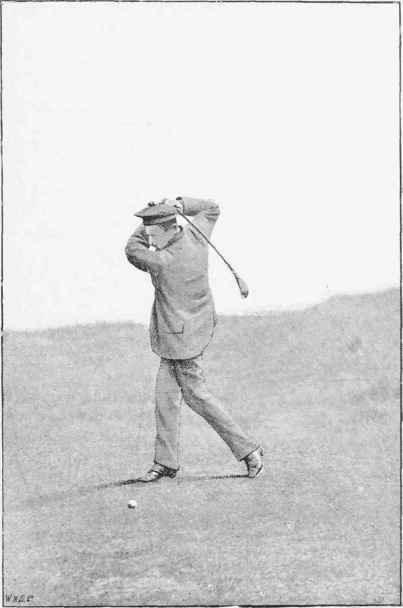
JIM MORRIS DRIVING ( 1 ).
Whether this plan of preliminary flourish is or is not the best, there is no doubt the grip should be found by some sort of trial swing, not by placing the club behind the ball, and settling down as comfortably as possible. The true grip is that which accommodates itself to a free swing, not to a commanding stance. Indeed players may be divided into two classes, according as they act upon or ignore this principle. The one arrives at the position of the hands typified in Figs. 6 and 7, and perhaps Fig. 10; the other is prone to the fault shown in Figs. 8 and 9. The one makes its flourishes, places its club for an instant behind the ball, and without hesitation strikes. If they allow it to dwell longer, it is not comfortable perhaps. Nor need it be. Ease whilst swinging, not whilst at rest, is the essential thing. The other finds its grip whilst the club is at rest, and then proceeds to flourishes. Take the case of a player of this class who makes the orthodox figure-eight gyration. He takes his grip, makes a motion over the ball, and, unless by chance it is a true one, disturbs it by so doing. You may see him pause a moment to rearrange it; the other accepts the disturbance as a proper correction. Whatever the prowess of the player, his class in this respect can be detected by watching whether, after putting" his club finally behind the ball, he hesitates or strikes at once. Nearly all bad players belong to the class which does not arrive at its grip by experiment but dogmatically; not that all in it are bad, however. Their grip may by chance be good, or they may have the tact to accommodate their swing to the conditions they have imposed upon it. But assuredly this common error of taking hold of the club in the most comfortable way for aiming at the ball, rather than for the blow, has to answer for many monstrous styles, efficient and otherwise.
Swing. - 'My swing' is a constant theme for conversation with the young golfer. He is for ever making it quicker or slower, longer or shorter, some skilful player being in his mind's eye, whom he fancies he is imitating - or rather, whom he is imitating in every way except one - the only one which will give him a true style - not thinking about it when playing, which the good player never does. His one problem is to sweep the ball away with speed. This is done by his body remaining a firm fulcrum for the lever composed of his arms and club. His swing back ends when the contact of his left biceps with his chest prevents it going further, his wrists remaining as taut as he can keep them. Not that he thinks of this, or of anything but sweeping the ball away. Let the beginner devote himself to the same problem. For a long time he will have a short swing; but it will lengthen quickly enough. There is not the slightest danger of its not doing so, unless he fall into the error of supposing that the more gently he hits the surer he is.
Many begin in quite another way. They see the professional's club swishing round his back, and they determine, at all costs, to get theirs as far round. By a variety of schemes they accomplish this, and become the proud possessors of a concatenation of contortions, in which no one but themselves recognises the resemblance to a full swing. Some swing naturally to a certain point, then, letting their wrists bend, drop the thing down their backs, draw it up again, and proceed to drive the ball. In the meantime their position has almost certainly changed in some way, so that the club head does not return to the ball along the same imaginary line it went from it. Others avoid the natural check of the biceps against the body by sticking out the left elbow and passing the arm round the neck, which, being thinner, allows the hands to get as far as the back of the head. To play in this way it is usual, or at least better (if I may be allowed to use an approbatory adjective at all in reference to such a matter), to employ upright clubs, although they will not overcome the inevitable uncertainty of direction. To get the club to the back of the neck, it must be drawn away at a tangent to the direction the ball is to be driven in. To prevent it going to the left, the player has to resort to some counter modification. He must, after impact, let his arms away to the right. Should he be lucky enough to catch the ball at the exact instant when his curve is practically parallel to the direction it is meant to go in, although ' cut' the shot will be straight; if he reaches it a hair earlier, it will be 'pulled'- -a hair later, it will be 'heeled.' These are the terms the player would use. It would be more exact to describe the three drives as a cut to the right, a cut to the left, and a straight cut. Some who drive in this way stand well in front of the ball, and thus reduce their curve more nearly to a straight line; but I have seen none get rid of the cut entirely, which they might do by turning their back altogether to the line of fire.
Continue to:


My Books

