


Chapter I. The Mental Picture
Description
This section is from the book "The Golf Swing, The Ernest Jones Method", by Daryn Hammond. Also available from Amazon: The golf swing, the Ernest Jones method.
Chapter I. The Mental Picture
It will have been gathered from the preceding chapter that in this exposition of the golf swing the writer's aim is not to decide such points as whether in the up-swing the shoulders move before, at the same time as, or later than, the hands, but to suggest to the reader that mental picture of the physical processes involved which will help him to obtain the result he seeks.
In the long game the golfer wants the utmost length that he can get without sacrificing control. It is of little use to him to hit a ball "to blazes"; for almost invariably it is difficult to get back from that locality to the green. It will not even serve his purpose to hit one long straight ball at every second shot. Obviously what he requires most of all, if he is sane, is control. In the short game indeed, control is everything. Nothing else matters.
The primary question, then, for the golfer is how to control the behaviour of the ball - that is, how to gain control over the club head.
Control over the club head connotes two things - power and "touch/' Power can be gained by gripping the club in the palms of the hands, but it is given only to few people to obtain "touch" in that way. "Touch" can be obtained by gripping the club lightly in the fingers, but power cannot be gained in that way. Something between the two methods of gripping is required.
There are, perhaps, two natural methods of holding any implement with which one intends to strike. If one were about to break stones or fell a tree, one would instinctively take hold of the hammer or the hatchet deep in the palm of the hand. The grip would adapt itself to the notion of power. If, on the other hand, one were nonchalantly decapitating daisy-heads in the course of a country walk, one would instinctively hold one's cane lightly in the fingers: the grip would adapt itself to the notion of flexibility and speed.
The golf ball is a light thing compared with the stone, a heavy thing compared with the daisy-head; and the golf club is a light thing compared with the stone-breaker's hammer, a heavy thing compared with a cane.
Jointly, then, the golf club and golf ball should suggest to the mind a compromise between power and speed, between "hefti-ness" and flexibility.
It is the blending of these two qualities which baffles the average golfer. He is apt to attach by far too much importance to power, and the result is that he manipulates his club ponderously and ineffectively, never for one moment realizing the idea of speed or "touch/ and usually failing to achieve his one objective - power. His mental picture is ill-conceived, and therefore his action goes astray. His hands and fingers have failed to do their full share of the work, and consequently his body comes into the shot at the wrong time and in the wrong positions.
In the revolutions of a wheel the speed of the hub bears a fixed ratio to the speed of the rim, but the golfer who mistimes his shot suggests the analogy of a wheel in which the hub and the rim are at variance, the hub being determined to increase the ratio of its speed to the speed of the rim. The result, in the example of the wheel, would be broken spokes and a buckled rim. In the case of the golfer, the arms are too flexible to break (though the club is not), but the result is a jerky and retarded, not a quickened, movement of the club-head; moreover, the course of the club-head is out of truth: the shot is a failure.
The fingers bear to the other members of the body involved in the golf swing a somewhat similar relationship to that which subsists between the toes and the other members of the body involved in walking. If one walks, thinking only of the action of the hips, one will instinctively take long strides, and the gait will suggest considerable power but little "life." If in walking one thinks only of the action of the knees, the effect produced will be one of feebleness and ineffectiveness. If, however, one walks concentrating on the action of the toes and the ankles, the stride will be short and quick, and great flexibility and vitality will be felt and suggested. The reader is invited to make the experiment and enjoy the sensation of the toes gripping the ground and promoting a rapid forward movement of the legs. The type of gait, it will be observed, is the outcome of the mental picture.
It is so with golf. The swing is the outcome of the mental picture. Let the reader visualize clearly a swing in which the motive force is applied by and through the hands and particularly the fingers; let him cease to care what other physical processes are involved; and let him rest assured that if his brain prompts the hands and fingers to do their work, the other members of the body will probably do theirs. If he does this, he will be well on the way to achieving that crisp, decisive method of hitting a golf ball which makes the professional's game the despair of the ordinary amateur player.
The golfer should fix it firmly in his mind that his object is not to pit his strength against the inertia of the golf ball, but to lash a responsive ball away by flinging the club-head at it at the highest possible speed. Speed is the sine qua non.
Much learning has been devoted to the question whether the golfer's action is a swing or a hit. Most good golfers say it is a swing, but what most good golfers have in mind when they make a shot is to hit. This kind of bewildering inconsistency is rampant in golf. The mental picture suggested by the idea of sweeping the ball away may be instinct with rhythm, but it does not suggest that dash, that speed, that crispness, that "pinch," that "nip," which is of the essence of the modern professional's action.
The golfer should picture to himself that he has to hit the ball away with the club-head, and that in order to do this most effectively he must set the club-head moving and keep it moving all the time by hand and finger work. He must not give a moment's thought to the action of the legs, or the feet, or the hips, or the shoulders, or even to keeping his eye on the ball. He must be preoccupied, he must be obsessed, by the one idea of bringing the clubhead on to the ball by means of a persistent movement of the hands and fingers. He must not think of keeping his left arm and the club-shaft in one line as long as possible (this idea shows a complete lack of appreciation of the functions of hands and fingers); he must not think of keeping his left arm stiff (this, in so far as it happens, is an effect, not a cause); he must think of nothing other than the one idea of making the club-head move all the time with the hands and fingers, and of letting arms, shoulders, hips, legs, and feet respond unhampered to the call made upon them. As a fact, if he goes on taking the club back by finger pressure as far as it will go, he will find that his left knee will automatically turn toward his right, that the left side of his left foot and the left heel will slightly leave the ground, that the left shoulder will turn underneath the chin, that the left arm will be moderately extended (certainly not fully extended or rigid), that at the top of the swing the hands and wrists will be underneath the shaft of the club, that the sole of the club-head will be facing upward, and so on. If any of these effects are not produced, it will not help him consciously to insert them into the up-swing. He must get back to the basic notion of persistent finger work, and he will find that in so far as the traditional symptoms are not exhibited in his swing, he has failed somewhere in that finger work. Somewhere in the upswing the finger work has been relaxed and has failed to give the necessary impetus to the other, the subordinate processes. Similarly, if the down-swing betrays any lack of rhythm, if the body moves too soon or too late or in the wrong curve, if the weight does not follow the club-head - if, in short, anything goes wrong with the swing, let the player try to discover where he has failed in his hand and finger action. He is almost sure to find that at some point or other the finger action has ceased to assert itself, so allowing processes which should be subsidiary and accommodating processes, to take the initiative. If the mind is concentrated on manipulating the club-head by means of hand and finger work, the body can hardly get into the shot too soon, and if the player is determined to let everything respond which wants to respond to the impulse suggested by the hands and fingers, the body is not likely to lag behind. The hands and fingers must so control the club-head that at the vital moment they are ready to make the club-head (which up to that point in the down-swing has been behind the hands) lash through the ball, pulling hands, arms, shoulders, and legs after it.

Fig. 4. - Down swing. The body has turned on its own initiative.
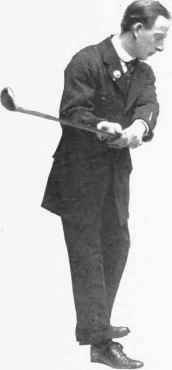
Fig - 5 - The body has followed the lead of the hands.
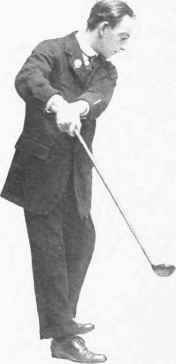
Fig. 6. - The hands have started the club -head moving but the shoulders have not responded.
If one considers for a moment the movements which take place in an ordinary Indian club exercise, one will realize that the performer's mind is concentrated on the work of the hands and fingers. The arms, the shoulders, the body, the legs and the feet respond sympathetically to the movements suggested and set up by the work of the hands and fingers. They do not initiate, but on the other hand, they do not retard. Their province is to be ready and willing to move in order to allow the manipulation of the clubs to proceed with the utmost freedom, precision, and rhythm. It may be that the shoulders and other members of the body do in fact move at the same time as the hands, but the essential thing for the mind to dwell upon is not what movements take place, but how and where to apply power. For if power is properly applied the accessory or accommodating movements are not likely to give trouble.
Continue to:


My Books

