


Chapter VIII. Socketing
Description
This section is from the book "The Golf Swing, The Ernest Jones Method", by Daryn Hammond. Also available from Amazon: The golf swing, the Ernest Jones method.
Chapter VIII. Socketing
It is one of the many ironies of golf that some of its maladies beset the mature player almost equally with the novice; and of these maladies socketing is perhaps the chief. Not even players of the first flight are immune from it. The writer knows many scratch and plus players whom it victimizes from time to time - occasionally over long periods. One of these is an English international of golf-wide reputation who distinguished himself in an international match by an orgy of socketing, resulting (so far as international matches are concerned) in a record round for the number of holes lost. Another is an open champion who for months failed to hit a mashie shot off the middle of the club-face except by accident. It is, of course, to be expected that the novice should be capable of any golfing enormity - he may give at the knees, he may fall forward whilst trying to hit the ball, he may refuse to work his elbow-joints, he may do a score of things he ought not to do - and socketed shots may be the result of any one of them. For him there is but one method of treatment: he must learn to swing properly; and there is nothing more to be said. But the case of the mature golfer who falls a victim to socketing may be analyzed usefully; for his knowledge of the game is such that he is able to appreciate points which could but befog the beginner.
As first sight it seems that there must be something in socketing which even in golf is unusually mysterious. The writer is, however,, of the opinion that the mysterious element is rather apparent than real, and that the practised eye can always trace the germ of the disease in the normal action of any mature player who is capable of periods of socketing.
The player is recommended to analyze the normal socketed shot on the following lines:

Fig. 56. - The socketing position par excellence.
(1) To note the position in which he finds himself, and the position in which he finds the club-head, at the finish of the faulty shot.
(2) To compare these positions with the corresponding positions in the correct movement.
(3) To discover what method he would adopt if he wished to commit the fault he is trying to cure.
(4) To compare this method with the method of attaining the correct positions.
(5) To locate - by means of the comparison
- the point at which the differentiation begins, and to identify the particular action which distinguishes the correct shot from the faulty shot.
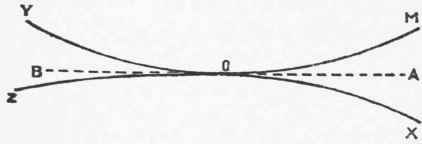
Proceeding on these lines, the writer offers the following observations on the socketed shot:
(1) (a) The player's right shoulder has not followed on in its natural curve; its movement has been checked at some point either before or at the moment of impact. (b) The club-head has finished, not to the left, but to the right of the line of desired direction.
(2) In the diagram, AOB represents the line of desired direction, XOT the path of the club-head, XOZ the path the club-head should have taken.
(3) Experiment will at once show that in order to make the club-head take the line XOY, the best plan is -
(i.) to keep the right shoulder from turning;
(ii.) to keep the hands and fingers inactive; and
(iii.) to push the club-head out in the line OY by straightening out the right arm at the elbow-joint, and by preventing the right forearm from turning from right to left.
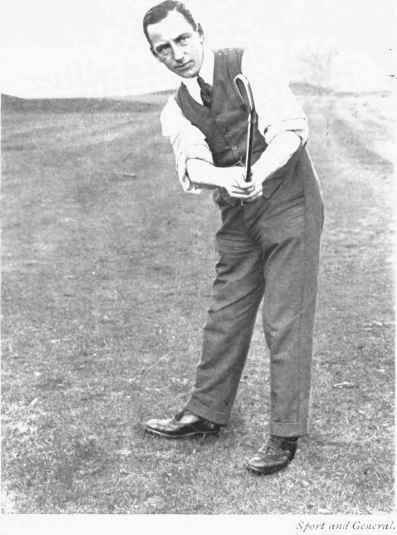
Fig. 57. - An ideal finish.
(4), When the club-head takes the proper line XOZ, it is found - (i.) that the right shoulder responds to the pull of the club-head; (ii.) that the hands and fingers assert themselves and make the club-head do its work; and (iii.) that there is no stiffness anywhere, the right forearm turning freely from right to left in response to the impulse set up by the hands and fingers. (5) The differentiating movement is really performed by the hands and fingers. If these are made to do their work and the body and arms are allowed to move so as to give them free play, the club-head will take, not the line OT, but the line OZ.
The reader will probably have noticed some similarity in the behaviour of the club-head in the socketing shot and the behaviour of the club-head in the cut-mashie shot. Indeed, socketing is often the outcome of playing the cut-mashie shot with stiff forearms.
The cut-mashie shot can, however, be played with safety if two points are borne in mind:
(i.) The directing energy should be determinedly applied through the hands and fingers; and
(ii.) The club-head should travel, not in the line XOY, but in the line MOZ.
[In the up-swing it should travel outside the line of direction, and in the follow-through inside that line, whereas in the socketing movement it travels, in the up-swing, inside the line of direction, and, in the follow-through, outside that line.]
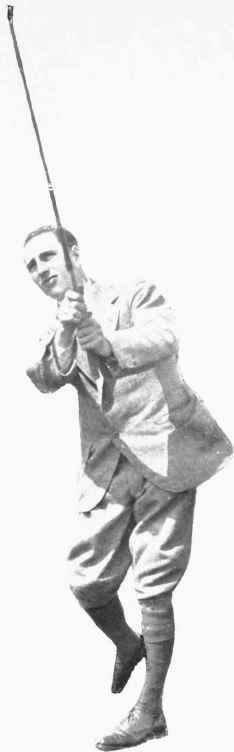
The push-shot (Fig. 58), even more than the cut-mashie shot, bears certain outward resemblances, and oftener than not, alas ! certain inward resemblances, to the socketed shot (Fig. 56).
In the push-shot there is, of course, considerable firmness of wrist and forearm; the clubhead follows through further on the line of flight than in the ordinary iron shot; and the toe of the club does not get in front of the heel. The margin of error is obviously small. If instead of taking the line XOZ, the club-head goes outward ever so slightly in the line XOYy the shot will be socketed.

Fig. 5S. - The push shot.
Continue to:


My Books

