


Socketing. Continued
Description
This section is from the book "The Golf Swing, The Ernest Jones Method", by Daryn Hammond. Also available from Amazon: The golf swing, the Ernest Jones method.
Socketing. Continued
Fig. 59. - Note the delicacy and freedom of the finish of this iron shot.
Nearly all the textbooks and nearly all the teachers make a fetish of the essential difference between the iron shot (ordinary as well as push) and the swing with the wooden clubs. The player is told that in playing his irons the grip must be firmer, the arms and wrists tauter, the body more rigid, the up-swing shorter, and so on.
The effect of this teaching is to stiffen and cramp the iron play, even of many first-class players: in a word, to implant in it the seed ot socketing, a disease which, it is vital to note, is practically confined to play with iron clubs and has no counterpart in wooden club play. There is no essential difference in the manipulation ot iron and wooden clubs, and socketing would be rarer if this fact were recognized and iron shots were made with some of the freedom which distinguishes wooden-club play. The golfer must gain control of the club - whether iron or wood - in his hands and fingers. He must know clearly the manner of the flight of the ball that inevitably results from a certain type of swing, and he must make the club-head perform the desired type of swing by means of appropriate hand and finger action. If he wants to force an iron shot against the wind, he will obviously not flick the ball lightly into the air with a delicate movement of the fingers; he will beat it down and forward by actions at once definite and powerful. But those definite and powerful actions should be the result of hand and finger work consciously applied. They should not be the result - as is so persistently urged by those who mistake symptoms for causes - of holding the body, the forearms, and the wrists rigid or of gripping the club with vice-like pressure.
If the seat of control is in the hands and fingers, the player can produce any one type of shot as readily as any other type of shot. It is just as easy for him to make the club-head finish in front of him, as in the push-shot, as to swing it heroically over his left shoulder. If the club-head stops in front of him he will notice that the forearms and wrists are taut. He has, in fact, produced the shot in such a manner that the wrists and forearms must be taut. This is a totally different matter from trying to produce the shot by means of taut wrists and forearms. The difference is the difference between cause and effect. Thus in the case of the push-shot, if the player aims at producing the shot in the correct manner - that is, by a movement of the club-head dominated by the fingers - he will never be likely to socket. If, however, he aims at producing the shot by stiffening certain limbs and muscles, he will never - despite any success he may achieve - be an entirely sound golfer; he will always be more or less liable to lapses from form, and amongst the lapses socketing will most probably find a place.
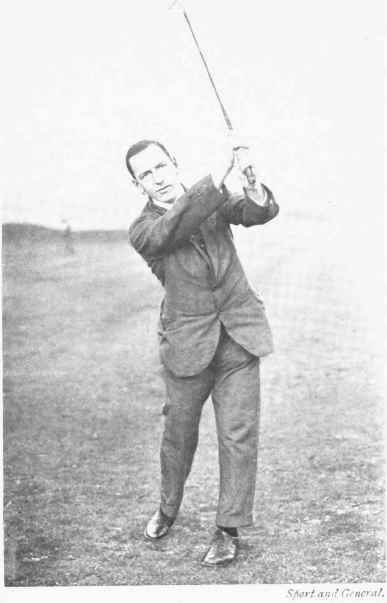
FlG. 60. - The finish of a firm iron shot.
The following propositions are offered for the reader's consideration:
The player can never socket who keeps control of the club in his hands and fingers and does not interfere with the responsive movements.
Socketing may occur whenever the stiffening of the arms or wrists or body interferes with the full and free working out of the swing at the instance of the hands and fingers.
The time-honoured doctrine of accentuating the follow-through along the line of flight or throwing the arms out after the ball, is a dangerous one; it tends to devitalize hand and finger work, to stiffen the forearms, and to put the line of the follow-through out of true relation to the line of the up-swing.
The caddy's advice to stand further away from the ball is pernicious; if carried out, it is likely to accentuate the stiffness which is the cause of the disease.
The advice of the club-seller to buy a set of non-socketing irons should be ignored even by millionaires. Non-socketing irons have one grave defect: they socket.
The advice to keep the right elbow close to the side, the right arm close to the body, and the left elbow close to the side, is not good; these positions are symptoms, not causes, of properly hit shots; and if the player concentrates on making his swing conform with a number of fixed points instead of so producing the swing that it must conform with those fixed points, he will inevitably deaden it. The true golf-swing is to be achieved, not by placing the body and the limbs into a series of carefully chosen positions, but by learning how to communicate life to the club-head through the fingers. The artist gives life to his line, not by tracing the line through a series of points, but by making one unfettered sweep of the pencil - he communicates life to the line through the fingers. . . .

Mrs. Alan Macbeth. (Miss Muriel Dodd.)
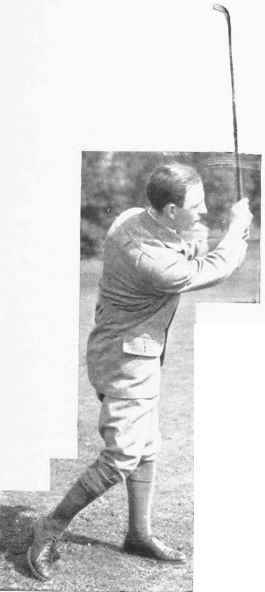
Figs. 6i and 62. - Two perfect iron shots. Note the essential similarity of the positions. No suspicion of stiffness or rigidity.
The socketer will appreciate that alternatives are open to him: one is to learn to swing properly; the other is to give up the game. The writer apprehends that the former course will normally be followed as being the easier of the two.
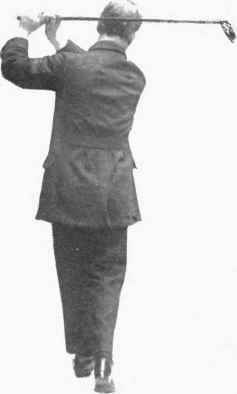
Fig. 63. - Finis.
Continue to:


My Books

