


Chapter VII. Over-Swinging
Description
This section is from the book "The Golf Swing, The Ernest Jones Method", by Daryn Hammond. Also available from Amazon: The golf swing, the Ernest Jones method.
Chapter VII. Over-Swinging
It is the custom to speak of any movement which allows the club-shaft in the up-swing to pass appreciably beyond the horizontal position as over-swinging. It does not matter how this position is achieved, whether by relaxing the grip or by carrying the club high over the shoulders, or by both processes combined - it is glibly called over-swinging.
Observation shows that the few players who really control the club usually have an up-swing in which the horizontal position is not appreciably passed, and that the many players who fail to control the club usually have an up-swing (or rather an upward movement) in which that position is left far behind; and these coincidences invite the inference that the test of over-swinging is to be found in the length of up-swing.
In the days of the gutty ball, however, no golfer worthy of the name was content with an up-swing which failed to give the club-head a close view of the left heel - witness illustration of such famous players as Douglas Rolland and Lady Margaret Scott; and it would be absurd to suggest that this fulness of movement was mere rhetoric - something flowing out of the exuberant egotism of the player rather than the stern necessities involved by the stolidity of the ball and the length of the club. It would also be absurd to suggest that the good player of those days failed in complete control of the club.
It must therefore be admitted that there is no essential incompatibility between complete control of the club and a luxuriantly prolonged upswing, and that, inasmuch as controlled swinging can never be over-swinging - the two terms are contradictory - the test of over-swinging is to be found elsewhere than in the length of the up-swing alone.
Lady Margaret Scott threatening her left heel in the up-swing and her right heel in the follow-through, yet controlled her club. Mrs. X., whilst falling far short of the former achievement, falls still further short of the latter. What is the difference between the swing of Lady Margaret Scott and the swing of Mrs. X.? The difference lies in the fact that the swing of Lady Margaret Scott was a swing, and that the swing of Mrs. X. is not a swing at all. One proceeds inevitably to the generalization that the person who can swing a club will never over-swing it, and that what is called over-swinging is simply not swinging at all. The logical conclusion is that the cure for what is called over-swinging is to be found in learning to swing, and not, as is popularly supposed, in shortening the swing.

Fig. 50. - The old-fashioned up-swing: exuberant, yet controlled. A slashing and powerful movement.

Fig. 51. - Clumsiness and lack of control.
Though Lady Margaret Scott might choose to allow the club-head to coquet with her heels, she never permitted the club-shaft to toy with her shoulders. On the other hand, no such restraint on the club-shaft is imposed by Mrs. X.
What happens in the "swing" of Mrs. X. is this: (1) Instead of being set in motion by hand and finger work, the club is pulled away from the ball by the premature turning of the shoulders. (2) Instead of being incessantly moved round the body by hand and finger work, the club is lifted more or less vertically upward, and the shoulders having expended their energy too soon, now find themselves without stimulus to further action; they therefore cease to turn. (3) The whole mechanism is by this time out of gear - the movement is obviously incomplete; the player's position is cramped and feeble: she must free herself somehow; but the body is rigid and the arms have gone as far as they will go. Something has to give way - the fingers oblige, the grip is relaxed, the club-shaft strikes the shoulder and rebounds. (And this rebound is the beginning of the down-swing !) Instead of an up-swing, there are three movements - a drag, a lift, and a flop - and the down-swing is inaugurated with a jerk !
Now, what is the attitude of Mrs. X. to her incompetence? As a rule she resigns herself to what she deems to be the inevitable - it is not, she argues, given to everyone to play like a professional, and it is evidently in the nature of things that she should drag, lift, flop, and jerk the club rather than swing it. . . . But Mrs. X. may be of different texture. She may be determined to rid herself of the scourge at all costs. How does she set about it - in the normal case?

Fig. 52. - Good as far as it goes.
In the first place she makes a wrong diagnosis. She commits the cardinal error of confusing symptom with disease. She regards the flop as the disease; she ignores the drag and the lift which precede it. To her mind the movement goes wrong at the moment she relaxes her grip, and not before. Alternative methods of treatment promptly suggest themselves to her. The first is to maintain at all costs a fiercely tight grip throughout the movement. The second is to stop the movement before the temptation to relax the grip becomes pronounced. The effects of the first method need not be dwelt upon. It is enough to say that golf can never be amongst them. The second method may usefully be analyzed.
What is Mrs. X. left with when she has eliminated the "flop" from the upward movement of her club? Is it anything more nearly resembling a swing than it was before? It is not. She has made no material alteration in her action. She has left the root and the stalk of the weed and merely cut off the flower. Instead of drag, lift, and flop, her action is now drag and lift. That is all. Mrs. X. doubtless regards herself as a short swinger. But she is not. She is merely a caricature of a short swinger. Even the short swinger must be given his due. . . .
What, then, is the typical action of the short swinger?
The short swing properly so called is a swing which is quite sound as far as it goes (Fig. 52). It is the ordinary up-swing stopped short of its maturity. It is, in fact, the swing normally adopted for an iron shot. It is the ideal swing for an iron shot because it lends itself to the exact placing of the ball. It is not the ideal swing for a wooden club shot (in ordinary circumstances) because a longer swing will give greater distance and as much accuracy of direction as is normally required in a shot with a wooden club. The question, it will be observed, is, like most other questions, one of compromise. Every shot in the game must have two qualities - a certain length and a certain degree of accuracy. The proportion between these two qualities varies in different shots, and the type of swing varies with it. Normally the full shot with a wooden club is the one in which the element of accuracy is most subordinated to the element of length. But even in this shot only a small degree of variation is possible, and the swing must therefore always be thoroughly controlled - whatever its length.
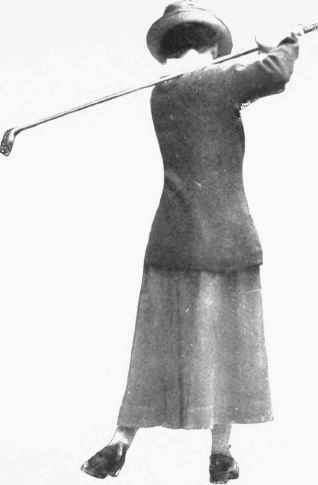
Fig. 53. - A frequent sight on the links.
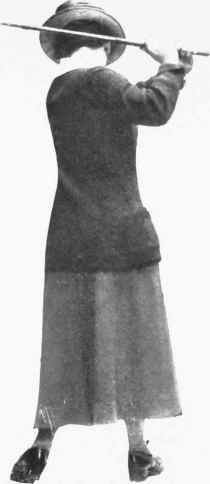
Fig. 54 - A trifle too careful.
It has been seen that the players of a past generation were able to control a longer swing (see Fig. 50) than the swing now favoured. But experiment will show that the difficulty of control is increased when the swing is lengthened beyond a certain point.
The problem presents itself in this way. The gutty ball is an unresponsive thing compared with the rubber-cored ball. It requires a greater effort to drive it a given distance, but its behaviour on being miss-hit is less erratic. In these circumstances the golfer was preoccupied in getting the utmost length of which he was capable, knowing that if he did not hit the ball quite accurately - so long as he hit it freely - it would not behave in the eccentric manner of the modern rubber-core. In other words, of the two qualities of accuracy and length, he could afford to think more of the latter than the former. He chose, therefore, a club with a long shaft, and adopted - largely as a consequence of using a long-shafted club - a long and exuberant swing.
With the modern ball, however, it is found that no greater distance is obtained by using a long-shafted club and prolonging the up-swing beyond a certain point, whilst accuracy is endangered; and the expert wisely contents himself with an up-swing finishing in the region of the horizontal position. But this up-swing, though short in comparison with the up-swing of twenty years ago, is a complete up-swing. The club is taken back as far as it will go on the basis adopted. The hands and arms have described a spiral round the body and the body has twisted in response, and the club comes to rest at the top of the up-swing, not because the player actively stops it at that point, but because fingers, hands, arms, body, legs and feet have completed their work (Fig. 48). If the club went further, the player would fare worse - he would be a surgical case.
It is of the very essence of the golf swing that the club-head should be kept moving all the time. "Keep the club-head moving ' might well be substituted for "Keep the home fires burning." And the shoulder hitter who thinks to cure himself of his disease by stopping the club at a chosen point in the up-swing is "flying in the face of Providence." He wantonly stops the movement of the club at the very moment when the hands and fingers should be forcing it into a position of precision and power. Let him take his courage as well as the club in both hands, and at the point when he imagines the fatal flop is about to begin, let him force the club-head resolutely further behind his head by persistent hand and ringer action. He will then find that the shaft will not strike his shoulder, and that the up-swing will stop when the hands and fingers have accomplished the fullest natural movement of which they are capable.
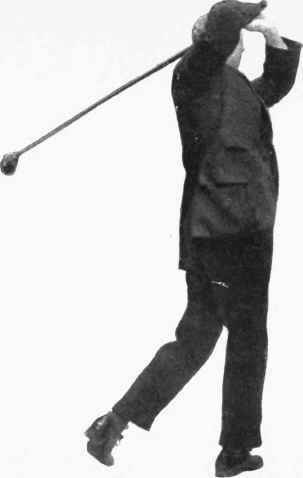
Fig. 55. Compare with Fig;. 50.
Under-swinging is not less of a vice than over-swinging, and the golfer should always be on his guard against it. For under-swinging is neither more nor less than the failure to make full use of the hands and fingers. It is just as easy to under-swing in a short mashie chip as in a full swing; for even in a short mashie chip the hands and fingers should function to the fullest extent possible having regard to the type of the shot.
It is this determination to move the club-head as far as possible with the hands and fingers at every point in the swing which is at the root of all good golf. It precludes the possibility of relaxing the grip, of shoulder-hitting, and other pathetic symptoms of incompetence (see Figs. 51 and 53); and it allows the player to get the utmost speed and the finest precision out of that good servant, but bad master, that faithful friend, but bitter enemy - the club-head.
Continue to:


My Books

