


Chapter V. Approaching
Description
This section is from the book "Hints To Golfers", by O. K. Niblick. Also available from Amazon: Hints To Golfers.
Chapter V. Approaching
One difference between a first-class and a second-class golfer is the inability of the latter to make approach shots, as the average golfer gives most of his time to perfecting himself in driving, in which he takes pride, and neglects to learn the many approaching strokes with which he ought to be familiar. Although he may, perhaps, be able to drive his ball twenty yards further than his expert opponent with his first stroke, and with his second stroke be able to send his ball still another twenty yards further ahead, yet his opponent, although forty yards further away, will be nearer the hole with his approach shot.
In making approach shots many different conditions arise, and many things have to be considered. One, therefore, not only has to become familiar with several kinds of clubs, but has to know also how to make with them several kinds of strokes. Approaching irons, strictly speaking, are the mid-iron, the lofter, the mashie, and the niblick. They differ from the cleek in having the face laid further back so as to give the ball a backward spin, and in being broader at the toe so as to have as much face as possible with which to get that spin; the lofter being laid back more than the mid-iron and the mashie more than the lofter; the mashie being evolved as a cross between the niblick and the lofter, to be used for those short approaches where little impetus is to be sent into the ball. The niblick, which is used in approaching when the ball has such a bad lie that the club has to dig into the ground, differs from the other irons in having a thick and heavy head which is laid back more than the mashie, in order to get as far under the ball as possible, the shaft being particularly stiff, as the club often has to be fearlessly used when the ball is lying among stones or in brush or high grass. In fact, all approaching clubs should have stiff shafts, as approaching strokes generally mean grazing the top of the ground. With the niblick the essential thing is weight ; with the lofter and mid-iron, balance; and, with the mashie, balance and lightness. The use of these different clubs varies according to the fancy of the player; one who likes the lightness of a mashie using it with a full swing where another would use a mid-iron with a half swing; and one who gets better execution with his lofter using it in short approaches where another would use a mashie.
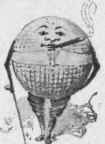
A studied approach!
( 58 )
With every approach shot, whichever club is used, there are certain problems which have to be decided before the stroke is made.
First: It must be decided whether a full swing, a three-quarter swing, a half swing, a quarter swing, or a wrist swing should be used, for the longer the swing the more power and the greater distance. By varying, then, the length and the speed of the swing, the distance which the ball will travel can always be definitely determined, the length of the swing and the speed being a gauge to fix the distance which the ball can go. The impetus, therefore, which is to be sent into the ball is not to be determined by the amount of strength put into the swing, but by the length and speed of the swing; for, if this were not so, the amount of impetus being dependent upon the will alone there would be no definite basis for accuracy. The swing, then, should always be made with the same amount of strength, and the distance which the ball is to be driven based upon the length and speed of the swing taken.
Second: In making approach shots when there is an obstacle between the ball and the hole which makes a lofted ball necessary, it must be decided whether it is safer to pitch the ball dead or to have it run after it strikes the ground. If the ball is to have a run, the arms must stretch out with the backward swing so that with the forward swing the club head can give the ball a forward spin. Because of this lengthening out of the arms, the stroke is called the stiff arm stroke. If, however, the ball is to be made to fall dead because there is also an obstacle just beyond the hole, it must be given a backward spin. To give it this backward spin, the arms must bend with the swing instead of sweeping out and because of this bending of the arms the stroke is called the bent arm stroke. When, however, instead of the obstruction being between the ball and the hole, the only obstruction is just beyond the hole, it must be decided whether it is safer to play a lofting shot, a cutting approach shot which makes the ball fall dead without much loft, or a running approach shot which runs the ball along-the ground. In this case the condition of the ground and the direction and force of the wind become factors. When, however, the ball is in a cup and the club head has to dig into the ground to get at it, a stroke known as the chop or jerk stroke has to be used.
Approach shots, then, subdivide into
Distance | Full swing. |
| swing. | |
1/2 swing. | |
1/4 swing. | |
Wrist swing. |
Balls having a run or the stiff arm stroke, sometimes called the swinging approach stroke. | ||
Elevation | Balls without a run or the bent arm stroke. | |
The chop or jerk stroke. |
Continue to:


My Books

