


Bohemia. Part 13
Description
This section is from the book "Bohemia - John L. Stoddard's Lectures", by John L. Stoddard. Also available from Amazon: John L. Stoddard's Lectures 13 Volume Set.
Bohemia. Part 13
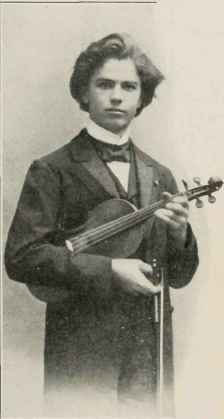
Kubelik.

The Hradschin, From The Moldau.

The Archbishop's Residence And The Entrance To The Palace On The Hradschin.
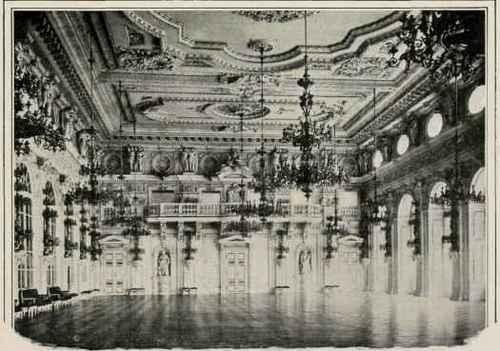
A " Banquet-Hall Deserted".
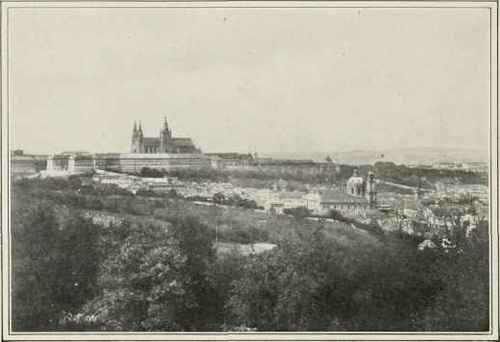
The Palace.
It was not, therefore, at close range that I best realized the nobility of the Hradschin. Remoteness renders it sublime. Then the imagination, fired by inspiring memories, finds scope for idealization. One should assuredly visit the Hradschin as one descends to study in detail the gorges of the Arizona Canyon. But after one such intimate inspection, one is better pleased to view both marvels from a distance. The Hradschin is an object to admire from the river-bank, or from the loggia of the Belvedere. Seen thus, so splendidly suggestive of Bohemia's past, it is a thing to rouse enthusiasm and awaken dreams. Noble by day, and magical by moonlight, the majesty of its colossal architecture forms a vision which can never fade from memory, - severe yet tender, dignified yet beautiful, formidable yet feminine, and - while inspiring hope - sad on account of an uncertainty of future which must touch the heart. How many would-be conquerors have the Hradschin's ramparts kept successfully at bay, until the covetous invaders were compelled to raise the siege! One of the titles formerly bestowed on Prague was that of "The City of a Hundred Towers." Although the number was no doubt exaggerated, the rhythmical hyperbole was largely justified. The entire city was enclosed with walls, and the Hradschin height especially was girdled by a line of crenelated bastions, which followed the declivities and elevations of the hill, and rose at intervals in massive towers. Some of the latter are still standing, and may be inspected.
One, called the Daliborka, is especially interesting. Its title was derived from an unfortunate nobleman, named Dalibor, who for political offenses was imprisoned here in 1497, and having languished in obscurity and misery for twenty-two years, was finally brought out into the light of day only to be beheaded! In his heart-breaking solitude this wretched prisoner had one source of joy, - a violin. Some say that in a corner of his narrow, fetid cell, he found this former consolation of his predecessor. Others attribute its possession to the sympathy of his jailer. Dalibor, it is true, had never learned to play the violin, but such an obstacle was soon surmounted. He was a Czech, that is to say, a born musician. Accordingly, having become a master of the instrument, he drew from its poor frame such plaintive strains, that those that passed beneath the tower would often pause in wonder and compassion, as they detected in those tones the anguish of the prisoner's soul and his impassioned prayer for liberty. One day the violin was mute. The cell was tenantless- left empty, like an outgrown shell. But in a corner of the moat was seen a new-made grave. Smetana, an illustrious Czech composer, has given to this pathetic story immortality by making it the theme of one of his finest operas. Even more gruesome is another dungeon here, within whose gloomy depths many a victim of oppression, doomed to die, has perished of starvation, his first revolting duty, on arriving, being to lower the dead body of the previous occupant into a rayless oubliette, whose horrors no one knew. Among the objects found in a less sinister apartment, in the course of restoration fifty years ago, were numerous playing cards, which the guide at present shows with grim complacency. They were invented by the captives for diversion, lest their prolonged imprisonment should drive them mad. Upon these pitiable bits of pasteboard-gathered and secreted, who knows how? - the spots and figures were produced by mixing dust with drops of their own blood! One hardly knows which is the more pathetically tragic, the stupefying horror of their long captivity in sunless vaults, or the weird means employed to give their wretched lives a semblance of amusement.
Continue to:


My Books

