


The Upper Danube. Part 11
Description
This section is from the book "The Upper Danube - John L. Stoddard's Lectures", by John L. Stoddard. Also available from Amazon: John L. Stoddard's Lectures 13 Volume Set.
The Upper Danube. Part 11
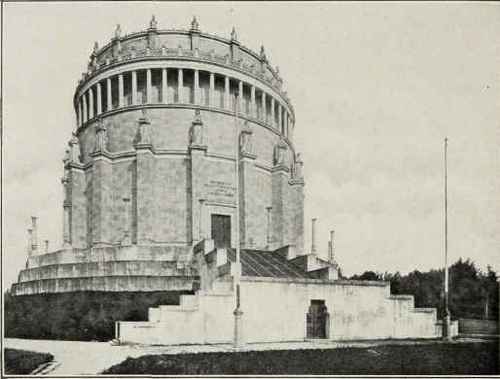
The Hall Of Liberation.
But why, it may be asked, was so much money spent upon mere Halls of Fame? That is a question prompted by the spirit which recoiled in horror, when Mary Magdalen poured out the precious spikenard on her Saviour's head. "To what purpose is this waste?" it was objected; "this ointment might have been sold for much, and given to the poor." Yet, to-day, wherever the gospel is preached, that story of the Magdalen is told as a memorial of her. Money expended in the preservation of ideals is never wasted. In one sense the chief value of these costly edifices lies in the fact that they are not " useful." Their generous appeal to the national soul of Germany is a fine protest against measuring values and results by money standards only. It marks a victory in the ever increasing conflict between aestheticism and commercialism; between the rival claims of beauty and business; between the spirit that preserves Niagara and that which seeks to drain away its glorious waters into hideous factories. Inspiring buildings such as these, thrown open daily to the public, do more to call forth reverence for lofty character and noble deeds than scores of structures reared for strictly "practical" purposes. Well would it be for a young man, whose chief ideal is the ignoble one of quickly heaping up a mighty fortune, to tread these halls, in which not one of those whose sculptured lineaments confront him was distinguished for his wealth. Mankind would be the better for the erection of a number of such temples, devoted to what might be called, in a commercial sense, the worship of the listless. Upon their walls, among the busts and statues of the world's great teachers and philanthropists, should be portrayed in words, or by pictorial and sculptured art, ideals which offer no pecuniary reward, but on the contrary demand for their attainment self-denial and economy. There men should learn the blessedness of money-giving, rather than of money-getting. There myriads of weary toilers, whose dull, sterile lives have been devoid of intellectual enjoyment, should be convinced that well-used leisure and soul-culture in the afternoon of life may rightly form the aim of every man who has accumulated for himself and family a reasonable competence.

The Interior.
Moreover, as a preparation for those profitable years of calm retirement, they should be led to know from personal experience the exaltation of the soul, which comes not only from the perusal of the finest literature, but also from the ministry of Nature, through the songs of birds, the rapture of the brook in its glad journey to the sea, the music of the wind - swept pines, the aromatic odors of the forest, the solemn grandeur of the mountains, and the limitless expanse of ocean's blue. Then would the world be spared the present melancholy sight of haggard men absorbed in merely adding to their bank accounts; and that of gray-haired slaves of self-indulgent families, still struggling in the whirlpool of commercialism, that sons may waste their patrimony, and wives and daughters lavishly outdo their social rivals. Within these temples should be also taught a cult of knightly conduct and manly courtesy, to counteract the selfishness and cynicism of our rush for wealth and ostentation. Above their portals might be fittingly inscribed the motto, "Noblesse oblige"; yet the nobility referred to should be that of character alone. There poetry should precede plutocracy, and education should aim principally to inspire love and admiration for plain living and high thinking. If, in the future, there awaits humanity a Golden Age, it will arrive when men shall deem a golden dollar of less value than a golden sunset, and both of less importance than the Golden Rule. A spirit of devotion to the best ideals made the Greeks our masters. That spirit we must also gain, unless we are to see our over-vaunted civilization rush itself to ruin, and our competitive strenu-ousness end in sanitariums.

One Of The Victories.
A river's progress, like a human life, is marked by crises which decide its destiny. Such an important turning-point in the Danube's history presents itself at Pas-sau, near the Austrian frontier. The situation is superb, the scenery imposing. Passau itself resembles in its form a miniature New York, in that it lies upon a narrow tongue of land, washed by two noble rivers. On one side comes the Inn triumphantly from Switzerland, Bavaria, and the Tyrol. Along the other sweeps the steady current of the Danube, rich in its reminiscences of the Black Forest and the Swabian lands. Both rapidly converge toward Passau's terminating point, which corresponds thus to the New York "Battery." The site of Passau is, however, far smaller than Manhattan Island. Even in the heart of the city, less than three hundred yards divide the approaching torrents, which finally unite in a majestic flood, destined a little later to be reinforced by the arrival from the north of a third mountain stream, the Ilz, which often brings upon its dark-hued waves substantial offerings from Bohemian forests. Of course, a site like this was seized as soon as possible by the Romans; and when they came, a score of years before the Christian era, to profit by its natural advantages, they found a Celtic stronghold on the spot, founded a century earlier. Then, in the course of time, the Roman camp became a fortified city, and thither came, in the fifth century, St. Valentine, - already mentioned in the volume upon "South Tyrol," - who was, however, so badly treated by the pagans, that he returned to Obermais, near Meran, where he died in the year 470 a.d., his little church remaining there to this day. In spring, especially, a day or two may well be given to Passau. For not alone are its quaint, terraced buildings picturesque and pleasing, but the surroundings of the city on its various river banks invite one to excursions, memorable for the glorious views which they command. Particularly fine, in pleasant weather, is the panorama visible from Passau's mediaeval fortress,-now a military prison, - known as Oberhaus, which crowns a wooded hill three hundred feet above the town. I can recall few more impressive sunset vistas than one which I enjoyed on this precipitous bluff, beholding in the evening glow the snow-capped summits of the Salzburg Alps; while, close at hand, down three converging valleys, the dark green Inn, the sable Ilz, and tawny Danube, yielding to an irresistible attraction, came hurrying to their common rendezvous. It was with more than ordinary interest that I watched the meeting of the Inn and Danube. Beside the former I had often driven through the Engadine from Saint Moritz to Landeck. The latter, also, I had thus far followed from its source. For both I felt a kind of personal affection. Hence, as I saw them rushing toward each other at a lessening angle, I found it difficult to determine which of these rivals should be called the principal, and which the tributary. The Inn had thus far traveled only three hundred and fifteen miles, while its competitor had achieved a journey of about four hundred; but, on the other hand, the breadth of the Inn at Passau exceeds by one hundred and sixty feet the width of the approaching Danube. The question of preeminence was, however, settled centuries ago, and we have merely to accept the verdict. The Danube's greater length was no doubt in its favor. So also was its vast importance as the northern boundary of the Roman Empire, confronting what was called by Tacitus the Forehead of Germany. At all events, the former masters of the world considered it the dominant river; and, notwithstanding the great volume of the Inn, they gave to the augmented flood resulting from this confluence the name which hitherto the northern stream alone had borne, - Danubius. There is a conflict here before the Inn surrenders its identity and strikes its colors; and as the rival currents struggle for supremacy, one feels regret that the Tyrolean river cannot hold its independent course, and keep its title unimpaired from Engadine to Euxine. But the inevitable comes to pass. The two great torrents blend, as two strong personalities unite in marriage. Both compromise, and are the nobler for their union, but only one preserves its name.
Continue to:


My Books

