


Genoa. Part 10
Description
This section is from the book "Genoa - John L. Stoddard's Lectures", by John L. Stoddard. Also available from Amazon: John L. Stoddard's Lectures 13 Volume Set.
Genoa. Part 10
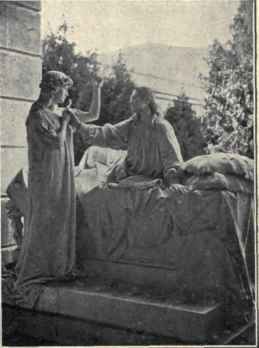
The Da Passano Monument.

Simple Grief. The Drago Monument.
Of all the works of art, however, which line these mortuary halls, that which impressed me most was the memorial to Carlo Erba - another masterpiece by Saccomanno. The general idea of it is seen at once. It is that of a lonely, broken-hearted woman leaning against the tomb's dark portal in despair. But gradually, as one studies this remarkable figure, one realizes its consummate art. The helplessness and absolute abandon of the posture, the relaxation of the weary form, the upturned, anguish-laden face of one too crushed as yet to pray, and utterly oblivious of everything but sorrow, together form a picture of such mute despair and hopeless grief as I have never elsewhere seen in marble. Moreover, with a poet's instinct, the sculptor has suggested two great thoughts which may in timeconsole this broken heart. For one hand holds a bunch of poppies - emblems of eternal sleep. The other rests upon the tiny model of a serpent, whose curving body, joined at head and tail, formed once the symbol of eternity and immortality. So far as other consolation goes, one feels that this majestic figure is typical of perfect constancy. Upon the awful tragedy of this separation the curtain of another drama of the heart can never rise. If her pale lips could speak, we may feel sure that she would say:
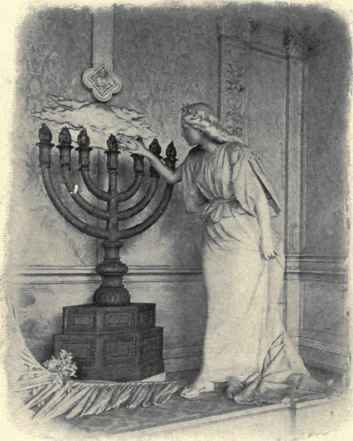
The Montanara Monument.
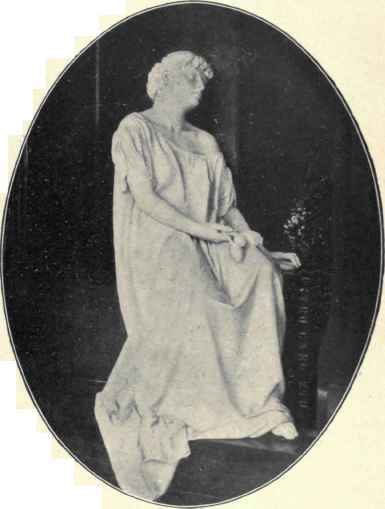
The Anguish Of Bereavement. The Erba Monument.
" I have loved as a woman may love But once in her life. Hereafter My heart shall pulse as a shell
To the throb of remembered seas.""
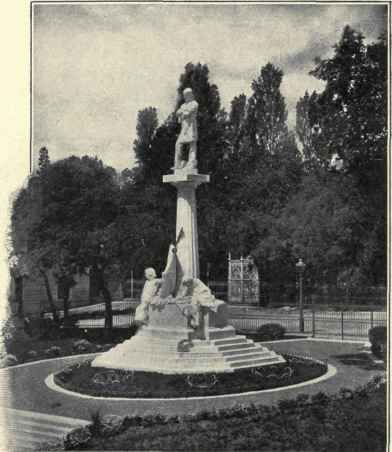
The Mazzini Monument.
The names of most of those who sleep in Genoa's Hallowed Field are unknown to the foreign visitor; but on the hillside, just outside the statue-bordered corridors, reposes one whose efforts in the cause of freedom long since gave him an immortal fame, - the great Italian patriot, Mazzini. Here, then, is still another gifted son of Genoa, who suffered persecution all his life, yet is now honored, as few men have ever been, by an adoring nation.
"City superb, that hadst Columbus first For sovereign son; Be prouder that thy breast hath later nursed This mightier one".
And Genoa is proud of it. Hence, in addition to her monument to Christopher Columbus and the equestrian statues of Victor Emmanuel and Garibaldi which one finds in all Italian cities, there has been also reared in Genoa a memorial to the inspired Dreamer of United Italy. Upon a single Doric shaft, symbolic of his austere life of self-denial, he stands absorbed in contemplation, while allegorical statues; representing Thought and Action, ornament the pedestal. Sadness is outlined in his marble lineaments, as it was really stamped upon his face; for, as Carlyle once said of him, his was "a martyr soul".
Every one knows what Italy was in the early part of the nineteenth century, when Metternich cynically called it nothing but "a geographical expression," when monarchy was there synonymous with despotism, and when the dungeons of the Spielberg, like those of Petropavlosk in St. Petersburg to-day, were tenanted by hundreds of heartbroken patriots. It was, indeed, the sight of some of his unhappy countrymen, dragged off from Genoa to exile and imprisonment, that led Mazzini, when but sixteen years of age, to dedicate his life to the liberation of his fatherland from foreign and domestic tyranny. Accordingly, in 1830, he organized the revolutionary party, called "Young Italy," which soon acquired such a dangerous notoriety. Its motto was "God and the People"; its method popular education and, if necessary, insurrection; its aim a unified Italy, under whatever form of government should be ultimately chosen. Mazzini himself desired only a republic; yet when his dream of unity had been fulfilled, and Italy instead of a republic had preferred a constitutional monarchy, he wrote: "I bow my head sorrowfully to the sovereignty of the popular will, but monarchy will never number me among its servants or its followers." But before seeing even this partial realization of his hopes, how many dreary years of suffering were necessary! For so convincing were his arguments, and so contagious was his enthusiasm, that he was feared by every State in Europe, and secure in none. His was a soul that knew no foolish vanity, and hence when living in London as an exile, and earning a precarious livelihood by writing for periodicals, he opened a night school for Italian waifs, mostly the boys employed by organ-grinders, and notwithstanding his small means mainly supported it for seven years. The records of the disappointments, failures, acts of treachery on the part of friends, and plots for his assassination, which filled his forty years of patient struggle, would have completely crushed a less courageous soul. Sorrow, sacrifice, and separation formed the trinity of his fate. But hope rose ever in his lonely life like a perennial fountain in the desert. The consciousness of Right sustained him; and even his enemies conceded the heroic grandeur of the man, the lofty elevation of his moral tone, and his unwavering faith in God. For he was always careful to distinguish between republicanism and atheistic socialism, and heartily condemned the acts of the Parisian Communists, and many of the aims of
Continue to:


My Books

