


Genoa. Part 8
Description
This section is from the book "Genoa - John L. Stoddard's Lectures", by John L. Stoddard. Also available from Amazon: John L. Stoddard's Lectures 13 Volume Set.
Genoa. Part 8
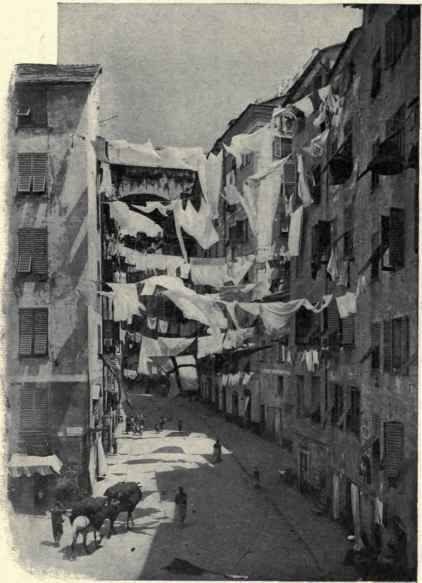
A High Wind In A Highway.
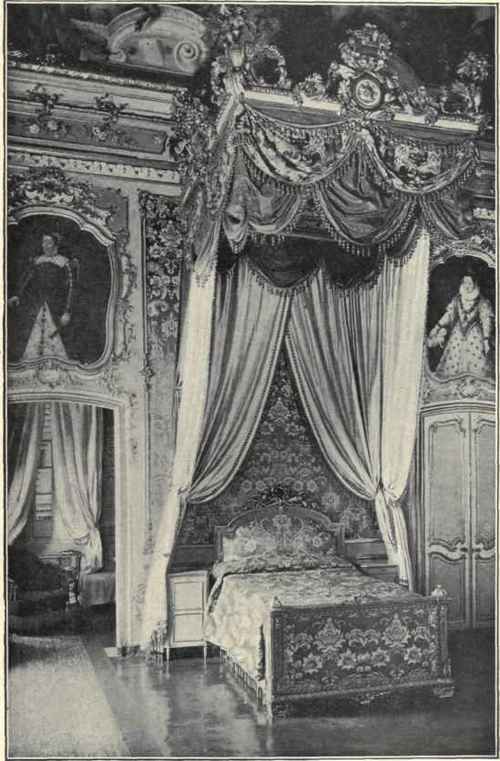
Bedroom Of The Doge Of Genoa, Eighteenth Century.
It is agreeable, too, in Genoa on a summer's day to leave the glare and tumult of the broader streets and enter such a church as that of the Annunziata, whose lavish decorations, it is said, were made at the expense of one of Genoa's old, noble families. To saunter slowly through its vast enclosure, noting its ceilings radiant with paintings set in frames of gold, its lofty, fluted columns of red marble, and all the art and richness of its sumptuous chapels; to choose at last a seat in one of the cool aisles that stretch in dusky splendor from the heavy leathern curtain at the doorway to the gorgeous chancel; and then and there to read, for an hour or two, of Genoa's mighty past - is to enrich one's life with memories that can never die. But, above all, no haste in doing this! No "chatting" with companions upon personalities! One sympathetic friend will be enough in such a place - perhaps too much. For profitable sight-seeing is spoiled by crowds, inane remarks, and a lack of suitable companionship; and many a priceless pilgrimage, dreamed of for years, and finally attained by sacrifice, is, in the realization, spoiled by mere gregariousness.
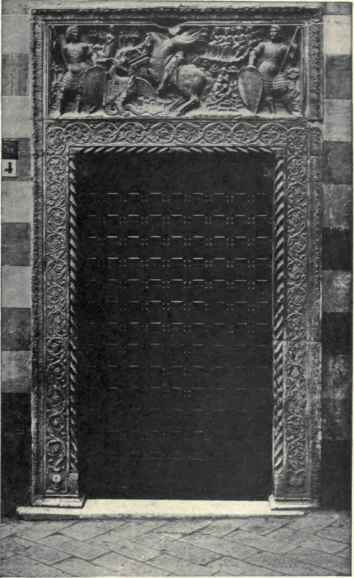
A Relic Of Better Days.

Interior Of The Church Of The Annunziata.
There is a little church in Genoa, called San Donato, which dates from the twelfth century, and calls to mind an even older Genoese conspiracy than that of Fiesco, since close beside this sacred edifice stood the palace of the chief intriguer, the Marquis of Raggio. That residence, however, like the palace of Fiesco, was long ago torn down by the Government, as the home of traitors. The plot of Raggio was discovered by a lucky stroke of fortune on the very eve of its accomplishment; and as the Marquis callously avowed his part in it, he was condemned to death. While on his way to execution near this church, he asked, as a last favor, that he might once more clasp a famous crucifix which one of his ancestors had brought back from the Holy Land. His prayer was granted, and a priest was sent to his palace to obtain it. Meanwhile the convoy of the prisoner halted in the street, surrounded by the populace. At length the desired crucifix was brought. The Marquis kissed it reverently in presence of the multitude; then with a sudden motion drew the upper part of it from the body of the cross, which, like the sheath of a sword-cane, really held a dagger. Plunging this poignard in his breast, before the amazed attendants could prevent it, the prisoner fell lifeless at their feet.
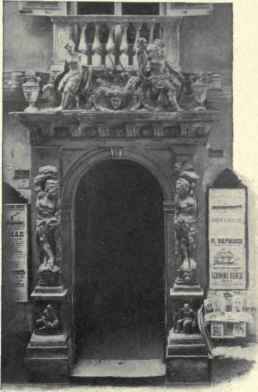
The Old And New In Genoa.
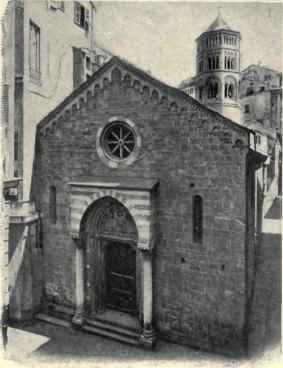
The Church Of San Donato.

The City Of The Dead, Genoa.
In a picturesque valley, nearly two miles from the city, lies the Campo Santo, or cemetery of Genoa, which in its number of magnificent funeral monuments has no equal in the world. It is unfortunate that both the Italian and German languages have much more beautiful names for the loved resting-places of their dead than has our own. The former's sweet, harmonious "Campo Santo," or the Hallowed Field, and the appropriate German title "Friedhof," or the Court of Peace, suggest a tenderness of sentiment, wholly lacking in our practical titles "Burial Ground" and "Graveyard," and the still colder and more formal "Cemetery." Akin to the meaning of "Campo Santo" also is the touching German name "God's Acre," of which the poet Longfellow has sung:
"I like that ancient Saxon phrase, which calls The burial-ground God's Acre ! It is just; It consecrates each grave within its walls, And breathes a benison o'er the sleeping dust".

Genoa's Campo Santo, From A Distance.
Genoa's city of the dead is seen at a considerable distance up the valley, and, like the city of the living, has for its background an amphitheatre of majestic mountains, screening it from northern storms. It first reveals itself as a gigantic quadrangle surrounded by imposing colonnades. The farther wall, much higher than the rest, - with which it is connected nevertheless by steps and galleries, - is built upon a terrace; and in the centre of its white façade a circular temple stands in spotless purity, domed somewhat like the Pantheon at Rome. Within the square itself are multitudes of lowly graves, each designated by a slender cross, beside which often hangs a small memorial lamp. These snow-white crosses, from a distance, look like flowers blooming in a garden, and call to mind the legendary asphodels whose pallid blossoms covered the Elysian fields. Moreover, in the centre of this hallowed area stands a noble figure of Religion, which, as it clasps the Bible and the Cross - the emblems of its faith in God and immortality - and gazes heavenward serenely from a scene of sorrow, otherwise unbearable, appears the guardian of the thousands sleeping near it, and the comforter of those who mourn. But there are other features of the Campo Santo more impressive than this vast enclosure. For what appear to be from a distance merely plain white walls and colonnades, prove upon closer inspection to be galleries of enormous length, bordered on either side by sculptured tombs and groups of statuary, bewildering in their number and variety. Let me concede at once that all of their designs are not in perfect taste, and even that some of them are characterized by unpleasant realism. But of what gallery of painting or of sculpture in the world cannot the same be said ? In all art exhibitions we are forced to make a selection, passing by works which have for us no interest, and choosing those which most appeal to us. This must be also done in Genoa's Campo Santo.
Continue to:


My Books

