


Lake Como. Part 15
Description
This section is from the book "Lake Como - John L. Stoddard's Lectures", by John L. Stoddard. Also available from Amazon: John L. Stoddard's Lectures 13 Volume Set.
Lake Como. Part 15
The gardens of the Villa Carlotta, as well as its collection of rare works of art, are every day thrown open to the public, even when the venerable owner is residing there. Hence it is no uncommon thing to see, clustered about the villa's stately steps, a score of empty boats, whose passengers are lingering in polyglot impatience at the iron gate, which swings upon its hinges every thirty minutes to admit new visitors. Indeed, so many are the applicants, that regular tickets are now sold here for a franc apiece, the receipts from which must often aggregate forty dollars a day. Ascending rose-embowered terraces, resplendent with their banks of bloom, we enter finally a spacious hall, where stand the sculptured works for which the villa is renowned. Four of these are by Canova, - the most admired being his well-known Amor and Psyche. The gem of the collection is, however, the superb relief by Thorwaldsen, placed as a frieze around the walls of the apartment, and representing in a cortege, more than one hundred feet in length, the triumphal entry into Babylon of Alexander the Great. Peculiar interest attaches to this work, for it was ordered, originally in plaster, by Napoleon I. to decorate the throne room of his palace of the Quirinal at Rome. Later, he gave directions that it should be also carved in marble, intending it probably for the temple of Glory in Paris--now the church of the Madeleine. The sum of three hundred and twenty thousand francs was allotted for this purpose, but only half of this had been paid when the Napoleonic downfall came, and the modern Alexander found himself a prisoner at Saint Helena. The Bourbons naturally did not care to carry on a work designed for their great adversary, and hence Thorwaldsen was compelled to enter into negotiations with several European courts, and offered to sell the frieze to any one who would furnish the money necessary to complete it. No representative of royalty came, however, to his rescue; and it was only a private individual - Count Sommariva - who purchased it, and caused it to be finished in marble at a cost of seventy thousand dollars. One should not fail to notice, at the end of this array of animated warriors and horsemen, its last two figures, - to the right of the entrance door, - for these are portraits of the sculptor and his benefactor, the former calling the attention of the latter to the work. Count Sommariva's likeness is commemorated also in a marble bust, placed in a corner of this hall of sculpture. Unfortunately, however, the interest naturally awakened by the portrait of so generous a patron of the fine arts is somewhat marred by the discovery that the bust has been consigned to a pedestal, from which the title of a former statue has not been erased. Accordingly, beneath the manly, dignified countenance of the count one reads with some astonishment the word, - "Maternite"!

The Entrance Gate.
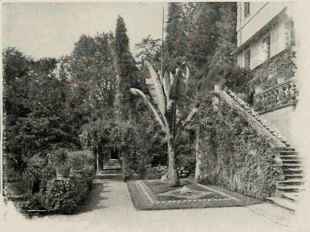
The First Terrace.
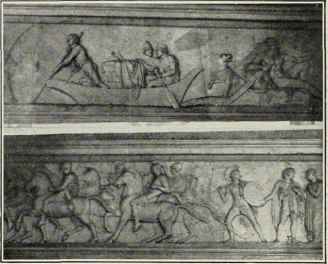
Part Of The Alexander Relief. Figures Of The Sculptor And Sommariva At The Right.
From the fine art collection of the Villa Carlotta it is but a step to the perennial verdure and seclusion of its famous park.
To one accustomed to the flora of the northern part of the United States, the vegetation of the Italian lakes - in fact, of most northern Italy and South Tyrol - is charmingly surprising, since all these regions have a latitude farther north than that of Boston. This is particularly true of sheltered portions of Lakes Como and Maggiore, where in a narrow strip of territory every kind of trees and plants known in a temperate clime, as well as many representatives of the tropical and frigid zones, are found as vigorous and luxuriant, as if they were indigenous to the soil. Thus palms, bananas, and other tropical plants grow side by side here with Siberian pines, cedars of Lebanon, Japanese cryptomeria, and Californian sequoia. One sees here also many pergolas, whose roofs are gemmed with citrons, oranges, and lemons, though these must be in winter guarded from the frost by frames of wood and glass. Of this remarkable productiveness and prodigality of charms no finer example can be found than in the gardens of the Grand Duke. Flowers are never absent from their shady avenues and sunny slopes, nor perfume from their balmy air; and though the same is true to some extent of all protected gardens on the Italian lakes, such as the Villa Melzi, Villa Trotti, Villa Margherita, and many more, yet those of the Villa Carlotta present these characteristics on the grandest scale. Long after the twilight of the year begins to fall, the subtle perfume of the olea fra-grans - whose insignificant flowers are often passed unnoticed by the stranger - mingles with other autumn scents, and gives the air around Lake Como a distinctive character that renders it a standard, with which similar atmospheres may be compared.
Continue to:


My Books

