


Lake Como. Part 24
Description
This section is from the book "Lake Como - John L. Stoddard's Lectures", by John L. Stoddard. Also available from Amazon: John L. Stoddard's Lectures 13 Volume Set.
Lake Como. Part 24

Tomb Of Pope Clement XIII.
Who would suppose it possible to find upon this road two celebrated works of art? Such is the case, however; and what is even more remarkable is the fact that the small town of Cremia, half a mile beyond Rezzonico, contains them both. One forms an altar-piece in the old sanctuary of San Vito, on the shore, and is a really beautiful Madonna, painted by Borgognone, the great contemporary of Leonardo da Vinci, and one of the foremost artists of his age. The other hangs in the church of San Michele, situated far up on the mountain-side, and is a genuine work by Paul Veronese, the subject being the victory of the archangel Michael over Lucifer. That this comparatively unknown town should have acquired such treasures is due to the civic pride of its citizens. Who gave to it the exquisite Madonna of Borgognone is uncertain; but Veronese's noble painting was secured for it in 1586 by Count Pez-zetta, who loved his native place and wished to make it famous. Two other public-spirited men contributed its frame. Of course the Cre-mians are immensely gratified to own these works, and would not part with them on any account. Yet they have not been left untempted. About a century ago, an envoy of the Austrian emperor approached the Cremian commune with a handsome offer for the painting by Veronese, together with the promise of an accurate copy of the original to replace it. The town authorities went so far as to take the matter into consideration, and there were arguments for and against the alluring proposition; but it was finally refused, and little Cremia, poor but proud, still owns the picture of the great Venetian, which it has treasured for three hundred and twenty years.
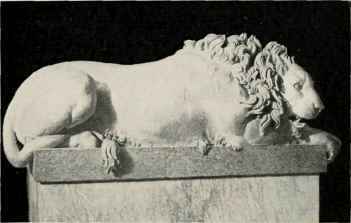
Figure Of One Of The Lions.
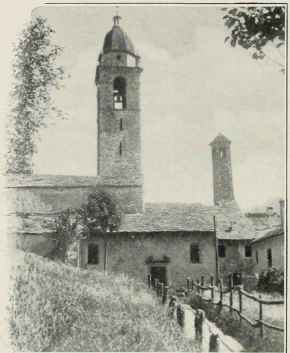
The Church Of San Vito.
Advancing farther northward on the Strada Regina, which here commands the noblest views, we see, not far from Cremia, on a cliff five hundred feet above the lake, the massive ruin of a once redoubtable robber's nest. It is a remnant of the formerly well-known castle of Musso. Its situation is imposing, and must, three hundred and fifty years ago, have been impregnable. Moreover, it possesses a romantic history, wild as the crag on which it stands, and illustrating well the mediaeval days when its despotic lord spread terror far and wide. In 1525 the chatelain of Musso was a man whose name - Gran Giacomo de' Medici - was claimed by him to be a proof that he was related to the famous family of Florence. However that may be, he was then commonly known, and is still usually spoken of, by the diminutive title of "II Medeghino," or the Little Medici. Unscrupulous and daring, this young adventurer, at the age of sixteen, had already committed murder in Milan, - a deed for which he was exiled to Lake Como. This may have been advantageous for Milan. It certainly was not so for the lake, where from that time, for many years, his evil genius found free scope for crime. He was at once attracted to the castle of Musso, perceiving in its easily defended site a suitable base of operations for the part he meant to play upon the world's disordered stage. He therefore frankly asked Francesco Sforza, Duke of Milan, to give it to him, in return for certain favors he had rendered him. ' It was significant of the morals of that frightful age that Sforza promised him the castle, provided he would first oblige him by murdering a member of the great Visconti family, whom he dreaded as a rival. True, this Visconti happened to be a friend of II Medeghino, but such a trifle gave that youthful ruffian no concern. He therefore promptly ran his sword through him, and claimed the castle for his own. It was another action typical of the times that Sforza, while apparently conceding it with pleasure, gave to II Medeghino, together with the title-deed and letter of introduction, a private missive for the keeper of the stronghold. Giacomo was shrewd enough, however, to unseal and read this note, and found that it instructed Musso's guardian to cut his throat at once! Needless to say, the missive was destroyed. Nor is it strange, that when II Medeghino found himself the actual possessor of the fortress, he cast all scruples to the wind, and entered boldly on a course of piracy. The castle, naturally strong, was forthwith made by him so formidable, that it could easily repel attack, and outlast any siege. And now as an unprincipled brigand, plundering right and left, levying tolls on every passing boat, and paying his retainers well, II Medeghino speedily gathered round him several thousand well-armed desperadoes, and with them manned a powerful fleet. Little by little, the exploits of these outlaws made their chief a man worth cultivating by contending rivals. Accordingly, adroitly favoring now the Duke of Milan, and now the French or Spaniards, this corsair of Lake Como played for years a great political role, which paid him well. Thus, for his aid in making war upon the Swiss within the valleys bordering on the lake, he was rewarded with the titles of Governor of Musso, Marquis of Como, and Count of Lecco, and was informed that he might add to his domains all of that territory he could take. Indeed, by his attack upon the Swiss, - who were intruding on the dukedom of Milan, to aid the French king, Francis I., - II Medeghino no doubt caused in part the defeat and capture of that sovereign at Pavia! Such was his power, that he at one time actually coined money, stamped with his own name and arms. At last, however, in 1532, having offended both the Swiss and Milanese, his enemies combined against him, and brought the old marauder to extremities. Yet, though defeated by his numerous foes, and driven into Musso, like a lion to its lair, he still was strong enough to make good terms, and left his stronghold only after having received an extensive tract of territory, a pardon for himself and followers, and liberty to take with him his arms and ammunition. These terms were honorably kept; but when the castle he had held so long was empty, the prudent Swiss dismantled it, and made it the old, harmless ruin that it is to-day. Thenceforth, although his power was largely gone, II Medeghino lived on as a soldier of fortune, letting his troops out to the highest bidder. As such, he served the Spanish emperor, Charles V., in the Netherlands, as well as the Duke of Tuscany in Italy, but was at heart the same freebooter to the last. How can we understand the fact that this notorious assassin seems to have been admired and loved by many? His soldiers, family, and servants certainly were devoted to him; and at his death, in 1555, the Senate of Milan went into mourning, and the old pirate's corpse was followed to the grave by thousands who, in an age when vigor passed for virtue, looked upon him as a hero.
Continue to:


My Books

