


Lake Como. Part 6
Description
This section is from the book "Lake Como - John L. Stoddard's Lectures", by John L. Stoddard. Also available from Amazon: John L. Stoddard's Lectures 13 Volume Set.
Lake Como. Part 6
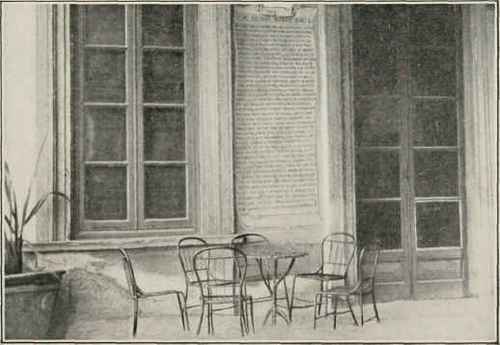
Pliny's Letter.
To linger leisurely beside this intermittent stream, and watch its ebb and flow, before it passes underneath the villa to the lake, requires more time than one can usually spend here, particularly as the guardian is reluctant to remain for hours with an unknown traveler. But in repeated visits I have seen a noticeable increase or a diminution of its flood, caused probably by some peculiar syphonlike construction of its subterranean reservoir. This variable fountain furnishes, however, only a fraction of the water which comes sweeping down the mountain here. The greater part of it is concentrated in a fall, three hundred feet in height, behind the villa. Always a cascade of considerable strength, its volume is at times so great that any one who stands then on the balcony within the gorge, is in a moment drenched with spray. The roaring of the cataract is, of course, continuous; and for this reason, and because of its inevitable dampness, I cannot see how such a house can ever have been a comfortable abode. In fact, it is no longer occupied, - its present owner, the Marchesa Trotti, preferring to reside in her beautiful villa near Bellaggio. Still, two or three of the old rooms retain a little furniture and family portraits, including that of the famous Princess Belgiojoso, whose name, as we shall presently see, will always be associated with the spot. But everything seems falling to decay. One portion of the building, it is true, still partially relieves it of its gloom. This is its central portico, between whose Doric columns one beholds a glorious view far up the lake and toward the opposite shore. Outside the villa, also, is a garden which repays inspection, although its solitary walks are weed-grown and neglected; while here and there a few poor roses, on bushes which present the appearance of having known better days, still struggle to maintain an evanescent shadow of its former charm. Yet the abandoned spot possesses even now a certain fascination. Its time-worn terrace overhangs the dark green water of the lake, and one can hardly fancy anything more delightful, for one whose spirit is serene, than to walk back and forth beside its vine-clad parapet at evening, and watch the flush of day fade from the snowy mountain peaks, rising from Larian waters to the sunset sky. What opportunities for happiness seem wasted here! Beyond this garden's southern gate, a path winds onward through the silent forest toward the outer world, solemn and almost sinister in its seclusion. Occasionally ancient stairways, green with moss, incline mysteriously upward to the wooded height, much as one sees them in some immemorial forest in Japan, marking the way to an old Shinto shrine. Below this path, the cliff descends abruptly to the lake; and, since no parapet is there to check the fall - intentional or accidental - of a passer-by, the sharp declivity and gloomy depths suggest some gruesome possibilities. In fact, the founder of this villa is said to have committed crimes which caused him to retire to its lonely site, where till his death he was a prey to constant apprehension and remorse. What is known, therefore, as the Villa Pliniana was not actually the residence of Pliny. The Roman's name has been bestowed upon it simply because of his description of the spring. The building was erected in the year 1570 by Giovanni Anguisola, who is believed to have chosen this retreat through fear of assassination at the hands of papal agents, in punishment for his share in the murder of the son of Pope Paul III.
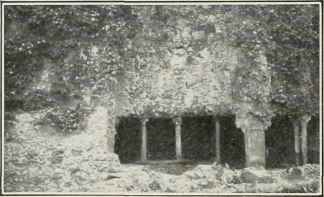
The Intermittent Spring.
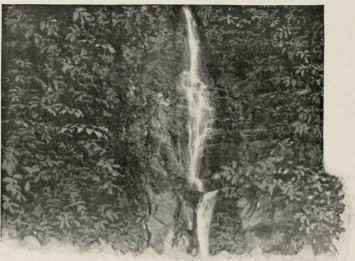
The Cascade Of Villa Pliniana.
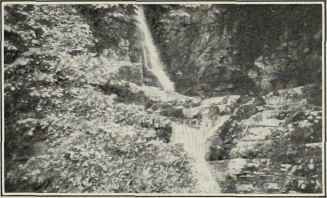
The Lower Falls.
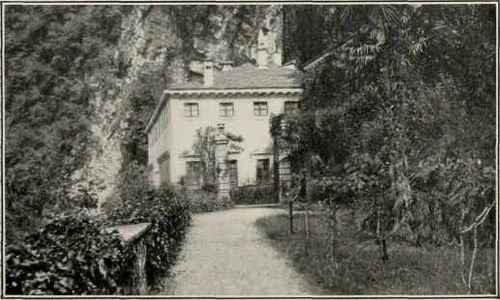
In The Garden.
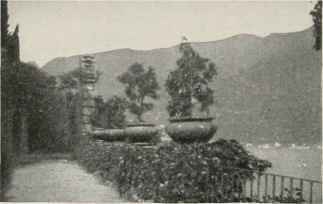
The Terrace.
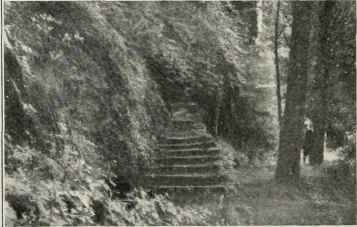
The Forest Walk.
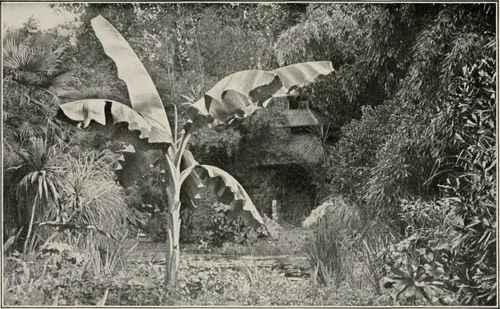
In The Park Of Villa Trotti.
Later, the masterful Viscontis owned it; and when, in 1797, the star of Bonaparte had risen over the battlefields of Areola and Rivoli, it was for a time the abode of the future emperor of France and king of Italy. Of its more recent occupants none is so interesting as the mother of its present owner, - the beautiful Princess Christina Belgi-ojoso, who lived here in the middle of the nineteenth century, and proved herself one of the most heroic and devoted partizans of Italian unity. All through her youth, in the dark days of desperate efforts and of hope deferred, she had profoundly sympathized with the aspirations of her countrymen, looking with horror on the espionage and cruelty with which such noble patriots as Silvio Pellico and Mazzini were hunted down, imprisoned, killed, or exiled in their struggles against despotism. Hence, finally, in 1848, when Lombardy rebelled against the rule of Austria, this revolutionary princess threw herself into the movement heart and soul. Not satisfied to influence Italians merely by her eloquence, she actually raised and equipped a body of volunteers, and personally served with them in the army of King Carlo Alberto of Sardinia. When he, however, - defeated at Novara by the Austrian general Radetsky, - had abdicated in favor of his son, Victor Emanuel, she hastened to the defense of Rome under the leadership of Garibaldi, and showed there splendid powers of organization in administering hospitals for her wounded countrymen. There, too, together with other patrician ladies, she is said to have even handled the spade in throwing up barricades to resist the enemy! These efforts proving temporarily unavailing, the princess left her native land, and was forbidden by the Austrian Government to reenter it. Retiring to Paris, her home there soon became a refuge for political exiles and rendezvous for advocates of liberty. A friend of Victor Hugo and of Heine, she founded, edited, and supported journals favorable to the cause she loved, and finally became so dreaded by the Austrians, that all her property, including the Villa Pliniana, was confiscated, and remained so till, by the amnesty of 1856, she was permitted to return. Not long then was the hour delayed for which she had so
Continue to:


My Books

