


Lake Como. Part 8
Description
This section is from the book "Lake Como - John L. Stoddard's Lectures", by John L. Stoddard. Also available from Amazon: John L. Stoddard's Lectures 13 Volume Set.
Lake Como. Part 8
In those days there were also rowboats for the public, which, weather permitting, made their regular trips in relays up and down the lake, the motive power being sturdy oarsmen. Such boats were then distinguished by a curious figure-head, in the diminutive statue of a swarthy Moor, clad somewhat after the fashion of a ballet dancer, and pointing out the course with outstretched hand. A few of these odd figures still remain in boatmen's families on the lake, and are regarded by their owners with a sort of reverence, as tangible memorials of the " good old times." I must confess to being talkative with those who serve me, especially if they are stage-drivers or boatmen. I cannot bear to sit beside them glum and silent, as if I held myself too much aloof to ask them questions appertaining to their daily labor and their simple life. Yet it would be a difficult task to estimate how much time and money I have lost in thus conversing on Lake Como! For one amusing characteristic of its boatmen is their inability to say a dozen phrases without gesturing. Hence it is dangerous for a "fare," whose time is limited, to lure his barcauolo into a discussion; for, as he waxes eloquent or grows excited, he drops first one and then another of his oars, to give his hands free scope for emphasis, and frequently these conversational parentheses consume as much of the hour as the voyage itself. As to their mode of speech, it is unfortunate that what is probably the most musical language in the world should be deformed and mutilated by so many dialects. These are so unlike pure Italian, and so provincial in pronunciation, that the inhabitants of different parts of Italy cannot understand one another's patois. That of Lake Como is particularly harsh, consisting principally of the elision of the final vowel of a word, while on the syllable thus truncated is laid a violent accent. Adesso will be shortened to adess, and cinque to cinq - both abbreviations being spoken quite explosively. Even Bellag-gio becomes in this rude dialect Bellag! Fortunately, however, most of the people understand Italian, even though they may not speak it fluently, for education to a certain extent has been made compulsory, and the Italian tongue is taught in all the schools. A foreigner, therefore, is not forced to acquire the vernacular, in order to hold communication with the natives.
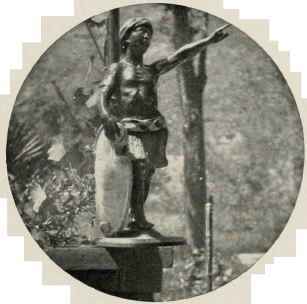
An Old-Fashioned Figure-Head.
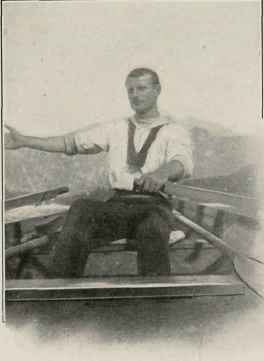
Eloquence By The Hour.

Young Dialect-Icians.
A noticeable characteristic of Italians on the borders of Lake Como is their love of singing. This does not necessarily mean that they sing well, though one occasionally hears pleasing voices. But, well or ill, these humble, hard-worked people sing as much as possible. All through the winter, in the darkness of the dawn, as well as in the twilight of the waning day, the youths and children of both sexes, going to and from the factories, have usually passed my villa with a song; and frequently from workshops, where the hours are long and toil is practically unbroken, one hears a hundred voices blending in pathetic harmony. Pathos indeed forms one of the characteristic features of their songs, which often call to mind the far-off chant of patient laborers on the Nile. An indefinable sadness haunts them - especially the songs of fishermen at night. They seem to tell of tears and suffering in a not too distant past. There can be nothing radically wrong in those who sing thus voluntarily at their work; and it is with great pleasure that I testify from personal experience to many excellent qualities in the laborers of northern Italy. In reconstructing an old villa, and changing fundamentally its neglected garden, I frequently employed for weeks at a time from ten to twenty workmen daily, yet none of them was ever other than respectful, honest, sober, and industrious, and all were eager to secure, and anxious to retain employment, although the payment for it averaged only fifty cents a day. As builders, they are unsurpassed, and scarcely less remarkable as artificers in metals, while their achievements in producing exquisitely inlaid furniture are astonishing. Unlettered masons often mold the ornaments of palaces. Each village has at least one artist - sometimes several - who can paint a fresco, model a statue, or produce a wall of imitation marble, with a skill that fills one with surprise and admiration. In truth, however, this lake has always been renowned for its skilled artisans. Even in Roman days, before the Lombards conquered it, these laborers were known as the "Magistri Comacini," or Como's Master Workmen, who subsequently organized themselves into a famous guild of architects and masons; and to their genius and fine craftsmanship numerous towers and churches in North Italy are due. There is but one successful way to treat these people, and that is with invariable courtesy, together with that sort of humorous indulgence which one frequently employs toward children. Hauteur, disdain, and arrogance breed in Italian laborers instantaneous resentment; and foreigners who think it necessary to their dignity to talk to them de haut en has, and call them curtly by their first names, in an effort to impress upon their minds that they - poor devils - are inferior to the rich sig-nori, fail to obtain the amount and quality of work desired, and make themselves not only hated, but despised and laughed at by the whole community. The fabled answer of the king of beasts - "One, but a lion" - might well be the reply to any one who should inquire of Lake Como how many islands it possessed. And yet the leonine nature of the solitary Isola Comacina is not physical, but moral. Less than a half a mile in length, some fifteen hundred feet in breadth, and with its summit scarcely fifty yards above the lake, its gentle slopes are eminently peaceful in appearance. Yet valiant men have made its history heroic, as wicked men have sometimes made it horrible, and it has certainly played upon the world's stage a unique and memorable role. About an hour after leaving Como, the steamer comes in sight of it; but so extremely narrow is the curving channel which divides it from the shore, that not until we are in close proximity to it, can we realize that it is an island. How few of all the passing tourists, who give its scanty, almost uninhabited surface but a hasty glance, have any idea that this was the last stronghold of the Roman Empire in northern Italy, - an isolated remnant of a submerged world after an inundation of barbarians, - the one poor fragment of imperial sovereignty which restrained, for a brief time at least, those fierce invaders, destined to give forever to the fertile plains adjoining the Italian lakes the name of Lombardy! Yes, here the little handful, still remaining loyal to the Roman emperor at Constantinople, struck their final blow. It was a hopeless struggle; and, after gallantly withstanding for six months the force attacking them by land and lake, they finally were starved into submission, and gave up both the island and its buried treasures to the Lombard king, Autharis. It was, however, no disgrace to yield to such a conqueror; for so complete and numerous had been his other victories, that he had struck with his spear an ancient column, standing near the modern Reggio on the Straits of Messina, and claimed that it should thenceforth mark the southern boundary of his dominions!
Continue to:


My Books

