


South Tyrol. Part 8
Description
This section is from the book "South Tyrol - John L. Stoddard's Lectures", by John L. Stoddard. Also available from Amazon: John L. Stoddard's Lectures 13 Volume Set.
South Tyrol. Part 8
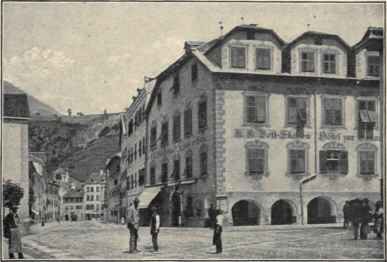
A Street In Meran.
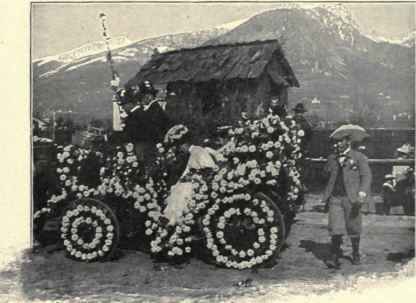
A Flower Corso In The Sport-Platz, Meran.
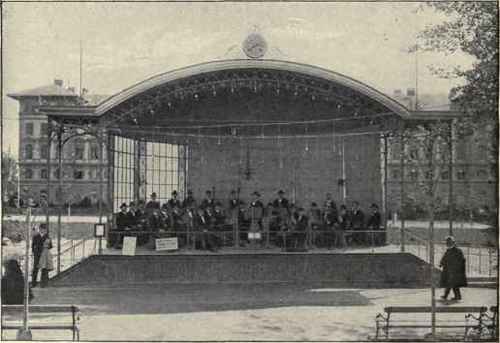
The Orchestra At Meran.
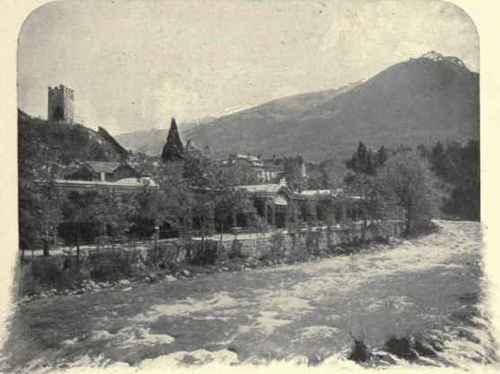
A Portion Of The Wandelhalle.
Yet, unlike many rendezvous for invalids, the quest for health is not too much in evidence in Meran. Here, for example, is no boiling spring, around which, as at Carlsbad, Ems, and numerous other resorts, the patients gather at a certain hour to drink their regular doses. The curative agents here are principally pure air, glorious sunshine, and delicious grapes. Meran is not a place prescribed for the seriously ill. Only a few of those who come here to be cured are incapacitated for exercise or pleasure. The great majority have been advised merely to shun the rigors of a northern winter, without, however, going to a climate as relaxing as that of Sicily or the Riviera. Hence, pilgrims to Meran are veritable sun worshipers; and certain sheltered, southward-facing nooks are visited by hundreds, who stroll about, take coffee on the terraces, read, listen to music, play at fancy work, or are content for a few hours simply to bask, like lizards, in their chairs, absorbing the warm solar rays, though snow and ice may fringe meantime the opposite river bank, dark with shadow.
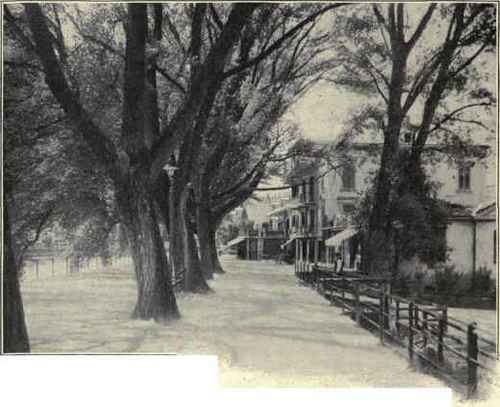
On The Promenade, Meran.
The favorite place for quiet walks and sun baths is the Gilf Promenade, beginning at the massive bridge of stone which spans the Passer in one mighty arch. This is a terraced walk, constructed on the cliffs of a wild gorge, through which the clear, green river cuts its way with flood and foam between the hill of Obermais, on one side, and, on the other, the almost perpendicular Zenoberg. It is so thoroughly sheltered and inundated with sunshine that it resembles an open-air conservatory; for on the bank of the stream, and bordering the ascending paths, are many species of exotic trees and exquisitely scented shrubs, besides a great profusion of ivy and Virginia creeper, covering the natural rocks and walls of masonry, in summer with luxuriant green, in autumn with magnificently colored tapestries of variegated foliage.

The Gilf Promenade.
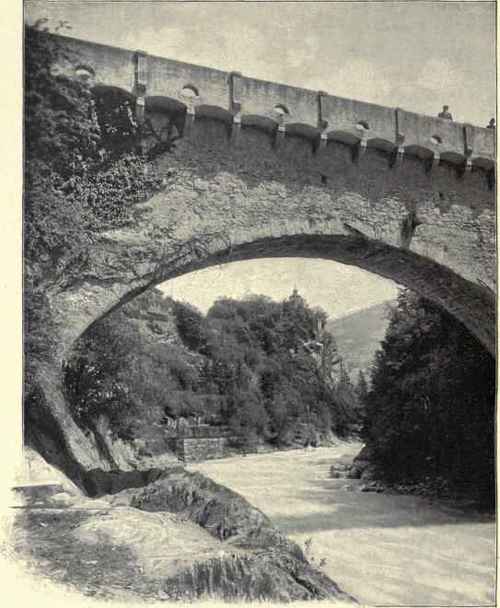
The Zenoberg, Seen Through The Stone Bridge.
The rugged Zenoberg is, from this point especially, a striking object in the landscape; and, forming as it does a natural barrier between Meran and the Passeier Thal, has occupied as prominent a place in the history of the town as it still does in its topography. The grand old rock now wears with melancholy pride only a broken coronet of ruined walls and towers; but these give ample proof that, centuries ago, it bore upon its crest those two essential architectural features of every mediaeval settlement of any size, - a church and castle. Such buildings usually stood On separate heights; but here the lion and the lamb lay down together. Whether the original church was founded by St. Valentine, and was dedicated to him, is still a matter of dispute; but there is no doubt whatever that it was known in the Middle Ages as the Church of St. Zeno, and has given to the hill its name.
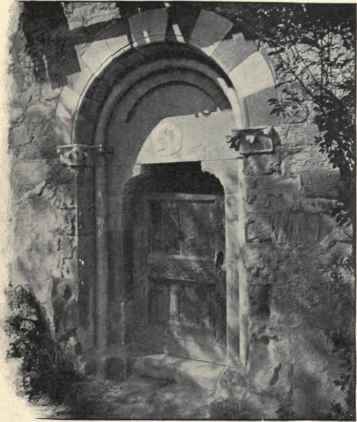
Portal Of ST. Zeno's Chapel, Meran.
If this St. Zeno does not enjoy a world-wide reputation, it has not been the fault of local admirers. Like the apostle for whom the great basilica at Rome is named, St. Zeno was at first a fisherman, and subsequently rose to be the Bishop of Verona, as St. Peter had been Bishop of Rome. One sees, indeed, to-day in the former city the finest Romanesque church in northern Italy, which was erected to St. Zeno in the twelfth century, and in the crypt of which is the bishop's tomb. St. Zeno's fame spread naturally from Verona to Meran, where his popularity is easily comprehended from the fact that he was believed to be very efficacious in averting river floods, - a virtue which commended itself particularly to the people of this valley, on whom the inundations of the Naif and Passer often brought incalculable loss and misery. Accordingly, a chapel was constructed in his honor upon the very brink of the steep cliffs that overhang the wild ravine, through which the Passer sometimes rages with a fury formerly uncontrollable. The curiously sculptured portal of this chapel is, in fact, one of the oldest architectural relics that exist in the Tyrol.
Continue to:


My Books

