


Malta. Part 8
Description
This section is from the book "Malta - John L. Stoddard's Lectures", by John L. Stoddard. Also available from Amazon: John L. Stoddard's Lectures 13 Volume Set.
Malta. Part 8

The Strada Reale.
Each house has one or more projecting balconies, sometimes screened temporarily by a colored awning, as in Spain ; sometimes enclosed and pierced with windows, the blinds of which are usually left slightly open, reminding me of Spanish jalousies, or still more of the Cairene mushrebiyehs, behind which one is always fancying that bright eyes flash and jewels gleam. These houses, too, resemble those of the Orient in having flat roofs, paved with stone or concrete and enclosed with parapets. On these the Maltese families like to sit in summer, to enjoy the evening breeze.
Malta is massive. Not only are its fortifications of stupendous strength, but even its dwellings are of solid stone, which, being soft when quarried, can be chiseled into graceful forms that with exposure grow as hard as marble. As little wood as possible is used in the construction of these houses, both within and without, not merely because masonry is fireproof and far more durable, but because wood is actually dearer here than stone. To the scarcity of the former material, also, is due the fact that coal and charcoal are universally used by the islanders for cooking. The ground floor of most of the edifices of Valetta is occupied by shops, which, in the Strada Reale especially, present an irresistible display of fancy goods, - fine filigree work in gold and silver, jewelry, silks, and, above all, elaborate specimens of Maltese lace, which has been famous for five hundred years. The side streets of Valetta, leading from the Strada Reale eastward and westward to the water's edge, although less rich and brilliant, are still more picturesque and curious than the central thoroughfare. They are impassable for vehicles, being literally staircases, whose broad stone steps are of necessity reserved for foot-passengers. Yet flocks of goats perambulate them, as they do the streets of Naples, their drivers milking them before the doorways with astonishing dexterity, while servant girls of the mansions nonchalantly wait until their cans or bowls are filled. All kinds of trades go on here in the open air, and in the space of half a block you may behold a barber lathering a dusky face, a cobbler soling shoes, a tailor mending clothes, and an old scrivener writing letters for illiterate lovers,-their shops the street, their roof the sky, their only luxury the shade. Valetta therefore, does not lack variety.
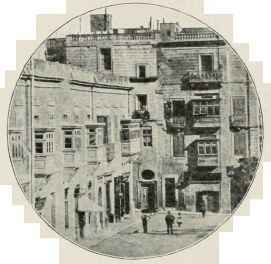
Some Maltese Windows.

The Royal Opera House.
Upon its streets of stairs, along the wharves, and in the marketplace mingles a motley crowd of Arabs, Negroes, Greeks, Italians, and Maltese, whose dark complexions are enlivened by a liberal sprinkling of blond Britons and the scarlet uniforms of English soldiers.
One hears of course a babel of strange tongues. All ports are polyglot, but to my mind Valetta holds the palm for number and variety of idioms. The Maltese dragon seems to speak all dialects. Within its mouth all languages of the Levant are mixed like metals in a crucible. The basic speech of Malta is "Maltese," which is by some considered an offspring of the old Phenician, by others a patois of the Arabic. Undoubtedly it is derived from both, and many of its sentences are ineffaceable signs of Syrian and Saracenic rule; for though we speak of "winged words," they frequently outlive the mightiest monuments, and are among the surest indications of the origin and history of races long since passed away. As for the other elements composing this peculiar language, it is not view of Malta's commerce with all sections of the Mediterranean littoral, and her proximity to Sicily, that the vernacular of her inhabitants should have absorbed a multitude of Levantine and Italian words, which make of it a curious conglomerate. It is, in fact, such a singular medley of oriental and occidental sounds, that it cannot be expressed by the Roman alphabet alone, but must use Arabic characters as well. Hence, it is neither read nor written, and Maltese children must learn English or Italian in order to obtain from books the slightest information. This is indeed a remarkable state of things to find existing in an English colony, almost within sight of Europe, and it undoubtedly accounts to a great extent for the deplorable ignorance of the immense majority of the common people, who speak nothing but Maltese. The education of the higher classes is, however, of necessity trilingual, for English is the language of the government, and the linguistic medium of the law courts has for centuries been Italian. The latter fact has often been a serious detriment to foreigners, and even to residents unfamiliar with Italian, since in all trials judges pronounce sentences, lawyers cross-examine, and witnesses give testimony, solely in the tongue of Dante, or else must trust entirely to the honesty and accuracy of interpreters. So many cases of injustice have resulted from this system, especially where British subjects were unable either to speak or understand the which their interests, honor, and possibly even their lives, were at stake, that the government has just decided that henceforth English shall be used officially in the courts as well as Italian, and that from 1 9 1 5 on the latter shall be superseded, and English employed exclusively.
Continue to:


My Books

