


Injection, Cleaning And Sterilizing The Syringe Tips, Disease As A Factor In Insemination
Description
This section is from the book "Instrumental Insemination Of Queen Bees", by Otto Mackensen, Kenneth W. Tucker. Also available from Amazon: Instrumental Insemination Of Queen Bees.
Injection, Cleaning And Sterilizing The Syringe Tips, Disease As A Factor In Insemination
Injection
The microscope is again positioned over the queen and the magnification changed to a higher power if desired. The sting hook is drawn dor-sally until the sting chamber appears as in figure 2. Applying a 3 percent aqueous solution of Fast Green stain while the queen is in this position will help the beginner to recognize the vaginal orifice and possibly the valvefold.
The syringe tip is then posed above the vaginal opening. With the left hand the valvefold probe is inserted into the dorsal part of the vagina and the valvefold is pushed ventrally until the point of the syringe has passed beyond (fig. 10). Then the probe is removed as the syringe is pushed in farther (about 1. 5 mm. ). If the surrounding tissue begins to move before the syringe has reached this depth, it is probably not in the oviduct. Sometimes the syringe needs to be moved ventrally slightly. The probe and syringe should be inserted only as far as necessary. Beginners have a tendency to insert these instruments too deeply.
Carefully attempt to inject the semen. If the column of semen does not begin to move immediately and the air between semen and saline solution begins to compress, the syringe is not in the median oviduct and must be withdrawn for another attempt. Some adjustments may be necessary. The dorsoventral centerline of the queen's body should be perfectly in line with the ventral and sting hooks, and the syringe should be inserted exactly in this centerline. If these precautions are observed, the syringe should enter the oviduct without difficulty. When the semen begins to move properly without any leakage around the point, the injection can proceed rapidly. Sometimes leakage can be stopped by inserting the syringe a little deeper, but if leakage continues, stop the operation and try again another day. When the injection is completed, the syringe is withdrawn and the queen removed from the queen holder.
Throughout the operation always steady the arms against the edge of the table and the hands and fingers against parts of the apparatus. Some operators object to use of the probe because it cannot be held steady enough to prevent injury to the queen. When we use the probe, we hold it steady by leaning the forefinger against the queen holder mounting.
If the probe is omitted, insert the syringe along the dorsal wall of the vagina; then move the syringe ventrally to push the valvefold aside, and then inward again. Queens of some strains are easily inseminated without the probe.
Some operators load the syringe first while others prepare the queen first. The order is a matter of personal preference.
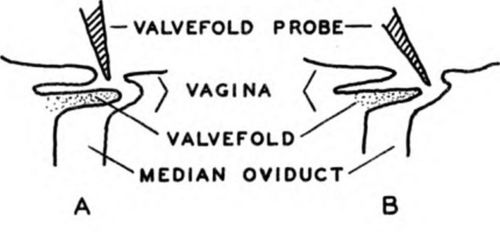
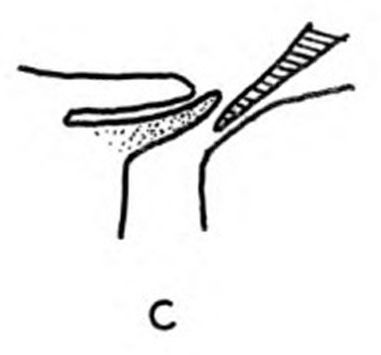
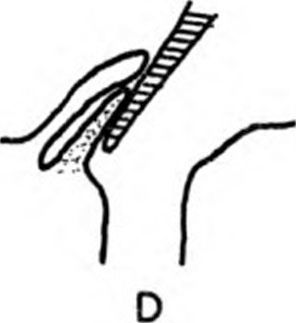
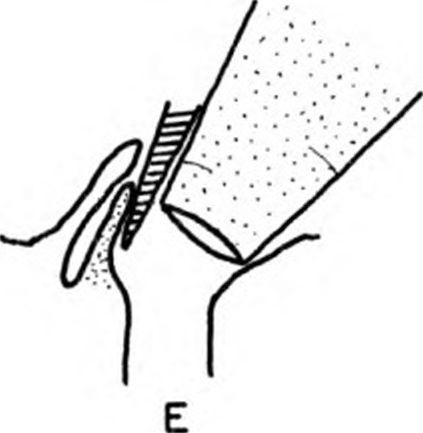
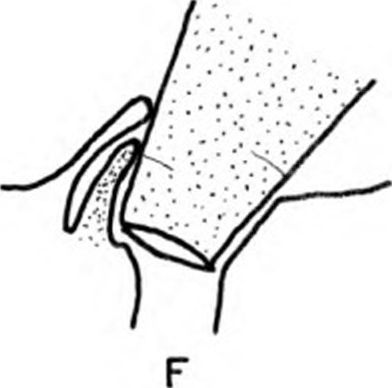
Figure 10. -Manner of pushing the valvefold aside and inserting the syringe. (Redrawn from Laidlaw and Eckert, 1962, by permission of The Regents of the University of California. )
Cleaning And Sterilizing The Syringe Tips
The best way to clean and sterilize the syringe tips is to flush them with water and soak them in ordinary household bleach (active ingredient: sodium hypochlorite) used full strength. Soaking overnight in this material loosens adhering semen so the tips can be flushed clean the following day. This material also sterilizes and does not affect the plastic. A fine wire, 0.005 inch or less in diameter, should be available in case the syringe tip does become clogged. The wire should be cut off squarely and have no sharp edges to damage the soft plastic.
Ordinarily, aseptic methods are not necessary . When changing from one type of sperm to another, the syringe tip can be cleaned and any adhering sperm killed by rinsing thoroughly with water. Precautions to be taken when paralysis or septicemia are present in the apiary are outlined next.
Disease As A Factor In Insemination
There are two adult bee diseases to contend with in instrumental insemination-septicemia and paralysis. Neither one is considered a very serious disease under ordinary apiary management, but in instrumental insemination they can cause disastrous losses if not controlled.
A queen that has contracted septicemia during insemination will die a day or two later and soon show the typical symptom of this disease: dismemberment of the body parts. If this bacterial disease is suspected but the symptoms are not yet evident, hold the queen a day under humid conditions. If the queen's legs and wings are then not pulled off easily (practically fall off), then the trouble is not the type of septicemia common in the United States. Other septicemias that do not cause dismemberment have been reported in Europe and would probably also be spread by insemination.
Septicemia is spread by instruments that come in close contact with the queen: syringe, sting hook, and valvefold probe. Contaminated ventral hook, queen holder, and hands are not likely sources of infection. The semen of drones dying of septicemia seems to be uncontaminated.
Paralysis is caused by a virus. It kills less rapidly than septicemia. Infected queens returned to their nuclei after insemination may simply not lay and disapper after a few days. Others gradually become sluggish and bloated with clear body fluid. In this condition they will live for several days on the comb or on the bottom board. Some will lay a few eggs before they become sick.
These diseases can usually be avoided by using free-flying drones of any age or confined drones as soon as they are sexually mature or at least within 3 weeks after emergence. Whenever they have appeared, we have controlled these diseases by instituting sterilization procedures. Between each operation or after every third operation, the plastic syringe tip was sterilized with sodium hypochlorite, and the probe and sting hook were sterilized with 70 percent alcohol.
Antibiotics have been used by a number of workers and can be used routinely. At the Bee Research Laboratory, Tucson, Ariz., Terramy cin is used. A stock solution is made up with 2. 5 grams Terramycin (poultry formula-6. 25 grams activity in one-quarter pound) in 100 cc. physiological sodium chloride solution and refrigerated. The stock solution is diluted with eight parts of the salt solution as needed. In loading the syringe with semen, a microliter of the Terramycin solution both precedes and follows the semen. All this is injected, and, as the syringe is withdrawn, an additional microliter of the Terramycin solution is placed at the opening of the reproductive tract before removing the sting and ventral hooks. The syringe is used continuously without cleaning. In a similar method, we substituted 0. 25 percent streptomycin sulfate for the Terramycin. At the Bee Management Investigations Laboratory at Madison, Wis., streptomycin sulfate (0. 5 grams per cc. ) is applied with a brush to the hooks and loaded syringe just prior to insertion of the syringe.
These methods control septicemia. In the case of paralysis, sterilization procedures may be necessary because it is a virus disease.
Continue to:


My Books

