


Manipulation Simplified
Description
This section is from the book "A Living From Bees", by Frank C. Pellett. Also available from Amazon: A Living From Bees.
Manipulation Simplified
Since I am of slight build and weigh only about 120 pounds the lifting necessary when operating with the big hives is something of a problem. I have accordingly sought for ways to simplify the system of manipulation necessary to the production of a crop of honey.
Thus year by year have come changes until it has been possible to demonstrate to my satisfaction that much of the manipulation commonly followed is not only unnecessary but undesirable. Every disturbance of the colony is at the risk of loss, either through balling of the queen or reduction in amount of honey stored or unsettlement of normal hive activity.
With the big hive operated in double units it is possible to produce a crop of honey with not more than three or four examinations of the brood nest in an entire year. As this is written our two story hives have from two hundred to five hundred pounds of surplus honey and the crop is not yet ended. It has been a very unfavorable season for colony preparation for the crop followed by an unusually good honeyflow.
Management is very simple but does require substantial investment in equipment. Only strong colonies should be wintered over and all weaklings should be united. Each colony is wintered in two Modified Dadant hive bodies with at least 100 pounds of stores.
With plenty of stores there is no occasion to disturb the bees by opening the hives until fruit trees are in bloom in late April. At this season a careful check should be made to see that enough honey still remains to insure no let-up in brood rearing in advance of the main honeyflow. Dead bees should be removed and bottom boards cleaned. Poor or failing queens should be replaced in case any were overlooked at the fall examination. At this time the queen will be laying in both hive bodies and the population should be enough to make a cluster to cover six to nine frames. Some of our clusters occupy nine frames in early April. This is the natural result of an abundance of stores with room for expansion.
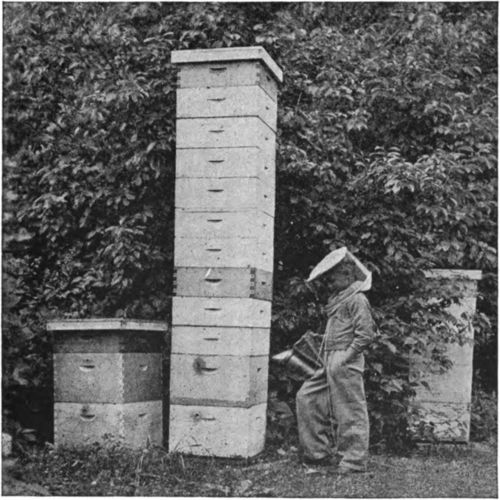
It is only the strong colonies which pile up the big crops of honey. To produce such colonies use big hives with plenty of reserve stores.
In our Iowa location the honeyflow usually starts the last week in May, or the first week in June in wet years when there is white Dutch clover. In dry years when we must depend upon sweet clover the flow starts somewhat later. By the time the flow starts the stores will be all consumed in the lower hive body and what honey remains will be in the upper one. At this time the two bodies are reversed and the upper one placed below so as to put all honey down. Only brood and empty comb will then be present in the upper body after reversing. The incoming honey thus goes to fill the upper body and provide reserves for the preparation for the next season.
Before the bees get crowded the first super is added. If the timing is right it will fill rapidly with honey and there will be no tendency for the queen to move into the super. Sometimes we miss our calculations as to the right time to add supers and the queen does start brood rearing in the super. In that case it is set underneath both bodies and may be left there until the close of the season as shown in the illustration. When the flow is well started it is only necessary to add more supers as needed. When the bees are found to be working well in a super another is placed on top to make sure there is never any shortage of space for storing the incoming nectar. The bees will not occupy the upper one until it is needed and its presence in plenty of time insures against loss.
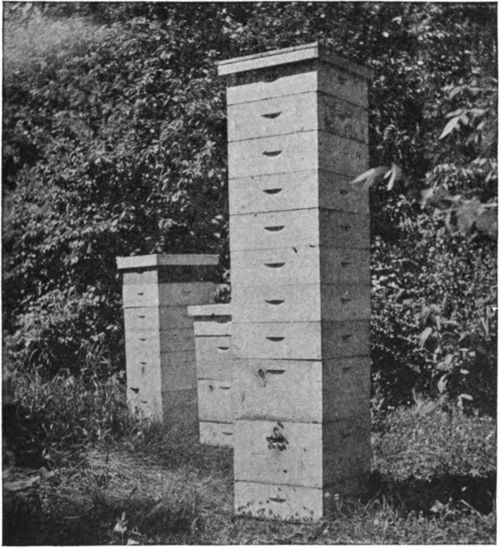
The first super was given this colony too soon, making it necessary to put it below after it had been occupied by the queen for brood rearing. It will probably be found empty at the close of the season.
The picture of the hive on scales shows about an average colony in the unusually good season of 1945 when we harvested our largest crop of honey. When the picture was taken on July 15 there were seven supers but others were added later until twelve in all were filled. Some colonies did even better.
This colony made a net gain of 549 pounds from May 31 until September 12. Of this amount 449 pounds were removed as surplus and 100 pounds left with the bees for winter stores.
In the spring of this year conditions were very unfavorable for bee flight and they were confined to the hives for several weeks, at a time when they usually are gathering forage from fruit bloom and dandelion. But for the large reserve of stores they would have been in very poor condition when the honey-flow started.
With the double hive body and ample supers there is relatively little swarming and no attempt is made to reduce or control it by cutting of queen cells or manipulation of the hive other than as above described. When swarms do come out they are hived and if no increase is desired later reunited with the parent colony. If wanted it is thus secured in quite a natural manner.
At the close of the season the supers are removed, the honey extracted and the supers stored until needed for another crop. The most important examination of the year comes when the crop is removed in the fall. At this season any disease should be found and disposed of to prevent further spread. Weak colonies should be united and poor queens should be replaced. Any colony with less than a full body of stores should be supplied and poor combs removed and replaced with good ones.
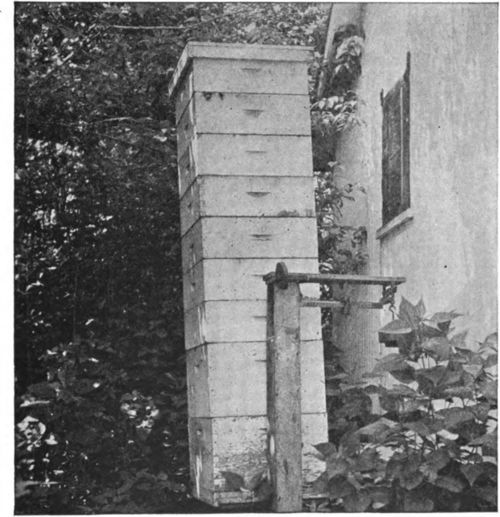
This colony made a net gain of 549 pounds from May 31 to September 10th. Of this 449 pounds was removed as surplus and 100 pounds left with the bees for winter stores.
It will always be necessary to use some colonies for the purpose of drawing new combs and filling extra brood combs with honey for use when needed. When a colony is found short of stores at the spring examination full combs of sealed honey should be available for food. For thirty years I have followed the rule of having at least one such full comb of sealed honey in reserve for each colony of bees. Not many may need them but in an unusually cold and backward spring such as in 1945, such reserves pay splendid dividends by enabling the bees to continue brood rearing under adverse conditions and thus be ready for the harvest when the flow starts.
It is not often that we have such a heavy honey-flow but in the poor seasons when the crop is short it is doubly important to be able to get all the honey there is in the field. It is only the very strong colonies that pile up a big crop and it is not possible to produce such colonies in small hives and with little food on hand.
Thus the manipulation is reduced to three essential examinations: The first at time of fruit bloom in spring, the second just at start of the honeyflow when hive bodies are reversed and the third after the surplus honey has been removed at the close of the harvest. Individual colonies may require more examinations for special reasons. Aside from these it only remains to put on supers, hive such swarms as may emerge, and remove the crop.
Contrast this system with the weekly manipulation in common practice which requires endless labor and brings no more honey at the close of the season. The double brood chamber permits storing sufficient reserves of stores to remove the necessity of feeding and in addition provide conditions to insure strong colonies of the kind that harvest profitable crops.
Increase is made by division of the poor colonies which fail to build a big field force in time for the harvest. Each nucleus is given a young queen reared in the apiary from our best stock. When broken up at the start of the honeyflow, each colony can be made into several as told in another chapter.
It should be noted that the two story Dadant hive has a much greater capacity than the Langstroth hive in common use.
Continue to:


My Books

