


Schedule Of Divisions, The Second Season, Control Of Swarming
Description
This section is from the book "A Living From Bees", by Frank C. Pellett. Also available from Amazon: A Living From Bees.
Schedule Of Divisions, The Second Season, Control Of Swarming
Schedule Of Divisions
The bees were left in their packing-cases until fruit bloom was over in May. The bees had been wintered in two-story hives in packing cases. The two-story hives gave them room for spring brood rearing and the packing cases provided protection against the changing weather of March and April. The bees built up rapidly and the hives were soon full of brood and honey.
As soon as weather seemed warm enough to make it advisable, queen rearing operations were started, so that each new colony could be provided with a queen. Whenever a colony became strong enough so that it could be divided safely, part of the sealed brood, with adhering bees, was taken away and placed on a new stand and given a sealed queencell. If a colony had ten frames of brood it seemed safe to take four frames with adhering bees and use them for making a new colony.
By the time the new queen had emerged and began to lay there would be a nice cluster of bees and the colony would build up rapidly. If weather continues favorable it is an easy matter to build up a nucleus of only two frames, but if there is a cold spell or a sudden check of the honeyflow such weak divisions will require much nursing to get them through, and it may easily happen that the beekeeper will lose much of his newly made increase.
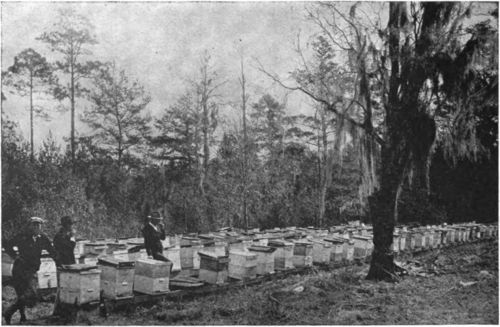
Apiary of extensive honey producer in tupelo region of Florida.
By taking only such an amount of brood as a colony can spare without greatly weakening it, and if necessary combine with available brood from other hives, to make a nucleus strong enough to weather unfavorable conditions, one need run little risk of failure. Later in the season when we did not wish to lose the time necessary to wait for the emergence of queens from cells, and the delay in mating, we secured a supply of laying queens. The queens were introduced immediately when a division was made, and would be laying in a very short time.
The hives were placed in pairs on cement stands, where they were expected to remain permanently. In addition to the frames of brood taken from the parent hives, the remaining space was filled with drawn combs so that the bees were not taxed to build combs when the colony was weak. Had it been necessary for each unit to draw its combs from foundation progress would have been less rapid. Sometimes it did become necessary to give foundation for lack of a sufficient supply of combs, but generally the combs were drawn above the parent colony.
At the end of the first season there were 59 strong colonies from the original fourteen and at no time during the season had the colonies been weakened seriously. In addition to the increase there was several hundred pounds of honey and about forty sets of newly drawn combs.
The Second Season
Since honey was desired instead of bees, the second season, every effort was put forth to make the colonies as strong as possible and to keep them from swarming. While it is impossible to entirely control swarming in large apiaries it can be greatly reduced by means of proper management. If some increase is desired it is much better to break up the poor colonies and make as many as possible from them, giving queens from the best stock.
Strong colonies are the ones that harvest the big crops and for this reason the medium or poor colonies are the ones to use for increase. It would be a mistake, of course, to breed the queens from these inferior stocks. The queens should be reared from colonies producing the largest yields of honey and having otherwise desirable characteristics.
However, no attempt was made to secure increase the second year. The close of the season found the 59 colonies increased to 67 by natural swarms.
Control Of Swarming
The bees had been wintered in the same manner as the year before and permitted to build up in the same way during early spring. At the close of fruit bloom many of the colonies were getting crowded and required some attention to prevent them from swarming. When they became strong, each was examined carefully, and if there was any indication of a desire to swarm, such as newly formed queencells, the queen was removed with a frame of open brood and placed in a new hive. A second frame containing eggs or newly hatching brood was also removed and placed beside the one on which the queen was found. The rest of the space was filled with drawn combs. The hivebody containing the queen was then placed in the same position where the hive had been and a queen excluder placed over it. The old hive was then placed directly over it so that the bees could pass freely up and down from the old brood nest to the new, but the queen was compelled to remain below, where the supply of empty combs gave her an abundance of room to lay. A few days later it became necessary to remove all queencells from the upper story to prevent swarming.
A sudden drop in temperature, just after lifting the brood above, resulted disastrously for a few colonies, since the bees went into the upper story and left the queen and her newly laid eggs below without suitable protection. There is this element of danger when it is done early in the season. A better plan is to place a body of empty combs directly over the brood nest and permit the queen to lay in this, and later set it below with an excluder between the bodies if the weather is still cold.
When the honeyflow began, supers of full drawn combs or full sheets of foundation, were set on the hives as fast as the bees were ready for them. As soon as they showed the least signs of crowding, another super was given, so that there was never lack of room in which to store. No effort was made to extract the honey until the clover flow was nearly over. At that time the colonies were four stories high, many were five stories and some were six stories high and all full of brood and honey from top to bottom.
The stronger colonies occupied two stories with brood and had four hivebodies full of sealed honey. About 140 sets of new combs were drawn the second season. Had we had sufficient combs to hold the incoming honey at the height of the season the showing would have been even better. About five thousand pounds of clover honey was taken and more than one thousand pounds of fall honey or more than three tons in all. It found a ready sale at 12 1/2 cents. As already stated about a half ton was left in the combs for use the following season so that including all taken the first year more than $800 worth of honey was produced. Nearly 100 pounds of wax was also secured.
No account of cost of supplies has been mentioned but these were for the greater part an investment for permanent use.
Continue to:


My Books

