


Introduction Of Laying Queens, Breeding Better Bees, The Making Of Increase
Description
This section is from the book "A Living From Bees", by Frank C. Pellett. Also available from Amazon: A Living From Bees.
Introduction Of Laying Queens, Breeding Better Bees, The Making Of Increase
Introduction Of Laying Queens
When queens are brought from a distance they will come in small cages with one compartment supplied with candy for food. There will be about a dozen nurse bees to care for each queen. Queens which have been long outside the hive and have come through the mails will often prove rather difficult to introduce to her new environment. The bees are hostile to a stranger and a period of adjustment is needed before she is released. The colony to which she is to be given must, of course, be queenless. It is better if the former queen be removed just before the new one is given to prevent the bees from becoming demoralized. On the cage will be found a card with printed directions. The instructions will suggest that the cage containing the new queen be placed between the frames in the center of the hive and the bees be permitted to eat away the candy and thus release her. If the compartment containing candy still be well filled, it will require a day or two for them to remove it and by that time they are likely to accept the newcomer.
The author has found that the queen is more likely to be introduced successfully if the nurse bees which come with her are removed from the cage before it is placed in the hive. Often the bees are more hostile to these strange workers than to the queen herself.
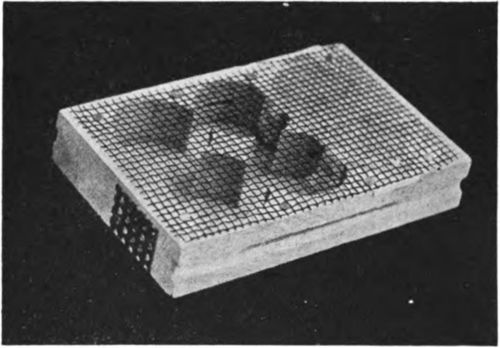
Cage for shipping queens.
Breeding Better Bees
Good stock is as important to the beekeeper as to the poultryman or cattleman. It is simpler to make an improvement in the strain of bees than to make similar changes in a herd of livestock. The life of the individual bee is short and by placing a pure queen at the head of the colony we soon replace the entire working force. If the queen is replaced in spring or summer the former stock will be replaced within a few weeks. In late autumn many of the old bees will remain in the hive until the following spring.
Since all the eggs in a hive are laid by the one queen she must be enormously productive. It is highly important to breed from the most prolific queens. Next to production, gentleness is the most desirable trait, although disease resistance is perhaps equally important. Non-swarming is also greatly to be desired.
The Making Of Increase
In a state of nature bees are likely to swarm when conditions are most favorable for the storing of honey. This, of course, offers safety for the bees since they can reestablish themselves quickly. The beekeeper, however, who is interested primarily in the crop of honey dislikes swarms as a means of increase since the crop is greatly reduced as a result.
In the business of honey production it is the best policy to discourage swarming as far as possible and to make such increase as is necessary at a time when it will not reduce the surplus stored to a serious extent or to depend upon the purchase of live bees in packages from the south.
If one is prepared to sacrifice the honey crop to the making of increase he can build up the number of his colonies very rapidly in a good season. The way this works out can well be illustrated by an experience of the author who devoted one season to the making of increase and the following year to honey production. The result was an increase of fourteen colonies to sixty-seven and the sale of more than $800. of honey in two seasons.
Without at any time running the risk of weakening the colonies to the danger point in making increase, the first season the colonies were divided as often as conservative methods would permit. The second season the bees were pushed for honey production. At the close of the second season we had increased to 67 colonies in good condition for winter, and had sold $700. worth of honey. In addition to the increase and honey we had 180 sets of new combs drawn, which at one dollar each, would be worth $180. This is about half the value at which newly drawn combs in full depth extracting combs are usually estimated. We had also reserved about $100. worth of sealed honey, which had not been extracted, for use in starting new colonies the following season. The total net return, in addition to the increase in bees, was then nearly one thousand dollars from fourteen colonies in two years.
It should be understood that such a result was possible only because there happened to be two very favorable seasons together. During the first season there was an almost continuous honeyflow, which made it easy to increase rapidly. Had it been known that the season would prove so favorable, it would have been possible to make a much larger increase in the number of colonies, but we did not at any time increase beyond the point of safety, in case the honeyflow ceased abruptly.
The second season proved to be one of the best for several years, so the crop was much above the average. Given the same favorable conditions, a beginner could hardly expect to equal such a result, although an expert beekeeper might make a better showing. This is not written with any intention of claiming any remarkable result, but rather to show the possibility when proper attention and favorable conditions are combined.
Continue to:


My Books

