


Any Other Colour Persians. Continued
Description
This section is from the book "The Book Of The Cat", by Frances Simpson. Also available from Amazon: The Book Of The Cat.
Any Other Colour Persians. Continued
Another type is the white-and-black cat, but unless the black patches are evenly balanced, especially in the face, the effect is not pleasing (see illustration, page 232). Harrison Weir gives particulars of some curiously marked cats coming under his notice - "one entirely white with black ears ; another white with a black tail only; another had the two front feet black, all else being white."
I cannot say I have any leaning towards tabby-and-white cats, or orange-and-white, these being the least attractive of any in the fancy. Blue-and-whites are seldom seen, but the photos on pp. 234-5 represent some sweetly pretty kittens of this variety. Their sire was "Yani," a noted blue owned by Miss E. God-dard, and their mother a black-and-white. Blue tabbies, so common fifteen or twenty years ago, are no longer to be seen, at least only here and there at shows, and they have really no value beyond being pretty pets. A cat that has done some winning and has sired some lovely kittens, but must, strictly speaking, be considered an "any other colour" cat, is "Blue Robin," formerly the property of Miss H. Cochran, and now in the possession of Mr. C. W. Witt. This is a blue cat with a tabby-marked head. He was bred from blues and silvers, and his chin, ear tufts, and eyebrows are silver, and his nose pink. As will be seen from his picture, on page 236, he has a grand head and beautiful expression. I am indebted to Miss Hester Cochran for the following notes on " any other coloured " cats : "The cats known as' A.O.C.'s' or' any other colour,' because they are of a colour for which no class is provided, are hard to write about, because they have no history.
They are not bred from A.O.C.'s, and A.O.C.'s are not bred from them. They are either pedigreeless or, more commonly, the result of indiscreet crossing of two definite colours, as, for example, when the owner of a white queen wishes to breed a litter of blue kittens. More rarely they result from a cross which has been resorted-to to fix some special point, as when a white and a blue with particularly massive heads or wonderful orange eyes have been mated with a view to producing a strain noted for their eyes. Years ago the classes were interesting, as they introduced all new colours. "I remember an A.O.C. class at the Crystal Palace not many years ago containing seven entries, all good smokes ; soon after smoke classes were given, and then chinchillas began to appear in this class. These cats being specially provided for, creams were the most noticeable A.O.C.'s ; but now the blue tabbies and broken-coloured cats - that is, some colour and white - usually occupy the A.O.C. class. Notable instances of cats with white spots were'Cain,"Nankipoo,' and 'Kingfisher,' all grand bines with this blemish.

"Lockhaven Colburn." A Good Example of Perfect Black-and-white Markings. (Photo : Koeline & Bretzman, Chicago.)
"In 1892 Mrs. Pattison's exquisitely shaped and coated orange-and-white' Chicot' (pedi-greeless), then shown as tabby with or without white, established a record by winning as best in show at the Crystal Palace. Other tabby-and-white cats have done well. Miss Malony used to show some good ones; the best,'Lindfield Sweet William,' was a blue tabby-and - white, very massive and heavily coated, son of the smoke 'Lindfield Bogie.' Mrs. Pearce, of New Barnet, also used to win with tabby-and-white cats, and Mr. Law's' Buffer' was a celebrity in his day, but whether he was a brown tabby or an A.O.C. is doubtful; he was later known as 'Leopold.' The Hon. Mrs. McLaren Morrison had a really good silver tabby with white feet in 'Kepwick Silver King' ; and later Miss Snell's grand-headed 'Wonderland' made a small sensation.
"Another good cat which won in an A.O.C. class is Lady Mait-land's' Cheeky Blue,' a lovely blue with a sprinkling of white hairs on her body. Blue and smoke tortoise-shells are freaks, and not really exhibition cats at all, but are by some people considered useful for breeding. Personally, I do not think they are capable of producing anything which a definitely coloured cat of proper ancestry cannot produce as well or better. When cream queens were unavailable they had to be used, but now they are becoming unnecessary. Perhaps the best is Miss W. Beal's 'R. Fluffie.' Mrs. D'Arcy Hildyard's'Sengo of the Durhams' was another. Miss Taylor's 'Tawney' began life as a blue with a few yellow marks, and wound up as a good tor-toiseshell, though a trifle too red. Mrs. Cunliffe Lee's 'Tiger,' a kind of yellow-brown, more ticked than marked, and principally distinguished by his great coat, made his mark in the A.O.C. classes.
"Of blue tabby cats which have won well (mostly bred from blues and silver tabbies) there is a long list. They became common through the craze for blues, as silver queens were sent to blue toms. Later the desire for chinchillas started them afresh, as blue queens were sent to chinchilla toms.
"Mrs. Herring's'Braemar' was a son of 'Coeruleus' by 'Turko'
' Upwood Dew' and' Camera' are from the' Timkins' strain ; Miss Jebb's' Julius Caesar,' Miss Rae's 'Romanoff,' Miss Nicholay's 'Sacho,' and Miss Jay's' Holm-wood Skittles' were all celebrated cats. Some of these have thrown beautiful kittens, both blues and chinchillas; and as a makeshift, when a correctly coloured cat of the required pedigree is unavailable, they may, when judiciously mated, be found useful; but good breeders will part with all mis-marked kittens for pets. The best and most definitely coloured A.O.C. I ever saw was Mrs. Davies" Sin Li,' a deep self-coloured chocolate - brown cat. He was supposed to be one of three Swiss mountain cats imported to this country, and he was a most handsome and interesting animal. Unfortunately, he died young, leaving no progeny. Another interesting A.O.C. cat I have seen was a short-haired neuter, red, with black stripes and white paws and chest. In the future I hope to see a variety of strange cats in the A.O.C. classes, but at present they are very uninteresting. Good suggestions for future colours are red, orange, blue, or white with black stripes, chestnut-brown self-coloured, and black with white tips to the fur.
So far as I can see, it should be possible by crossing with various foreign breeds to produce in a few years' time cats of all these colours." One of the finest " any other colour " cats of the present day is now in the possession of Miss Moxon, of Ilfracombe. "Cinder" was purchased from Mrs. Davies, who has a rare faculty of picking up uncommon-looking cats. Miss Moxon writes : - "I am sending you a detailed description of' Cinder,' who is a difficult cat to describe, and is quite the handsomest cat I have ever seen. By' handsome' I mean striking, as she attracts everyone's attention, and very often visitors to our well-filled cattery have not a glance to spare for our other specimens." The following is the description of this very uncommon long-haired cat : -

The Conquest Of The Air (Photo : E. Landor, Ealing.)

Silver Tabby And Orange-And-White Persians (From a Painting by Miss F. Marks.)
"'Tors Side Cinder,' winner of many prizes, including second Brighton A.O.C. kitten class, 1899 ; first A.O.C. kitten, medal, and two specials, Westminster, 1900; first and special for best cat in show, Maidstone, etc.
"'Cinder' was described to me by the lady from whom I bought her in 1901 as' a very peculiar colour - a kind of tortoiseshell creamy smoke.' She has a dark seal-brown mask and ears, except for one creamy orange (tortoiseshell) splash above left eye, and another under chin. These give great expression to her face. Head exceptionally fine, considerable breadth of skull, small tufted ears, short broad face, very sweet expression. Round orange eyes, for which she has won more than one special. Fine outstanding frill of a creamy smoke colour ; fur on chest very long and feathery, of a creamy, bluish smoke shade, with a pale cream knot in centre. Seal spine line, splashed with creamy brown, shading gradually lighter to shoulder knots and side puffs, which are of a rather darker tint than the frill. Paws and legs of a dark seal-brown; waistcoat and knickers of a bluish cream. Splendid thick brush - upper-side to match spine line, under-side of a bluish cream shade. Slightly bluish tint all over, distinct under-coat of palest cream shading to soft creamy blue."
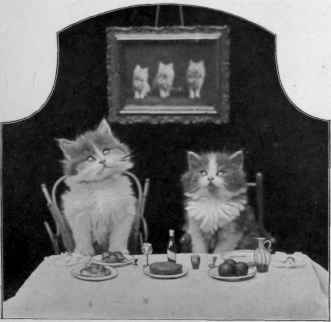
Grace Before Meat (Photo : E. Landor, Ealing.)

"Marcus Superbus," A Silver Smoke Owned by Miss Shaw. (Photo: Moffat, Edinburgh.)
American fanciers have always shown a partiality for broken-coloured cats, and orange-and-white and blue-and-white cats have classifications given for them at the leading shows. In England there is a marked antipathy to these cats, chiefly because they have little or no value for breeding, though they undoubtedly make pretty pets. As a sign of the times, I may mention that at the Westminster show in 1903 the three " any other colour " classes for males, females, and kittens had to be cancelled, no entries having been made.
Speculative, but, I must add, persevering fanciers might derive interest and amusement from trying to breed out - of - the - common specimens. A black-and-white, spotted like a Dalmatian hound, or a cat marked with zebra stripes, could doubtless be produced in time by careful and judicious selection.
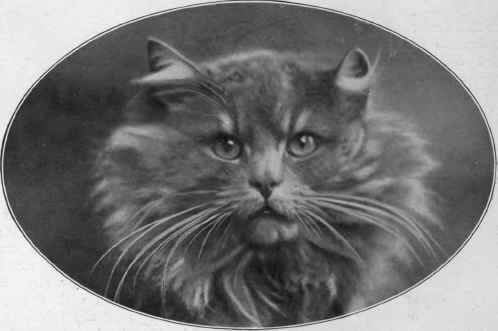
"Blue Robin." (Photo: Witcomb & Son, Salisbury.)
Continue to:


My Books

