


Silver Or Chinchilla Persians. Continued
Description
This section is from the book "The Book Of The Cat", by Frances Simpson. Also available from Amazon: The Book Of The Cat.
Silver Or Chinchilla Persians. Continued
It is a case of tabby blood which needs breeding out of the silvers, and which, no doubt, will be obliterated in time, so that two distinct types of silvers will only exist - the delicately tipped or shaded silvers, and the richly marked and barred silver tabbies. Just as in the case of the blue Persians it took a long while to eradicate the tabby markings which showed the existence of tabby blood, so amongst silvers the bar and stripes need to be carefully bred out, and we shall hope, in the good time coming, to have not self silvers, but a very near approach to this - namely, a perfectly unmarked but yet not wholly unshaded silver cat.

"The Absent-Minded Beggar. " Owned by Mrs. Neild. (Photo: E. Landor, Ealing. )

"Star Duvals. " Silver Persian Owned and Bred by Miss Meeson. (Photo: F. Parsons, Southend-on-Sea. )
There is a greater delicacy amongst silver cats, and more difficulty in rearing the kittens, than in any other breed, and this may be accounted for by the immense amount of inbreeding that was carried on indiscriminately at the beginning of the rage for silver cats; also the desire to obtain lightness of colour caused breeders to lose sight of the grave disadvantages of loss of bone and stamina. Therefore it is that among the silver cats exhibited at our shows we seldom find massive limbs or broad heads or full cheeks. There is a tendency to hare-like proportions, and the faces have a pinched and snipey appearance, and noses are too long. However, great improvement is taking place, and with the numerous stud cats now at the disposal of fanciers, there ought to be no difficulty in making a suitable selection.

"Omar. " The Property of Miss A. Pollard (Copyright 1901 - G. Hitter, Elizabeth, N. Y. )
The question as to the correct colour of eyes for a chinchilla or silver cat is still a vexed question. In self-coloured cats the broad line is clearly laid down - blue eyes for whites, orange for blacks, and orange for blues; but when we come to the more nondescript cats - such as silver and smoke and tortoiseshell - there seems to be a wider margin given, and the line drawn is not so hard-and-fast. Still, I think it is always well to have some high standard of perfection in each breed, so that fanciers may breed up to it, and to my mind the bright emerald green eye is the ideal for a silver cat. I have seen very fine amber eyes which could not fail to attract admiration; but if these are admitted, then all sorts of eyes, not amber but wishy-washy yellow, will be the inevitable result. So many silver cats have eyes that may be described as neither one thing nor the other. Often one hears the remark, " Oh ! but if you see So-and-so's eyes in the right light they are a lovely green. " But viewed by the ordinary eye of a critical judge, they appear an uncertain yellow.
Therefore it is best to set up a standard, and I think it is becoming an almost undisputed fact that silver cats of perfect type should have green eyes, and by green let it be understood that the deeper the tone the better will they accord or contrast with the pale silvery coat.
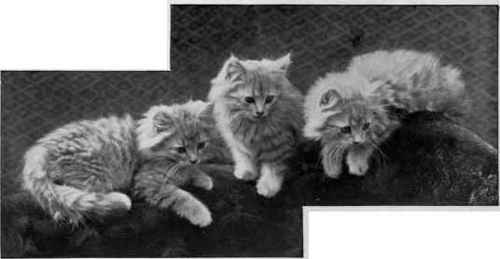
Three Pretty Silvers (Photo: C. Reid, Wishaw. )
I would here impress upon fanciers the great importance of striving to obtain the large, round, full eye, which gives such expression to a cat's face. How many of our silvers of to-day are spoiled by small, badly shaped or half-open eyes ! I do not think sufficient importance is attached by our judges to this point of size of eye. Many are carried away by the correctness of colour, and fail to deduct a sufficient number of points for a beady, badly shaped small eye.
Colour is fleeting, and with age our cats may lose the brilliancy of green or orange, but bold large eyes, placed well apart and not too deeply sunk, will be lasting points in favour of our pets.
There is one rather peculiar feature in the eyes of some silver cats. This is the dark rim which often encircles the eye. This rim decidedly enhances the beauty of the eye, and makes it look larger than it really is, and also throws up the colour. Light, almost white, ear-tufts and toe-tufts are adjuncts which go to make up a perfect silver cat. The nose is of a dull brick red, darkening slightly towards the edges.
Few Persian cats suffer so severely during the process of shedding their coats as silvers, and they present a most ragged appearance at this period of their existence. The lovely fluffy light silver undercoat almost disappears, and the top markings stand out very distinctly, so that a cat that in full feather would be considered a light, unmarked specimen will appear streaked and dark after the coat has been shed. As regards the silver kittens, it is a curious fact that these, when born, are often almost black - or, at any rate, generally very dark in colour, resembling smokes. It is seldom that a silver kitten is light at birth, but gradually the markings and shadings will lessen, and perhaps just the one mite that was looked upon as a bad black will blossom forth into the palest silver. In this respect, silver kits are most speculative, but in another they are cruelly disappointing, for a kitten at three months old may be a veritable thing of beauty, and ere it has reached the age of eight months, bars and stripes will have, so to speak, set in severely, and our unmarked specimen of a silver kit develops into a poorly marked tabby cat.
I may say that if the kittens are going to be really pale silvers they will in the majority of cases have very pale faces and paws, with little or no marking, whilst the body will be fairly even dark grey - perhaps almost black. In a week or two a change takes place, as the undercoat begins to grow, and it will be noticed that the kittens become more even in colour, the contrast between their light face and dark backs will not be nearly so accentuated, and by the time they are nine or ten weeks old they will look almost unmarked. The reason for this is that the dark fur they are born with is really only the extreme tips of the hair, and as their coats grow in length this shading becomes more dispersed.
And here I will allude to the so-called threefold classification which was part of the scheme of the Silver Society, founded by Mrs. Champion in 1900. At the inaugural meeting Mrs. Stennard Robinson took the chair. Voting papers had previously been distributed amongst the members, asking for their votes on the question of establishing three classes for silvers - namely, chinchillas, shaded silvers, and silver tabbies. The votes recorded were fifty-four in favour of the threefold classification, and nine against it. So this was carried by a large majority, and the question of points discussed and settled as follows:
Continue to:


My Books

