


Chapter XXV. Scientific Breeding
Description
This section is from the book "Everybody's Cat Book", by Dorothy Bevill Champion. See also: Your Cat: Simple New Secrets to a Longer, Stronger Life.
Chapter XXV. Scientific Breeding
If fanciers take the time, trouble, and go to the expense of raising cats, why not breed them on scientific principles? That is to say, do not breed a long-haired cat to a long-haired cat, just because it is long-haired, but try" to find out how your cat is bred, and then mate it according to colour, points, etc. Do not try to save yourself a little extra expense and trouble by breeding to a cat in your immediate vicinity, but choose a mate that you think likely to suit your' queen in colour, pedigree and points. Send her on an extra journey, if necessary, and give yourself more trouble and expense, rather than mate her to a cat of inappropriate colour and pedigree. In the end the results will repay you, both from a financial and show standpoint. For example, we will say you have two beautiful kittens, both the same colour and good points; one may be carefully bred for generations, the other one probably bred from cats of mixed colours, and therefore almost valueless for breeding purposes.
Now, if you wished to dispose of these two kittens, you could only ask half, or less than half, the price for the badly bred specimen that you could for the other, as anyone having a knowledge of breeding animals would not purchase a kitten or cat without a good pedigree, and would want to know also the colours of the ancestors.
Emblem of Columbine Cattery.
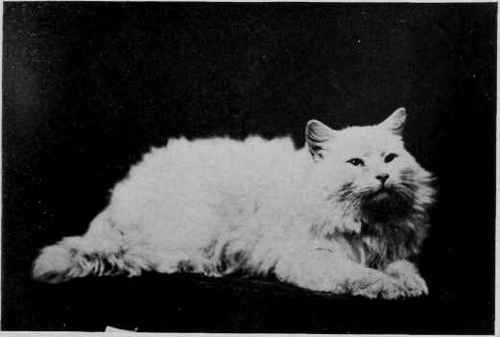
Columbine White Friar.
The great difficulty with most novices is to know what colours it is allowable to cross, so we will begin with whites and go right through the different colours. Always mate white to white, if possible; a tortoise-shell cross may be used, there being a recognized class for tortoise-shells and whites; but the introduction of one white cross will be sufficient for a great many generations. If too much white is introduced, the result would be white cats with probably black and orange patches.
If you wish to breed pure white cats, always mate to pure white, as any colour introduced is very hard to eradicate, except, perhaps, blue; this cross in many cases has proved successful when, of course, the blue is pure blue-bred for generations.
Blacks are better mated to blacks, unless there is any particular fault to breed out. For instance, a rusty black does well when mated to a dark blue, but of course this may produce an unsound under coat, so it is not always successful.
A black may be mated to a silver, producing very good smokes or shaded silvers.
Orange cats are sometimes used with blacks, to produce tortoise-shell; but the orange should be as free from tabby markings as possible, as a tortoise-shell with tabby markings is spoiled for exhibition.
Blues should be crossed with the same colour as much as possible, but if the colour should become unsound or too light, an introduction of a black cross will be advantageous. Never cross blues with browns, oranges or tortoise-shells, if you wish to continue breeding blues; if not, you may mate your blue with a smoke or a silver; but the resulting kittens cannot be sold for breeding pure blues.
Silvers, comprising chinchillas, silver tabbies, smokes, masked silvers and shaded silvers, may be crossed together, but never introduce browns, creams or oranges, as silvers are difficult to obtain without a creamy tinge, and any introduction of the aforementioned colours or tortoise-shell would prove fatal to purity of colour for many generations. If you wish to darken your silvers, try a smoke cross, and if you wish to intensify the colour of a smoke, cross with a black; if your silvers have a creamy tinge, try a blue cross. A blue-bred silver is one of the most valuable cats you can have in your cattery, as the blue cross entirely eradicates the creamy whiteness so often seen in the pale silvers.
Brown tabbies may be crossed with good, deep-coloured orange or orange tabbies, as the introduction of the orange prevents the grey tint that so many browns have. Black is sometimes tried as a cross for brown tabbies, but the results are more often poor, as the colour becomes too dark and is apt to lose the golden tint so much desired.
Orange and creams may be crossed together, also tortoise-shells. Blues are sometimes crossed with these colours to produce creams, but the resulting litters contain too many blue tortoise-shells and other spoiled colours to encourage breeders to try this, unless compelled to do so.
Tortoise-shells can be crossed with solid oranges, blacks and creams; a blue is sometimes used, but not always with good results. White should never be introduced among the solid colours, as parti-coloured cats will be sure to be the result, and although in this country a few classes (but no championships) are provided for these, to fill up the shows, we venture to think that tabby and white, blue and white, black and white, etc., will never be popular or bred for, as it ruins the colour of dozens of kittens before one is obtained with good straight markings, and without straight markings they are expressionless and ugly.
In breeding for colour, do not forsake points. This is just as important, if not more so, than colour, for what good is a cat for exhibition or breeding, with the wrong show points? No matter how good the colour, you had better select a good-pointed animal than one of the same litter with perfect colouring but nothing else to recommend it, as you must remember that the good, all-round specimen has colour in its breeding; therefore, by breeding from the perfect-pointed specimen, you are able to reach perfection quicker than if you choose an animal of perfect colouring only. Breeders will find pedigree counts more than anything else in breeding show specimens true to colour.
Sometimes a cat whose pedigree is said to be unknown turns out a splendid breeder; so, should you become possessed of a magnificent cat with an unknown record, it is well to try this cat, as the pedigree may have been mislaid, or the cat stolen when a kitten, in which case it might possess as good a pedigree as you could wish.
This happened in the best white male I ever owned. His pedigree was unknown; he became a champion, and his breeding record was unsurpassed. Doubtless his ancestors had been carefully bred for generations, but the person who first bought him, as a kitten, made no attempt to procure the pedigree. In such instances it is wise to try any good cat for breeding, even though it will take much longer to convince other fanciers of his good merits as a breeder, as very few fanciers will purchase long-haired cats without a known record, as most of them are aware of the necessity for a good pedigree in breeding animals.
Continue to:


My Books

