


Acariasis (Mange)
Description
This section is from the book "The Horse - Its Treatment In Health And Disease", by J. Wortley Axe. Also available from Amazon: The Horse. Its Treatment In Health And Disease.
Acariasis (Mange)
The parasites which belong to this division are the different varieties of ticks and mange-mites. The presence of ticks on the skin may be looked upon as an accidental circumstance, from which the horse in its' state of domestication is comparatively exempt. The same, however, cannot be said of the invasion of the mange-mites, two varieties of which are commonly found in the horse, one (Psoroptes) the cause of common mango and the other a burrowing mite (Sarcoptes) the ravages of which induce a more severe kind of skin disease, which is difficult to cure owing to the mites burying themselves under the cuticle.
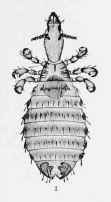
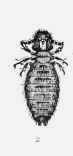
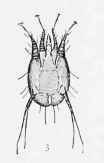
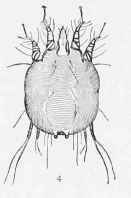
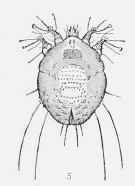
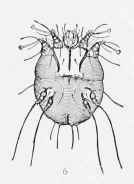

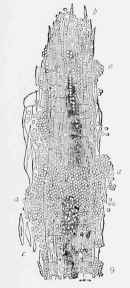

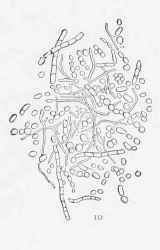
PLATE XXXVI. EXTERNAL PARASITES OF THE HORSE - After Neumann.
1. Haematopinus macrocephalus equi, female, X15.
2. Trichodectes pilosus equi, female, x 15.
3. Psoroptes communis equi, hexapod larva, X60.
4. Psoroptes communis equi, pubescent female, ventral surface, X60.
5. Sarcoptes scabiei equi, ovigerous female, dorsal surface, X60.
6. Same as 5, but ventral surface, X60.
7. Symbiotes communis equi, male, ventral surface, x6o.
8. Symbiotes communis equi, ovigerous female, ventral surface, X60.
9. Horse's tail invaded by tricophyton tonsurans, X200. a, a, mass of exterior spores; b, split summit of hair; c, cells of epidermis of hair, 10- Tricophyton tonsurans, X50.
Symptoms
In all forms of mange the prominent symptom in the first instance is itching, which induces the animal to bite and rub itself, sometimes so vigorously as to cause abrasion of the skin. The disease is first apparent on the withers, the upper part of the neck, the root of the mane. Ultimately it may reach the head, and indeed most parts of the body excepting the extremities. An examination of the skin will lead to the detection of small pimples, and elevations of the cuticle from the exudation which goes on beneath it. The formation of scabs all over the affected surface follows, and these become confluent as the disease advances. Scabs, if violently removed, disclose a raw surface beneath.
A peculiar form of mange in the extremities, due to the presence of a variety of mange-mite, which is known as the Symbiotes on account of being found in clusters or colonies, occurs in the horse, but is only rarely detected, as the itching which induces the animal to rub and bite its legs is generally ascribed to other causes. The acarus usually locates itself in the hind fetlocks, but occasionally it attacks all four limbs, and it is commonly found in cases of grease. The symbiotes appear to be particularly active at night, and a knowledge of this fact is important, because when a horse is found to kick at the stall-post or strike his hind- or forefeet constantly on the floor of the stable during the night, there is reason to suspect the presence of this form of mange (symbiotic mange), and a careful examination of the extremities should be made. The discovery of the symbiotes in the loosened cuticle of the legs will furnish satisfactory evidence of the nature of the disease.
The varieties of mange are to be distinguished with absolute certainty only by microscopic examination of the hair and scabs taken from the parts of the skin which are most affected. The examination is comparatively easy. Scrapings from the diseased parts have to be placed in a drop of water on the slide, teased out with dissecting needles, and covered in the usual way with a thin covering glass, and examined with the half-inch objective. The three varieties of mange-mites which have been mentioned are illustrated in the accompanying plate (Plate XXXVI, figs. 5, 6, 7, 8), and there will be no difficulty in distinguishing them by comparing them under the microscope with the figures.
Treatment
Under ordinary circumstances mange in the horse is amenable to treatment, but when sarcoptic mange is allowed to run its course, the rapid multiplication of the parasites, and the damage which they do to the skin, and the consequent irritation which results, frequently lead to fatal consequences, and it has been found necessary, on several occasions when the disease has assumed this virulent form, as it does among ponies which are left to run wild in mountain districts, to apply the stamping-out system in order to check the progress of the disease by the slaughter of the affected animals.
Mange frequently attacks horses in large working establishments, but is comparatively unknown in well-managed stables, in which horses are treated with particular care. In the present day it is never allowed to spread, even where horses are congregated in very large numbers, but is at once arrested by proper treatment.
It very commonly happens in large establishments, where animals are under veterinary supervision by contract, that mange dressings are among the remedies which are kept at hand, and as the veterinary surgeon employed pays periodical visits of inspection, the first symptoms of disease are noted, and the remedies are applied at once.
As a preliminary to any form of medical treatment it is essential that all the affected parts of the skin should be thoroughly washed with hot water and soft soap, applied by means of a hard brush, in order that all the scabs may be removed, so that the agent used may reach the surface of the skin. In instances where the scabs have become exceedingly thick and hard it is recommended to use the curry-comb to remove them.
Preparations of mercury, carbolic acid, sulphur, turpentine, and tobacco are commonly used as dressings, and perhaps it may be said that the selection of the remedy is of less importance than the manner of its application. One thorough dressing will prove more effective than any number of partial and intermittent applications which leave certain diseased parts untouched.
Dressings must of course be repeated, and in each case preceded by a thorough washing, until the cessation of the disease is indicated by the growth of new hair and the absence of itching. This can be ascertained by rubbing the skin and watching for movements of the animal's mouth, which certainly occur if any irritability remains.
Mange, like all parasitic diseases, is classed as a contagious affection simply because the acari may migrate from a diseased animal to others, or some of the eggs may be transferred by the agency of clothing or stable implements. It is therefore necessary to adopt precautions in all cases by disinfecting or destroying such articles as soon as the disease is cured.
Continue to:


My Books

