


Advisability Of Not Giving A Horse More Food Than He Can Consume At One Time
Description
This section is from the book "Stable Management And Exercise", by M. Horace Hayes. Also available from Amazon: Stable Management And Exercise.
Advisability Of Not Giving A Horse More Food Than He Can Consume At One Time
An important point in the routine of feeding is that a horse should not be given at one time more corn, mash, roots, or chop than he will consume "then and there." If he leaves some of the food, we should have it at once removed, and the manger cleaned out. I venture to base the reasonableness of this limitation of food, on the fact that the unconsumed remainder will be rendered more or less distasteful to the animal for a future meal, by his having breathed and slavered over it, and that if it is kept before him, it will be apt to put him "off his feed." Food which is left in this manner soon begins to decompose, as we can find out by the sour smell given off by it. We must here bear in mind that the horse is a delicate feeder, which, in a state of nature, continually changes the spot from which he selects his food; and that the fresher it is, the more will he relish it. I have often observed that a horse which would fail to consume during the night a large and last feed of corn given to him at six or seven in the evening, would eat up every grain if the same quantity of corn was divided into two halves, one to be given at six or seven; the other, at ten or eleven. When hay is given after the last feed at night, or at times when the animal is supposed to consume it at his leisure, it is best for it to be long hay; because, when it is in this form, the horse will be inclined to pull out the chosen mouthful and separate it from the remainder of the hay, which will then run but little risk of becoming tainted by the horse's breath and saliva. Taking into consideration the inevitable ennui which a horse must suffer from the more or less solitary confinement he undergoes in a stable, we ought, I think, to allow him the innocent distraction of selecting and picking out the stalks of hay, when rigid economy of fodder is not a matter of supreme importance. In any case, long hay might be given after the last feed at night.
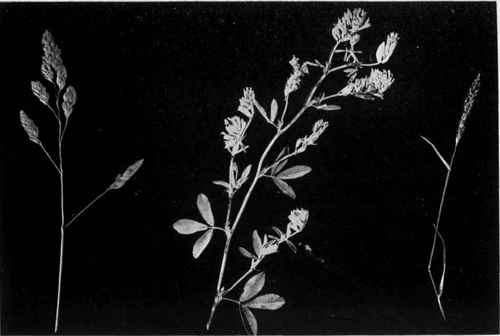
Fig. 12. - a, Rough Cocksfoot (Dactylis glomerata); b, Lucerne (Medicago sativa); c, Sweet-scented Vernal (Anthoxanthum odoratum).
Continue to:


My Books

