


308. - Form Of Soffit For Cireular Window-Heads
Description
This section is from the book "The American House Carpenter", by R. G. Hatfield. Also available from Amazon: The American House Carpenter.
308. - Form Of Soffit For Cireular Window-Heads
When the light is received in an oblique direction, let abed (Fig. 181) be the ground-plan of a given window, and efa a, vertical section taken at right angles to the face of the jambs.
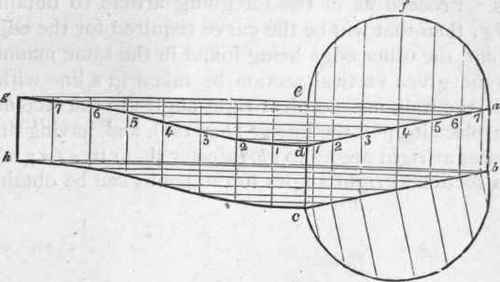
Fig. 181
From a, through e, draw ag at right angles to a b; obtain the stretch-out of efa, and make eg equal to it; divide eg and efa each into a like number of equal parts, and drop perpendiculars from the points of division in each; from the points of intersection, 1, 2, 3, etc., in the line ad, draw horizontal lines to meet corresponding perpendiculars from eg then those points of intersection will give the curve line dg, which will be the one required for the edge of the soffit. The other edge, ch, is found in the same manner.
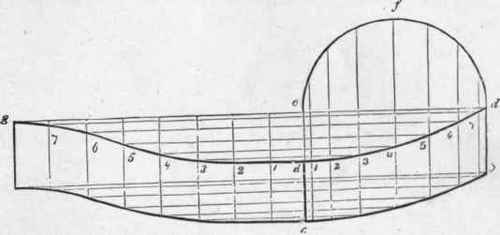
Fig. 182.
For the form of the soffit for circular window-heads, when the face of the wall is curved, let abed (Fig. 182) be the ground-plan of a given window, and e f a a vertical section of the head taken at right angles to the face of the jambs. Proceed as in the foregoing article to obtain the line dg; then that will be the curve required for the edge of the soffit, the other edge being found in the same manner.
If the given vertical section be taken in a line with the face of the wall, instead of at right angles to the face of the jambs, place it upon the line cb (Fig. 181), and, having drawn ordinates at right angles to cb, transfer them to ef a; in this way a section at right angles to the jambs can be obtained.
Interior Of St. Peter's, Rome.
Continue to:


My Books

