


313. - The Grecian Echinus
Description
This section is from the book "The American House Carpenter", by R. G. Hatfield. Also available from Amazon: The American House Carpenter.
313. - The Grecian Echinus
Figs. 192 to 199 exhibit, variously modified, the Grecian ovolo, or echinus. Figs. 192 to 196 are elliptical, a b and b c being given tangents to the curve; parallel to which the semi-conjugate diameters, ad and dc, are drawn. In Figs. 192 and 193 the lines a d and dc are semi-axes, the tangents, ab and be, being at right angles to each other. To draw the curve, see Art. 551. In Fig. 197 the curve is parabolical, and is drawn according to Art. 560. In Figs. 198 and 199 the curve is hyperbolical, being described according to Art. 561. The length of the transverse ax's, a b, being taken at pleasure in order to flatten the curve, a b should be made short in proportion to ac.
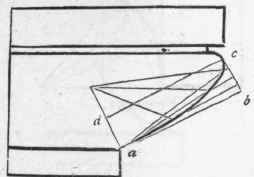
Flg. I96.

Fig. 197.
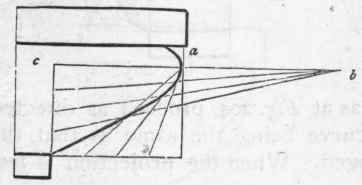
Fig. 198.
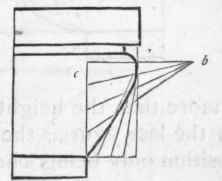
Fig. 199.
314. - The Grecian Cavctto
In order to describe this, Figs. 200 and 201, having the height and projection given, see Art. 551.
315. - The Grecian Cyma-Recta
When the projection is more than the height, as at Fig. 202, make a b equal to the height, and divide abed into four equal parallelograms; then proceed as directed in note to Art. 551. When the projection is less than the height, draw da (Fig. 203) at right angles to ab; complete the rectangle, abcd; divide this into four equal rectangles, and proceed according to Art. 551.

Fig. 200.

Fig. 201.
316. - The Grecian Cyma-Reversa
When the projection is more than the height, as at Fig. 204, proceed as directed for the last figure; the curve being the same as that, the position only being changed. When the projection is less than the height, draw a d (Fig. 205) at right angles to the fillet; make a d equal to the projection of the moulding; then proceed as directed for Fig. 202.

Fig. 202.
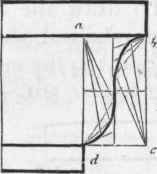
Fig. 203.
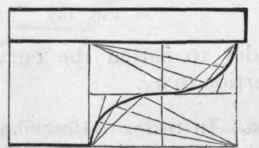
Fig. 204.
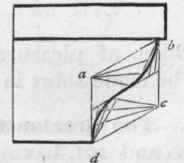
Fig. 205.
Continue to:


My Books

