


521. - In A Given Angle, To Describe A Tanged Curve
Description
This section is from the book "The American House Carpenter", by R. G. Hatfield. Also available from Amazon: The American House Carpenter.
521. - In A Given Angle, To Describe A Tanged Curve
Let a b c (Fig. 372) be the given angle, and 1 in the line a b, and 5 in the line bc, the termination of the curve. Divide 1 b and b 5 into a like number of equal parts, as at 1, 2, 3, 4, and 5; join 1 and 1, 2 and 2, 3 and 3, etc.; and a regular curve will be formed that will be tangical to the line a b, at the point 1, and to bc at 5.

Fig. 372
This is of much use in stair-building, in easing the angles formed between the wall-string and the base of the hall, also between the front string and level facia, and in many other instances. The curve is not circular, but of the form of the parabola (Fig. 418); yet in large angles the difference is not perceptible. This problem can be applied to describing the curve for door-heads, window-heads, etc., to rather better advantage than Art. 516. For instance, let ab (Fig. 373) be the width of the opening, and c d the height of the arc. Extend cd, and make de equal to cd; join a and e, also e and b; and proceed as directed above. .

Fig. 373.
522. - To Describe A Circle Within Any Given Triangle, So That The Sides Of The Triangle Shall Be Tangical
Let a bc (Fig. 374) be the given triangle. Bisect the angles a and b according to Art. 506; upon d, the point of intersection of the bisecting lines, with the radius d e, describe the required circle.

Fig. 374.
523. - About A Given Circle, To Describe An Equilateral Triangle
Let adbc (Fig. 375) be the given circle. Draw the diameter cd; upon d, with the radius of the given circle, describe the arc aeb; join a and b; draw fg at right angles to dc; make fc and eg each equal to a b; from f, through a, draw fh, also from g, through b, draw gh; then fgh will be the triangle required.
524. - To Find A Right Line Nearly Equal To The Circumference Of A Circle
Let abcd (Fig. 376) be the given circle. Draw the diameter ac; on this erect an equilateral triangle aec according to Art. 525; draw gf parallel to ac; extend ec to f, also ea to g; then gf will be nearly the length of the semi-circle adc; and twice gf will nearly equal the circumference of the circle a b c d, as was required. Lines drawn from e, through any points in the circle, as o, o and o, to p,p and p, will divide gf in the same way as the semi-circle a d c is divided. So, any portion of a circle may be transferred to a straight line. This is a very useful problem, and should be well studied, as it is frequently used to solve problems on stairs, domes, etc.
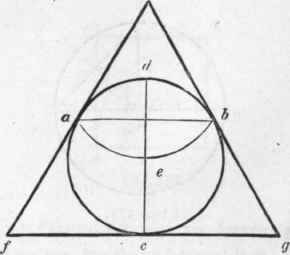
Fig. 375.

Fig. 376.
Another method. Let a bfc (Fig. 377) be the given circle. Draw the diameter ac; from d, the centre, and at right angles to ac, draw db; join b and c; bisect bc at e; from d, through e, draw df; then ef added to three times the diameter, will equal the circumference of the circle sufficiently near for many uses. The result is a trifle too large. If the circumference found by this rule be divided by 648.22 the quotient will be the excess. Deduct this excess, and the remainder will be the true circumference. This problem is rather more curious than useful, as it is less labor to perform the operation arithmetically, simply multiplying the given diameter by 3.1416, or, where a greater degree of accuracy is needed, by 3.1415926. (See Art. 446.)
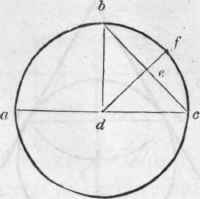
Fig. 377.
Polygons, Etc
525. - Upon A Given Line To Construct An Equilateral Triangle
Let a b (Fig. 378) be the given line. Upon a and b, with a b for radius, describe arcs, intersecting at c; join a and c, also c and b; then acb will be the triangle required.
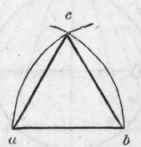
Fig. 378.
526. - To Describe An Equilateral Rectangle, Or Square
Let a b (Fig. 379) be the length of a side of the proposed square. Upon a and b, with a b for radius, describe the arcs a d and b c; bisect the arc ae in f; upon e, with ef for radius, describe the arc cf d; join a and c, c and d, d and b; then acdb will be the square required.
Polygons In Circumscribing Circles

Fig. 379.
Continue to:


My Books

