


Nailing Slates
Description
This section is from the book "Notes On Building Construction", by Henry Fidler. Also available from Amazon: Notes on building construction.
Nailing Slates
There are two methods of nailing slates, which differ very considerably, and will each be described separately.
Nailing Near The Head
In this method the nail holes are pierced at about an inch from the head of the slate, and the tails of the next course but one above override the nail hole by the specified "lap."
This plan used to be universally adopted, and is still in vogue, especially for very small slates.
It is preferred by some, because there are two slates over every nail hole, so that, when a slate is broken, the nail below is still coyered by one slate, and thus protected from the weather. On the other hand, however, when the slate is nailed near the head, the wind acts upon it with a leverage equal to nearly its whole length. This makes a considerable difference if the slate is large, and renders this system inferior, as a rule, to the methods shown in Tigs. 453, 454.
Fig. 451.

Fig. 452. Slating on Boards nailed near Head. Scale \ in. =1 ft.
N.B. The thickness of the slates in this and other figures is exaggerated, and the graining of the hoarding is in Fig. 451 shown in order that the slates may stand out more clearly.
Common or small slates secured with one nail only are necessarily fastened in the centre of the head.
Fig. 453
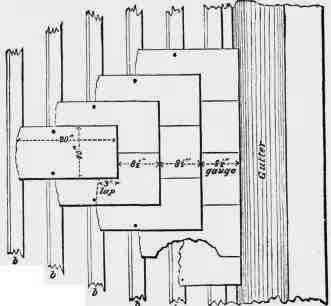

Fig. 454. Slating on Battens nailed near Centre. Scale 1/2, in. = 1 ft.
Nailing Near The Centre
In this arrangement, Fig. 453, the nail holes are placed near the centre of the slate at a distance from its tail equal to a little more than the gauge + lap, so as to clear the head of the slate below.
This is a plan of more recent introduction than the other, and is preferable for large slates, as from the position of the nails the wind acts upon the slates with a leverage of only about half their length. Moreover, the slating so laid is easier to repair. It is, however, objected to by some, as the breakage of one slate exposes the nail of the slate below to the weather, and opens a direct communication with the roof through the nail hole.
'With the same size of slates and same nominal depth of lap, the gauge is, under this arrangement, wider than when the slates are nailed at the head; it is therefore evident that fewer slates are required to cover the same area, and that this plan of nailing is more economical than the other. The so-called three-inch lap is, however, in this case really only barely 3 inches, whereas in the other method it is practically 4 inches.
Nails
In the best work slates are secured with copper nails, but zinc and "composition" nails are sometimes used, or simply iron nails dipped in boiled oil to preserve them from corrosion. In iron roofs slates are sometimes laid on augle irons, and may then be secured with copper wire.
The nails should be proportioned to the size of the slates, both in length and stoutness, and should have large heads, thin and flat, so that they may not prevent the slates from lying close.
In good work every slate should be secured with two nails, and in exposed places three have been used, though in very common work one nail only for each slate is often permitted.
In exposed situations the oversailing slates of gables should be secured by copper screws.
In nailing care should be taken not to bend or strain the slates, or they will crack, and fly under sudden changes of temperature.
Continue to:


My Books

