


The Eastman Gravity Printer
Description
This section is from the "Studio Light And The Aristo Eagle - A Magazine Of Information For The Profession 1909" book, by Aristo Motto. Also see Amazon: Studio Light And The Aristo Eagle - A Magazine Of Information For The Profession 1909.
The Eastman Gravity Printer
There has been an insistent demand for a simple, inexpensive and rapid printer for developing out papers that could be quickly installed and used with any light.
The Eastman Gravity Printer meets this demand in a most satisfactory manner, as it is exceedingly simple in construction and operation, and can be used with daylight or any form of artificial illumination. Uniformity of exposure is one of the strongest points, as the duration of exposure is so regulated as to make variation in a given speed practically impossible.
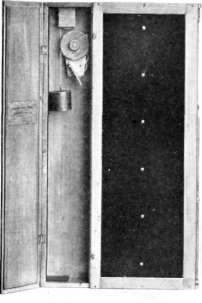
Fig. 1.
As shown in illustrations 1 and 2, the Eastman Gravity Printer consists of a cabinet, in one side of which is an adjustable opening for regulating the exposure, and a simple clock-work mechanism for lowering and raising a carrier containing an ordinary five by seven printing frame past the opening.
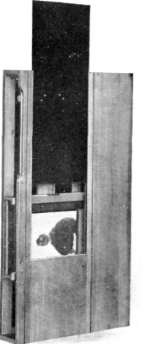
Fig. 2.
The exposure opening is fitted with an adjustable metal slide with graduated stops, affording exposure apertures from 7 inches to 1/4 of an inch, and, with a printing frame and negative of average weight, will afford an approximate exposure of one second per inch of opening. For instance, if the aperture is 7 inches, the exposure will be approximately 7 seconds. See illustrations 3 and 4. Illustration 4 shows method of adjusting exposure aperture.
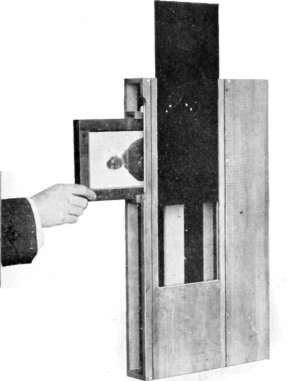
Fig. 3.
When the weight actuating the clock-work mechanism swings free, it will descend and thus raise the printing frame carrier just past the exposure aperture. The printer is installed with the exposure aperture squarely facing the exposing light, and with the light so adjusted as to come about the center of the aperture when fully open, and at a distance of about 7 inches from the opening, to afford even illumination. Illustration 5 shows the printer in use with two incandescent gas lamps.
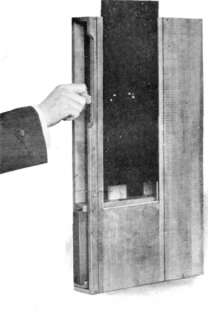
Fig. 4.
When desired, the exposing light may be boxed in by means of strips of asbestos or metal inserted in the grooves in the outer casing, on each side of the exposure aperture.
When ready to print, the loaded printing frame is inserted in the carrier, as shown in illustration 2, with the negative facing the exposure aperture; when released its own weight will carry it down past the exposing light, as shown in illustration No. 4, the exposure continuing until the carrier has reached the bottom of the shaft.
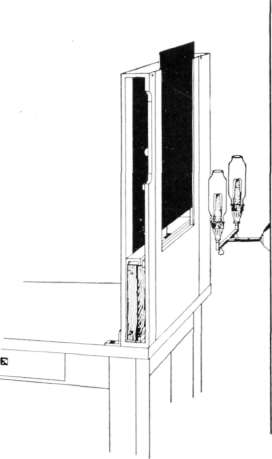
Fig. 5.
The carrier returns instantly when the exposed frame is removed, and while one exposure is being made, another printing frame may be loaded ready for insertion in the carrier.
The many advantages of the Eastman Gravity Printer are apparent at a glance, and its ease of installation, and low price, ten dollars, will particularly commend it to the professional using developing papers.
Order through your dealer.
August. The Only Condition
Our Pictures of men look like men. They show the force, energy, character of the sitter. They are portraits that really tell something of the men portrayed.
Aristo Motto
"We believe permanency is the Keystone of Photographic Success, and all brands of paper bearing our Trade-mark are manufactured on this principle. We hold our consumer's reputation and success identical with our own. We surround both with every safeguard known to chemical science and our own experience."
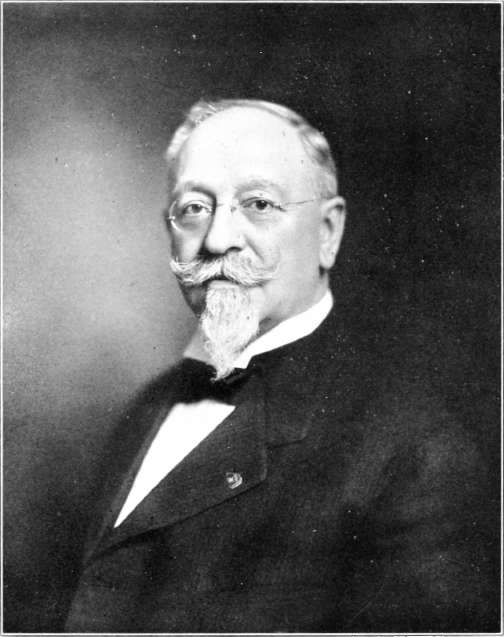
From An Aristo Platino Print By C. F. Bretzman Indianapolis, Ind.
Continue to:


My Books

