


Cotton Spinning. Part 6
Description
This section is from the book "The Engineer's And Mechanic's Encyclopaedia", by Luke Hebert. Also available from Amazon: Engineer's And Mechanic's Encyclopaedia.
Cotton Spinning. Part 6
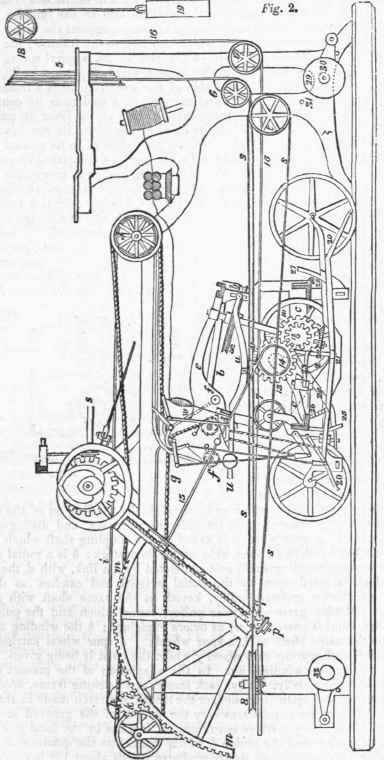
As soon as the cop has attained its full diameter, that is, when the bottom is formed, the winding on power then remaining uniform, the governor lever is no longer made to act upon the strap, and, consequently, the nut n travels no farther from the centre of the quadrant during the completion of the cop. Besides the adjustment of the whole amount of winding on motion, each stretch is adjusted to the growing diameter of the cop, which is effected by causing the point of attachment of the drag cord 15 to advance progressively upon the rim of the barrel 14. The grooved arm of the quadrant, by carrying the point of attachment of the cord 15, after the first stretch through an arc of about 90° at each run-in, causes the cord to be uncoiled from the barrel 14, by a ratio increasing as the carriage recedes from the quadrant; and this variable rotation of the barrel is increased by the successive shifts of the nut n from the centre of the quadrant, thus adapting the rotation of the spindles to the winding-on powers of the cop, through its various diameters from the base to the summit of the cone.
Having now described my improved mechanism for adapting the rotation of the spindles to the regular taking up of the yarn or roving, as the form and diameter of the cop changes throughout the operation of winding on, l do hereby declare, that my invention consists in the method or means to be employed for that purpose hereinbefore described. The mechanism thus employed by me affects the rotation of the spindle in two ways; first, rotatory motion is given to a drum or barrel, which turns the spindles whilst the carriage is running in by uncoiling from it a portion of a cord, strap, or chain, attached to the drum, and having its other extremity fastened at some point in a radial arm which describes an arc, whilst the winding-on drum is receding from the point of attachment of the cord in a right line. This compound motion adjusts the rotation of the spindles to the varying power of taking up by the conical cop as the yarn or roving is being coiled on its different diameters, during the winding on of each stretch.
Secondly, during the progress of the formation of a cop, the situation of the point of attachment of the uncoiled end of the cord, strap, or chain, on the radial arm, is changed progressively, as the increasing bulk of the cop demands fewer revolutions of the spindles to take up the stretch, and, consequently, there is a shorter length of the cord to be uncoiled from the barrel." We refer the reader to the articles Spinning and Weaving for further information on this important branch of art, as cotton is not the only fibrous matter to which such mechanism is applicable. It is a remarkable circumstance in the cotton manufacture, and highly honourable to British skill, that all its numerous and varied operations are performed by machinery. Mr. Baines, in his valuable History of the Cotton Manufacture, justly observes, " It is by iron fingers, teeth, and wheels, moving with exhaustless energy and devouring speed, that the cotton is opened, cleaned, spread, carded, drawn, roved, spun, wound, warped, dressed, and woven. The various machines are proportioned to each other in regard to their capability of workx and they are so placed in the mill as to allow the material to be carried from stage to stage with the least possible loss of time.
All are moving at once, the operations chasing each other; and all derive their motion from the mighty engine, which, firmly seated in the lower part of the building, and constantly, fed with water and fuel, toils through the day with the strength of perhaps a hundred horses. Men, in the meanwhile, have merely to attend on this wonderful series of mechanism, to supply it with work, to oil its joints, and to check its slight and infrequent irregularities; each workman performing, or rather superintending, as much work as could have been done by two or three hundred men sixty years ago. At the approach of darkness, the building is illuminated by jets of flame, whose brilliance mimics the light of day, the produce of an invisible vapour generated on the spot. When it is remembered that these inventions have been made within the last seventy years, it must be acknowledged that the cotton mill presents the most striking example of the dominion obtained by human science over the powers of nature, of which modern times can boast."
Fig. 1.

Continue to:


My Books

